

Review · SPAIN BUS TOURS
Barcelona: City Sightseeing Hop-On Hop-Off Bus Tour
Barcelona’s two bus routes give you a quick grip on a spread-out city. One ride can take you from Sagrada Familia and Park Güell to the beaches, Montjuïc, the Gothic Quarter, and FC Barcelona without forcing you to learn the metro on day one. You can sit upstairs for the view, listen to the audio guide, then hop off when a place deserves more time.
I like the two-route coverage and the freedom to build your own day. I also like the useful mix of old streets, Gaudí architecture, museums, football, parks, and sea views. The catch is timing: a full loop takes about two hours, buses stop at 7pm, and popular stops can be crowded. This is excellent for orientation, but it is not the fastest way to move between two specific sights.
Key points to know before you board

- Two routes, 38 stops: The Red and Blue routes together reach the city center, Montjuïc, the coast, Gaudí sites, Pedralbes, Tibidabo, and FC Barcelona.
- A 24-hour ticket means 24 hours: Start in the afternoon and you can use it the following morning, as long as the ticket has not expired.
- The Red Route is especially varied: It links Plaça de Catalunya, La Rambla, the port, beaches, Poblenou, Sagrada Familia, Montjuïc, and major art centers.
- Park Güell requires a steep walk: The Blue Route stop is not right at the park entrance, so allow extra time and energy.
- The bus is best for orientation and sightseeing: It saves walking and gives context, but the metro can be quicker for direct trips.
- The top deck depends on weather: Summer sun can be intense, December can feel cold, and some buses have had weak air conditioning or unreliable Wi-Fi.
Why this bus works well in Barcelona
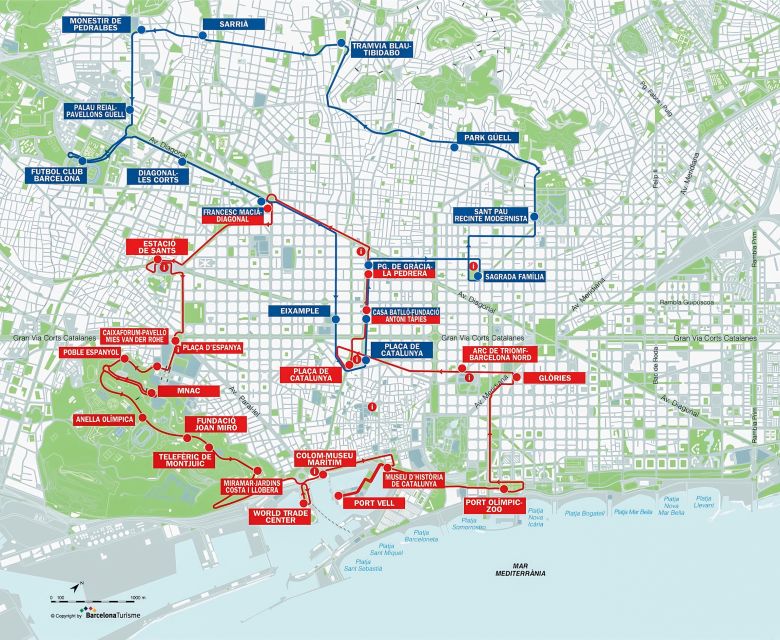
Barcelona looks compact on a map, but its main sights are scattered. The Gothic Quarter and La Rambla sit near the old port, while Sagrada Familia is farther north, Park Güell is uphill, and Montjuïc rises on the opposite side of the center. The beaches and Diagonal Mar stretch well beyond the old city.
That is where this tour earns its keep. You can see how the districts fit together without spending the whole day changing metro lines or walking long distances. I especially like it as a first full-day activity. The ride helps you decide where to return for a museum, meal, or longer visit.
The open-top design is another advantage. From upstairs, you get broad views of boulevards, towers, parks, and the coast. You also get a better sense of Barcelona’s scale than you do underground. The trade-off is that the bus cannot pause whenever you want a photograph. If you are hoping to frame every Gaudí building, you will need to hop off and walk.
Your ticket includes audio commentary in Spanish, Catalan, English, French, German, Italian, Chinese, Japanese, Portuguese, Russian, Dutch, Hebrew, Swedish, Arabic, Turkish, and Norwegian. The commentary gives useful background without requiring a live guide, and it helps explain why a plain-looking street corner or unusual building matters.
More Hop-On Hop-Off Bus Tours in Spain
- Barcelona: 24 or 48-Hour Hop-On Hop-Off Bus Tour
★ 4.4 · 20,872 reviews - City Sightseeing Barcelona Hop-On Hop-Off Bus Tour: 24 or 48-Hour
★ 4.0 · 5,250 reviews - Seville: City Sightseeing Hop-On Hop-Off Bus Tour
★ 4.0 · 4,633 reviews
The Red Route from Plaça de Catalunya to the waterfront
The Red Route is the stronger choice if you want the broadest mix of sights. It starts at Plaça de Catalunya, a natural meeting point between the old center and the Eixample grid. From here, the bus passes Casa Batlló and the Fundació Antoni Tàpies before reaching the Eixample district.
Casa Batlló is one of Antoni Gaudí’s most memorable works, with its unusual façade and almost dreamlike details. The bus gives you a quick exterior view, but you need an attraction ticket if you want to go inside. That applies throughout the tour: the bus ticket provides transport and commentary, not museum or monument admission.
The route continues toward Estació de Sants, Plaça d’Espanya, CaixaForum, and the Mies van der Rohe Pavilion. Plaça d’Espanya is a useful stop for Montjuïc, while CaixaForum and the pavilion appeal to anyone interested in modern art and architecture. The route then reaches Poble Espanyol, an attraction built to show architectural styles from across Spain.
The next stretch covers the National Art Museum of Catalonia, the Olympic Ring, the Joan Miró Foundation, the Montjuïc cable-car stop, and Miramar. This is one of the best parts of the ride for views. Montjuïc opens up the city, harbor, and surrounding hills, and you can combine several sights here if you plan carefully.
The cable car and Joan Miró Foundation need separate tickets. The bus stop is useful because Montjuïc is hilly, but do not expect to see the whole area in a quick hop-off. Pick one or two stops and allow time for walking.
After Montjuïc, the Red Route heads to the World Trade Center and Colom, near the bottom of La Rambla. This is your gateway to the waterfront and the old center. You can hop off at Colom to walk along La Rambla, explore the port area, or continue toward the Museum of the History of Catalonia.
La Rambla is lively and central, but it is also crowded and easy to rush through. I would use the bus stop as a starting point rather than treating the boulevard as the whole experience. Walk a few side streets, keep your belongings secure, and take time to look beyond the main strip.
The route then passes Port Olímpic, Bogatell Beach, Nova Mar Bella Beach, the Forum, Diagonal Mar, Poblenou, and Torre Glòries. This gives you a useful look at Barcelona beyond the medieval core. The beaches and newer districts feel different from the Gothic Quarter, with wider spaces and a more modern city plan.
Poblenou is a good place to hop off if you want a less concentrated part of the city. Diagonal Mar and the Forum show Barcelona’s more recent waterfront development. Torre Glòries is one of the city’s distinctive modern landmarks, with a rounded, illuminated form that is easy to spot from the bus.
The final Red Route stops include Sagrada Familia and Arc de Triomf. Sagrada Familia is the major reason many people choose this tour. The bus gives you several angles on Gaudí’s unfinished basilica, and a stop behind the church is useful for photographs.
You need a separate timed ticket to enter Sagrada Familia. If you plan to go inside, book that first and use the bus around the reservation. The stop can be busy, and it may take more than one bus to board, especially at popular times.
Arc de Triomf is close to the old center and makes a pleasant walking stop. The bus stop is nearby, although the monument itself may not always be directly in your line of sight. Watch the map and signs when you get off.
The Blue Route for Gaudí, hills, and football

The Blue Route begins at Plaça de Catalunya and follows Passeig de Gràcia, where you can see Casa Batlló and La Pedrera. La Pedrera, also called Casa Milà, is another major Gaudí work, known for its flowing stone exterior and rooftop forms. Again, the bus is good for a first look, while entry requires a separate ticket.
From there, the route reaches Sant Pau Recinte Modernista. This former hospital complex is one of Barcelona’s finest examples of modernist architecture and is often less overwhelming than the city’s biggest attractions. Its buildings, gardens, and tiled details reward a proper visit, so do not squeeze it into a ten-minute stop.
The Blue Route then climbs toward Park Güell. This is one place where you need to plan around the terrain. The bus stop is not directly at the main park entrance, and the walk can be long and steep. If you have limited mobility or simply want to save your legs, check the approach before you get off.
Park Güell is one of Gaudí’s most recognizable creations, with colorful tile work, curved structures, and views over Barcelona. Entry to the main monumental area requires a separate ticket. The bus gets you into the right part of the city, but it does not remove the uphill walk.
The route continues past Tramvia Blau and Tibidabo, then through Sarrià. These stops show a quieter side of Barcelona, away from the busiest central streets. Tibidabo is especially useful if you want hilltop views, though the bus ride itself may be enough if your schedule is tight.
Next come the Pedralbes Monastery and the Palau Reial and Güell Pavilions. Pedralbes offers a calmer historic stop, while the Güell Pavilions connect again with Gaudí and the city’s modernist story. These places are not as central as Sagrada Familia, so the Blue Route is valuable if you have more than a single day.
The football stop is FC Barcelona. This is the choice stop for football fans, although stadium access and any museum admission are not included in the bus ticket. The Blue Route spends a fair amount of time reaching the western side of the city, so if football is your only goal, public transport may be more direct.
The route returns through Diagonal and Les Corts, Francesc Macià, Eixample, and Sant Antoni. The final stretch is useful for seeing how Barcelona’s grid changes from grand avenues to neighborhood streets. Sant Antoni is also a practical point for exploring the central city on foot.
How to plan 24 or 48 hours
A 24-hour ticket is enough if your goal is to ride both routes, see the main sights from the bus, and make a few short stops. One smart plan is to take the Blue Route in the morning for Sagrada Familia, Park Güell, and Sant Pau, then use the Red Route in the afternoon for Montjuïc, the port, and the waterfront.
That plan is ambitious. You will not have time for a full visit at every attraction. I would choose two major stops, then treat the rest as passing views.
The flexible 24-hour period gives you a useful option. Start the Red Route after lunch, continue into the afternoon, then use the Blue Route the next morning. This works well if you want to split the two lines without buying a second ticket.
A 48-hour ticket is better if you want to enter museums and monuments, take long walks, or travel with children. Use the first day for orientation, then return to your favorite areas on the second day. The ticket must be used on consecutive days, so plan the start date carefully.
Buses are scheduled about every 20 minutes, and the first buses leave Stop 1 at 9am. The last buses leave Stop 1 at 7pm. That last detail matters: the service does not necessarily carry you back to your starting point after 7pm. If you hop off late in the day, arrange your return by metro, taxi, or another local service.
The tour operates all year except January 1 and December 25. Bring the supplied headphones, or use your own if they fit the audio connection. Mobile and printed vouchers are accepted, and buses are marked Barcelona Bus Turistic, which makes them easier to identify.
More Sightseeing Bus Tours in Spain
- Palma de Mallorca: City Sightseeing Hop-On Hop-Off Bus Tour
★ 4.1 · 4,450 reviews - Madrid Panoramic City Bus Tour
★ 3.5 · 3,118 reviews - Malaga: City Sightseeing Hop-On Hop-Off Bus Tour
★ 4.0 · 2,619 reviews - City Sightseeing Seville Hop-On Hop-Off Bus Tour
★ 4.0 · 1,782 reviews
Price, comfort, and the small frustrations
At $39 per person, this is not the cheapest way to move around Barcelona. The metro and regular city buses cost less for direct transport. The value comes from combining transport, sightseeing, audio commentary, and the ability to change your plan without buying another ticket each time.
I think the 24-hour fare makes sense for a first visit if you use both routes and get off several times. The 48-hour option earns its higher cost when you want a slower schedule or need to limit walking. It is less appealing if you plan to visit only one central attraction and spend the rest of the day on foot.
The buses are generally clean, and staff are helpful. The upper deck is excellent in mild weather, but summer heat can be strong and air conditioning is not equally effective on every bus. In winter, bring a layer because the open deck can feel cold.
Wi-Fi is included, though it may not work on every bus. The audio guide is informative, but connections can occasionally cut out. Keep the route map open and watch the stop names, especially when you are upstairs. Buses do not wait long, so move toward the exit before your stop.
The service is suited to families, older visitors, and anyone who wants to reduce walking. It can also help if you have a disabled passenger, though the supplied information does not give detailed vehicle access specifications. Contact the provider before booking if you need a particular boarding arrangement.
Who should book this Barcelona bus tour?
I would book it if you are visiting Barcelona for the first time, have one or two days, or want a clear overview before choosing where to spend more time. It is also a sensible choice for families with young children, people who tire easily, and anyone who wants to combine far-flung sights without constant route planning.
I would skip it if you already know Barcelona well, plan to stay mostly in the Gothic Quarter, or need fast point-to-point transport. The metro will usually be quicker for a single journey.
For most first-time visitors, the best approach is simple: take one complete loop without hopping off, then use the second route to visit your chosen sights. At $39, the ticket is worthwhile when you treat it as both a city introduction and a flexible sightseeing vehicle, not just as a cheap bus ride.
FAQ
How long is the Barcelona hop-on hop-off tour?
Each full route takes about 120 minutes. You can hop off during the route and rejoin later, subject to the operating timetable.
How many routes and stops are included?
The ticket includes the Red Route and Blue Route, with 38 stops across Barcelona.
Can I use the same ticket on both the Red and Blue routes?
Yes. Your ticket can be used on both routes during its valid 24-hour or 48-hour period.
What time do the buses operate?
The first bus leaves Stop 1 at 9am, and the last bus leaves Stop 1 at 7pm. Check the current schedule when you book.
Does a 48-hour ticket need to be used on consecutive days?
Yes. The 48-hour ticket must be used on two consecutive days.
Are attraction tickets included?
No. Entry to places such as Sagrada Familia, Park Güell, museums, the cable car, and football attractions is not included.
Is an audio guide provided?
Yes. Audio commentary and headphones are included in 16 languages, including English, Spanish, Catalan, French, German, Italian, Chinese, Japanese, Portuguese, Russian, Dutch, Hebrew, Swedish, Arabic, Turkish, and Norwegian.
Is Wi-Fi available on the buses?
Free Wi-Fi is included, although it may not work on every bus.
Can I cancel the booking?
You can cancel up to 24 hours in advance for a full refund. You can also reserve now and pay later when that option is available.
Recently added around Spain
- Seville: Panoramic Cruise, Hop-On-Hop-Off Bus & Walking Tour★ 4.0 · 147 reviews
- Tourist bus tour of Seville★ 4.5 · 529 reviews
- Palma de Mallorca: City Sightseeing Hop-On Hop-Off Bus Tour★ 4.0 · 270 reviews
- Formentor: Xperience Bus and Boat Tour from the North★ 4.3 · 131 reviews
- Alcudia/Marratxi: Valldemossa & Soller Tour by Tram & Bus★ 4.7 · 499 reviews
- From Malaga: Day Trip to Alhambra by Bus with Entry Tickets★ 4.5 · 116 reviews
- Gran Canaria Highlights Full-Day Tour by Bus★ 4.5 · 286 reviews
- Lanzarote: Full Day Bus Tour with Scenic Views★ 4.5 · 620 reviews
Hop-On Hop-Off Bus Tours, compared.
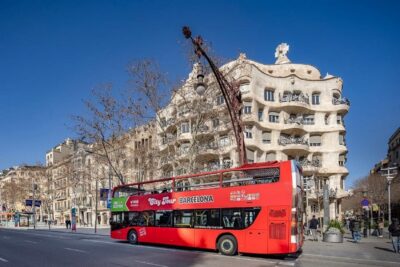

City Sightseeing Hop-on Hop-off Bus with Audioguide
Read our review →
Tootbus Hop-on Hop-off (Optional River Cruise)
Read our review →Big Bus Hop-On Hop-Off Tour with Optional Cruise
Read our review →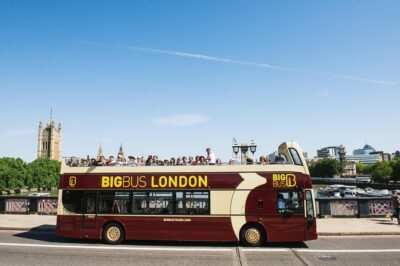
London Big Bus Hop-On Hop-Off Tour with Optional River Cruise
Read our review →
Big Bus Hop-on, Hop-off Open-Top Sightseeing Tour
Read our review →
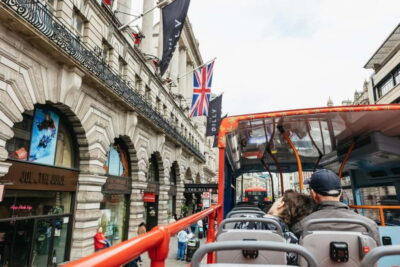
City Sightseeing London Hop-On Hop-Off Bus & Bookable Extras
Read our review →Browse the lists this tour appears in