

Review · SEVILLE BUS TOURS
Tourist bus tour of Seville
Seville’s main sights are spread across a wide area, from the Torre del Oro and Plaza de España to Triana, Isla Mágica, and the old tobacco factory that now houses the university. This 48-hour hop-on hop-off ticket gives you time to connect them without turning every visit into a march across town.
I like the two free walking tours, especially the chance to explore Santa Cruz and Triana on foot after seeing the city from above. I also like the extra evening route, which lets you see Seville after dark without paying again. The main drawback is service reliability: some riders have faced long waits, unclear stop markings, and faulty headphone sockets.
Key points at a glance

- Two full days of use: You can spread the sightseeing over 48 hours instead of squeezing every stop into one hurried circuit.
- Plaza de España and Maria Luisa Park: The bus brings you close to Seville’s grandest public square and its surrounding museums and gardens.
- Two free walking tours: Santa Cruz and Triana add the street-level detail that a bus commentary cannot provide.
- A second evening route: Romantic Seville gives you another way to see familiar sights after sunset.
- Useful discounts: Save at Isla Mágica, the Seville Aquarium, the Real Maestranza Bullring, bicycle rental, and Paddle Surf Seville.
- Operational weaknesses: Stop signs, audio connections, and bus frequency can vary, so you need a little patience and a backup plan.
What the Seville bus actually gives you

The advertised ride takes about 1 hour and 15 minutes if you stay aboard. That is the sightseeing circuit, not the full value of the ticket. You also receive 48 hours of hop-on hop-off access, two guided walking tours, a second bus route focused on illuminated Seville, an audio guide in nine languages, headphones, a city map, and onboard WiFi.
That changes the way I would use it. I would not treat this as a one-hour bus ride and leave it at that. I would use the first circuit to get my bearings, then return to the stops that deserve time on foot.
The price is $32.58 per person. That is more than a single city bus ride, of course, but public buses will not give you the same sightseeing loop, audio commentary, walking tours, or attraction discounts. The value is strongest if you use the pass over two days and take advantage of at least one walking tour or discount.
If you only want to ride once, the price feels less convincing. Several stops are better viewed as access points to neighborhoods and parks rather than attractions included in the ticket. You still pay separate admission for places such as the aquarium or Isla Mágica.
More routes around Spain:
- Barcelona: 24 or 48-Hour Hop-On Hop-Off Bus Tour
★ 4.4 · 20,872 reviews - Barcelona: City Sightseeing Hop-On Hop-Off Bus Tour
★ 4.4 · 10,061 reviews - From Madrid: Guided Day Trip to Toledo by Bus
★ 4.1 · 5,280 reviews
Starting at the Torre del Oro
Paseo de Cristóbal Colón is the most useful starting point. The route begins near the Torre del Oro, Seville’s famous riverside watchtower. This is one of the best places to take a first photo and get a sense of how the Guadalquivir shapes the city.
I would start here if you are unsure where to board. One useful tip is to go directly to stop number one at the Torre del Oro, particularly if you want to avoid searching for a less clearly marked stop elsewhere.
The tower itself is a landmark, not an included interior visit. The bus gives you a practical first look at the riverfront and lets you decide how much time you want to spend in this part of town.
Aquarium stop and the shark encounter
The Seville Aquarium is an optional stop for a separate visit. It is a good family choice, with marine life displays and a shark attraction that gives younger children a clear reason to get off the bus.
The ticket includes a 10 percent discount at the aquarium. That helps make the stop more worthwhile, though you should still allow enough time for the aquarium itself. A quick hop off and back on will not give you much more than a glimpse.
This is also a good example of how to plan the pass. If you are using the bus as simple transport, the stop is convenient. If you want to see the aquarium properly, treat it as a planned break rather than a quick stop between buses.
Plaza América and the grand scale of Plaza de España
Plaza América sits inside Maria Luisa Park and is surrounded by the Museum of Popular Arts and Customs, the Archaeological Museum, and the former Royal Pavilion. The setting is calmer than the city center, with gardens and open space around the museums.
The next major stop is Plaza de España. This is the stop I would protect time for. Its curved architecture, tiled details, water, bridges, and broad open space make it one of Seville’s most memorable sights.
The bus gets you close, but you need to walk around the square to appreciate it. Look at the tiled alcoves representing Spanish provinces, then continue through Maria Luisa Park if your schedule allows. The audio guide can supply context, but the real pleasure here is taking your time.
Do not expect the 1-hour-15-minute circuit to leave room for a full visit. Use the ride to identify the stop, then return during one of your 48 hours and get off.
Same city, a different seat on a different deck:
- City Sightseeing Barcelona Hop-On Hop-Off Bus Tour: 24 or 48-Hour
★ 4.0 · 5,250 reviews - Seville: City Sightseeing Hop-On Hop-Off Bus Tour
★ 4.0 · 4,633 reviews - Palma de Mallorca: City Sightseeing Hop-On Hop-Off Bus Tour
★ 4.1 · 4,450 reviews - Granada City Train 1 or 2-Day Hop-On Hop-Off Ticket
★ 3.5 · 3,128 reviews
The old tobacco factory and Plaza de Cuba
The University of Seville occupies a former tobacco factory. Tobacco production eventually moved elsewhere in the mid-20th century, and the old building became part of the university.
This stop gives you a useful piece of Seville’s working and civic story. It is not simply another handsome building. The change from factory to university shows how large historic structures continue to serve the city.
Plaza de Cuba takes you toward the Triana side of the river. It is a useful point for connecting the bus experience with the free Triana walking tour. I would not spend your entire visit looking through a bus window here. Get off, cross into the neighborhood, and use the walking tour for the lanes, plazas, and local feel that the recorded commentary cannot fully explain.
Triana, San Jacinto, and the river crossings
Calle San Jacinto is one of the stops associated with Triana. The neighborhood is best approached at street level, and this is where the included walking tour earns its keep.
Triana has a strong identity within Seville, and the bus gives you a simple way to reach it without guessing which city route to take. Once off the bus, you can explore at a slower pace and then rejoin the sightseeing route later.
The route also includes Puente del Cristo de la Expiración. Bridges matter in Seville because they show how the old center, Triana, and the riverfront fit together. You may find the views better from the bridge area than from the upper deck, depending on traffic and the position of the bus.
Monastery Santa María de las Cuevas and Isla Mágica
The Monastery Santa María de las Cuevas is another stop where the bus is mainly useful for getting you there. It forms part of the city’s broader cultural circuit and offers a change from the central plazas and shopping streets.
Isla Mágica is aimed more at families and anyone wanting a full day of rides. The park includes roller coasters, a water park, attractions, and a large lake, and it is near the Expo 92 complex.
The bus ticket gives you a 35 percent discount at Isla Mágica. That is one of the more substantial savings attached to the pass, but only if you already plan to visit the park. Do not count it as a reason to buy the bus ticket unless the theme park is part of your schedule.
The stop descriptions can be confusing because Isla Mágica and Macarena are both included in the route information. Check the supplied map and confirm the stop with the driver before getting off, especially if you have a timed plan.
Macarena, Alameda, and the old center

Macarena takes you toward another important part of Seville. The stop is useful for reaching the historic northern side of the center, while La Alameda is a public garden dating to 1574 and is described as the oldest public garden in Spain and Europe.
La Alameda is a good place to break up a day of monuments. It has a different pace from Plaza de España and the cathedral area, with space to sit and reset before continuing. The bus also gives you a way to connect it with the more central Plaza del Duque de la Victoria.
That square has been known since the 16th century as the Duke of Medina-Sidonia’s square, named for the palace once located there. Today, it is a practical shopping and city-center stop rather than a single enclosed attraction.
Plaza de Armas and the end of the circuit
Plaza de Armas completes the listed route. It is a useful transport point and a natural place to end the circuit before continuing on foot.
From here, you can decide if you want to return toward the river, head into the center, or use the bus again. The route does not give you a guided interior visit at each stop. Its strength is connection: it links parts of Seville that would otherwise require several separate walks or public transport changes.
The evening route is worth using
The ticket includes two bus tours: Monumental Seville and Romantic Seville by night. The second route is not simply a free extra to ignore. Seeing Seville after dark changes how the major buildings, bridges, and avenues feel.
I would use the daytime circuit for orientation and stop-offs, then take the evening route when you can sit back. A Spanish-language conversation on one evening tour made it harder for some English-speaking riders to follow, so set your expectations: the tour may be shared across languages and the guide or commentary may not always be perfectly timed.
The audio system is supposed to support nine languages, including English. On a good vehicle, the audio is helpful and gives the ride more purpose. On a poor one, static, dead headphone sockets, or a driver speaking over the commentary can make it frustrating.
Two walking tours fill the gaps
The free guided walks in Santa Cruz and Triana are among the best reasons to choose this pass over a sightseeing ride alone. A bus shows you the shape of Seville. Walking shows you the scale of it.
Santa Cruz is the classic old quarter experience, while Triana offers a different side of the city across the river. The included walks also solve a common problem with bus tours: some of the most interesting details are found in narrow streets where a large vehicle cannot go.
Guide Daniel has received especially warm praise for his tour. Still, the quality of a live guide can vary by departure and language. The walking tours are an added benefit, not a guarantee that every part of the bus narration will be equally detailed.
Discounts that can change the value
The included savings are useful only when they match your plans:
- 35 percent off Isla Mágica
- 20 percent off the Real Maestranza Bullring
- 10 percent off the Seville Aquarium
- 20 percent off Paddle Surf Seville at Calle Betis 19
- 10 percent off bicycle rental with Hop On at Calle Arjona 5
- Free bottle of water at the Intursafe information store on Calle Postigo del Carbón 6
- Free toilets for ticket holders at Torrons Vicens on Avenida de la Constitución 24B
- Additional discounts at selected cafés, restaurants, and museums
There is also WiFi onboard, though I would not buy the ticket for that alone. The water and restroom offers are small but handy on a hot day.
Practical problems to plan around
The biggest weakness is not the route. It is the uncertainty around operations. Some departures have involved waits of about 25 minutes, and one account described gaps approaching an hour. In Seville’s heat, that can quickly sour the experience.
Stop identification is another concern. Some stops are not clearly marked with the green bus number, and the exact location can be hard to find. I would carry the city map, confirm each stop with staff or the driver, and avoid planning a tight appointment immediately after a bus ride.
The audio sockets are also uneven. Test your headphones as soon as you sit down. If there is static or silence, move seats before the bus pulls away. Carrying your own basic wired headphones may help, though the supplied equipment is intended to work with the system.
A few riders also found the upper-deck view less useful than expected, with wet seats after rain or a driver moving too quickly for easy photographs. The bus is better for orientation and transport than for carefully composed pictures.
You need your ticket with you during the 48-hour period. An email confirmation and payment code did not replace a missing ticket in one reported situation. Keep the ticket accessible, not buried in your hotel room.
Who should book this Seville bus tour?
I would recommend it to families, first-time visitors, and anyone staying long enough to use the pass over two days. It is particularly useful if you want Plaza de España, Triana, the aquarium, Isla Mágica, and the northern sights without planning every connection yourself.
It also suits anyone who likes a mix of riding and walking. The two neighborhood tours give you more than a standard loop, and the evening route adds a second look at Seville.
I would be more cautious if you have only a few hours or a strict appointment schedule. Long waits, unclear stops, and audio faults can eat into a short visit. If your main interest is detailed history, a dedicated walking tour may serve you better.
Should you book it?
Book this tour if you will use the full 48 hours, want the two walking tours, or plan to claim one of the larger discounts. Start at the Torre del Oro, take the first circuit for orientation, and save Plaza de España and Triana for proper visits on foot.
Skip it if you only want a fast, highly detailed commentary ride or cannot tolerate uncertain bus intervals. At $32.58, the pass can be good value, but only when you treat it as a flexible two-day sightseeing tool rather than a simple 75-minute ride.
Cancellation is free if you cancel at least 24 hours before the start time. Changes or cancellations made later are not accepted for a refund.
FAQ
How long is the sightseeing bus ride?
The sightseeing circuit takes approximately 1 hour and 15 minutes if you remain on the bus.
How long can I use the hop-on hop-off ticket?
The ticket is valid for 48 hours.
Which languages are available for the audio guide?
The audio guide is available in nine languages. English is offered.
Are walking tours included?
Yes. The ticket includes two free guided walking tours covering Santa Cruz and Triana.
Does the ticket include an evening sightseeing route?
Yes. It includes two bus tours, Monumental Seville and illuminated Romantic Seville.
Is hotel transportation included?
No. Round-trip hotel transfer is not included.
Recently added around Spain
- Seville: Panoramic Cruise, Hop-On-Hop-Off Bus & Walking Tour★ 4.0 · 147 reviews
- Palma de Mallorca: City Sightseeing Hop-On Hop-Off Bus Tour★ 4.0 · 270 reviews
- Formentor: Xperience Bus and Boat Tour from the North★ 4.3 · 131 reviews
- Alcudia/Marratxi: Valldemossa & Soller Tour by Tram & Bus★ 4.7 · 499 reviews
- From Malaga: Day Trip to Alhambra by Bus with Entry Tickets★ 4.5 · 116 reviews
- Gran Canaria Highlights Full-Day Tour by Bus★ 4.5 · 286 reviews
- Lanzarote: Full Day Bus Tour with Scenic Views★ 4.5 · 620 reviews
- San Sebastian: Hop-On Hop-Off City Tour Bus★ 4.0 · 609 reviews
Spain Bus Tours, compared.
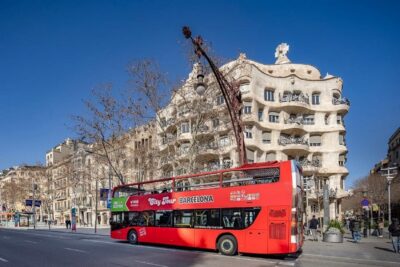

City Sightseeing Barcelona Hop-On Hop-Off Bus Tour: 24 or 48-Hour
Read our review →
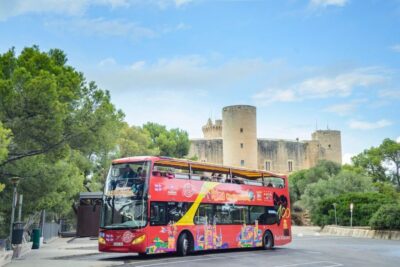
Palma de Mallorca: City Sightseeing Hop-On Hop-Off Bus Tour
Read our review →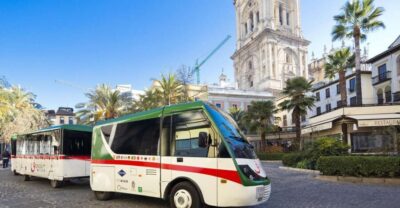
Granada City Train 1 or 2-Day Hop-On Hop-Off Ticket
Read our review →
Browse the lists this tour appears in