

Review · HO CHI MINH CITY BUS TOURS
Saigon: City Sightseeing Hop-On Hop-Off Bus Tour
Saigon is easiest to understand from above, where you can watch scooters stream around colonial buildings, markets, museums, and riverfront streets. This two-route bus tour gives you a useful first look before you decide where to spend your time.
I like the easy mix of sightseeing and freedom. You can ride a full loop first, then return to the War Remnants Museum, Ben Thanh Market, or a pagoda. I also like the air-conditioned lower deck, free Wi-Fi, and helpful staff who have handed out conical hats in the sun and ponchos in the rain.
The main drawback is the timetable. Buses run every 30 minutes on the Red Route and every 45 minutes on the Blue Route, so a missed bus can cost you time. Some stops are not clearly marked, and the recorded commentary can fall out of sync or become hard to hear above Saigon traffic.
Key points at a glance
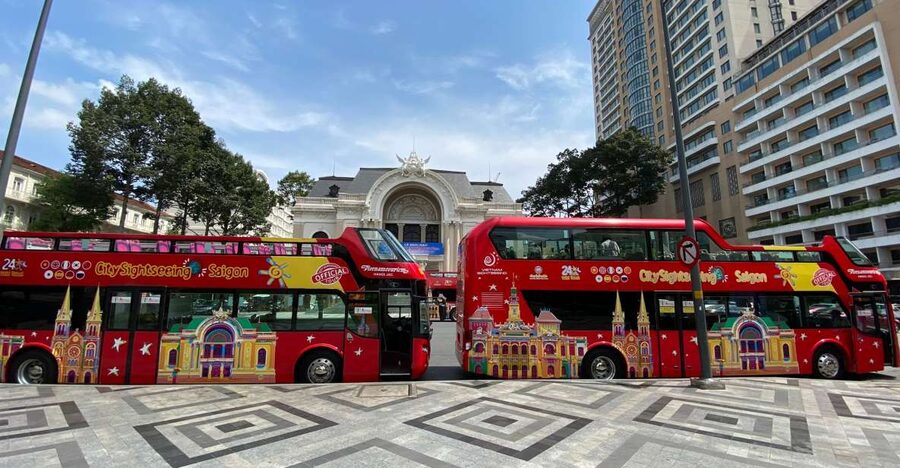
- Two routes, two different views: The Red Route focuses on central Saigon and its best-known landmarks, while the Blue Route reaches District 5, flower markets, temples, and Binh Tay Market.
- A strong first-day orientation: Ride a complete loop before hopping off so you can understand how the city fits together.
- The upper deck gives you the best view: It is excellent for photographs and watching traffic, but the sun and rain can be intense.
- Recorded commentary in nine languages: English, Spanish, German, French, Chinese, Japanese, Korean, Vietnamese, and Russian are available.
- The Blue Route deserves your time: It reaches areas many short city visits miss, including Ho Thi Ky Flower Market and several Chinese-Vietnamese temples.
- Allow time between stops: The bus is useful for orientation, but it is not a fast taxi from sight to sight.
Why the bus works well in Saigon

Ho Chi Minh City can feel confusing at first. The streets are wide in some places, narrow in others, and filled with a constant flow of motorbikes. Walking between every sight takes longer than the map suggests, especially in hot or rainy weather.
The bus gives you a high seat and a simple plan. You can watch the city change from French colonial streets around the Opera House to the food stalls and nightlife of Pham Ngu Lao, then toward older districts with temples and markets. That broad view is the real value of the tour.
For your first ride, I suggest staying aboard for a complete loop. The Red Route takes about 75 minutes, and the Blue Route takes about 80 minutes. Use the audio commentary to mark the places you want to revisit. On the second circuit, hop off with a purpose.
The pass costs about $21 per person for one day, with a two-day option available. That is not automatically cheaper than using Grab between attractions. If you only want to visit two or three central sights, individual rides may cost less. The bus makes better financial sense when you want an overview, plan several stops, or value the open-top view and commentary.
More Hop-On Hop-Off Bus Tours in Vietnam
- Hanoi: City Sightseeing Hop-On Hop-Off Bus Tour
★ 4.0 · 611 reviews - Hanoi: 24 Hour Hop on Hop off Bus Tour
★ 4.0 · 67 reviews - City Sightseeing Hanoi Hop-on-Hop-off Bus Tour
★ 3.0 · 53 reviews
The Red Route and central Saigon
The Red Route is the practical introduction to the city. It begins at the Saigon Opera House and passes through the central areas most first-time visitors want to see.
Saigon Opera House and Nguyen Hue Street
The ticket exchange counter is on the side of the Opera House facing the Continental Hotel. This is the main starting point, so allow a little extra time to find the correct counter and bus. Several buses may be nearby, and staff can direct you to the right one.
From here, the bus moves along Nguyen Hue Street, one of central Saigon’s broad ceremonial avenues. The elevated view helps you see the scale of the street and the mix of older façades, hotels, offices, and newer towers.
The Opera House is also a good place to begin on foot. You are close to the Continental Hotel, the city center, and several other sights. If you are staying nearby, you can start the day without arranging a separate transfer.
Nha Rong Wharf and the riverfront
The Nha Rong Wharf stop adds a riverfront perspective to the central loop. The building is tied to the story of Ho Chi Minh and the city’s port, and the stop gives you a change from commercial streets and colonial architecture.
This is a good place to hop off if you want a pause from the bus and a slower look at the river area. Do not expect the stop itself to fill a whole day. It works best as part of a wider route rather than as your only destination.
More Sightseeing Bus Tours in Vietnam
- Ho Chi Minh City: Panoramic City Bus Tour
★ 3.9 · 285 reviews - Retro Hop-on-hop-off Bonbon City Tour: Classic Package
★ 4.0 · 32 reviews - Hanoi City Tour: Bat Trang, Train Street, Lunch & Luxury Bus
★ 4.9 · 15 reviews
Tran Hung Dao Statue and the Museum of Vietnamese History
The Tran Hung Dao Statue stop puts you near a major city landmark and gives you access to the Museum of Vietnamese History. The museum is a useful choice for putting Vietnam’s long story into context, although the bus does not include admission to any attraction.
The route then reaches the Museum of Vietnamese History area. This is a sensible stop for you if you prefer museums and historical displays to shopping. Check the amount of time you want inside before getting off, since the next Red Route bus may be 30 minutes away.
War Remnants Museum
The War Remnants Museum is one of the most important stops on the Red Route. Its displays are direct and emotionally heavy, so give yourself enough time rather than trying to squeeze it into a rushed 20-minute visit.
This is also one of the recommended transfer points for the Blue Route. Red Route Stop 6 corresponds with Blue Route Stop 3. That makes the museum a useful place to switch lines, but check the staff instructions before you leave the bus.
Pham Ngu Lao Street and Ben Thanh Market
Pham Ngu Lao is associated with budget hotels, restaurants, bars, and evening activity. It is a lively part of the central city, though the immediate area can feel hectic and commercial. If you want food, a drink, or a convenient break, this is an easy place to get off.
Ben Thanh Market is more useful for browsing than for a calm shopping trip. You can look for souvenirs, clothing, small gifts, and food, while also getting a close look at everyday market trade. Prices may require bargaining, and the indoor setting can be hot.
Ben Thanh is another important interchange. Red Route Stop 8 corresponds with Blue Route Stop 2. If you want to cover both routes in one day, this is one of the clearest places to change buses.
Independence Palace and Notre Dame Cathedral
Independence Palace, also called the Reunification Palace, is a major stop for anyone interested in modern Vietnamese history. The grounds and interior give you more to see than a quick photo stop, so plan your bus connection carefully.
One practical issue is that the stop is not always clearly marked. Pay attention to the route map and ask staff to point out the exact place to wait. That small bit of preparation can prevent an unnecessary walk.
The final Red Route stops are Saigon Notre Dame Cathedral and the Central Post Office. The cathedral is one of the city’s best-known French colonial buildings, while the nearby post office remains a handsome and highly photographed landmark.
The cathedral has faced restoration work at different times, so the view may not always match your expectations. The Central Post Office is still worth seeing, and both buildings are close enough to combine with a walk around the surrounding streets.
The Blue Route into Districts 5 and beyond
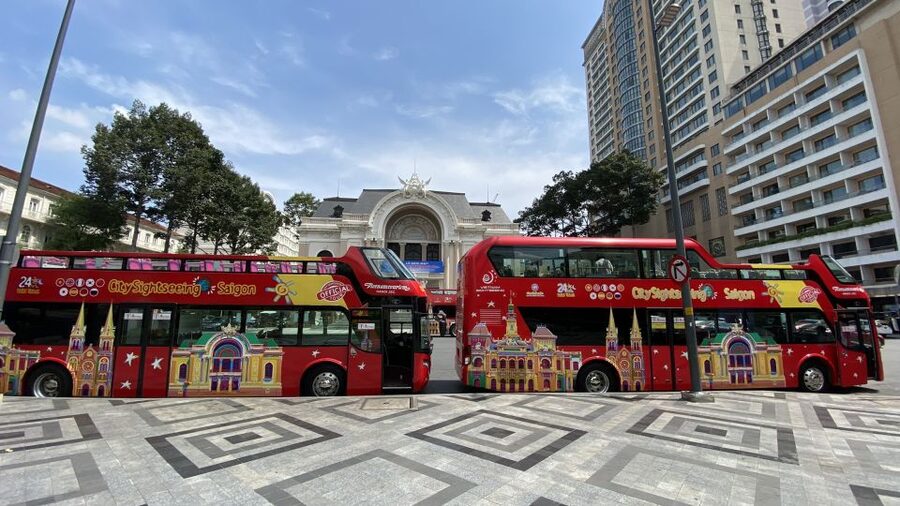
The Blue Route is where the tour becomes more than a standard central-city circuit. It reaches District 5 and areas shaped by Chinese-Vietnamese culture, local commerce, temples, and wholesale markets.
Beer Street and the second Ben Thanh connection
The Blue Route begins at Beer Street on Pham Ngu Lao Street, then reaches Ben Thanh Market and the War Remnants Museum. These first stops overlap with the Red Route, which is helpful for transfers but means you should not expect two completely separate city tours from the start.
If you have only a few hours, you may prefer to ride the Red Route first and use the Blue Route for the parts beyond the museum. That gives you more time in District 5 instead of repeating the central section.
Ho Thi Ky Flower Market
Ho Thi Ky Flower Market is one of the more distinctive Blue Route stops. It gives you a look at a working market area rather than only polished central attractions. The stop is especially useful if you want to see a different side of Saigon’s daily commerce.
Markets can be most interesting when you slow down and observe rather than simply taking photographs. Keep an eye on the departure time, since the Blue Route runs every 45 minutes.
Phuoc An society’s premises and Ong Bon Pagoda
These stops lead you farther into the city’s Chinese-Vietnamese religious and cultural areas. The Phuoc An society’s premises and Ong Bon Pagoda offer a change of mood from the wide boulevards around the Opera House and Ben Thanh Market.
The appeal here is the route itself. You see how the city extends beyond the familiar central district, with older neighborhood streets, local businesses, and religious buildings. The stops may require more walking than the major central landmarks, so comfortable shoes help.
Binh Tay Market
Binh Tay Market is one of the strongest reasons to take the Blue Route. It is a major market in District 5 and offers a different feel from Ben Thanh. The setting is more closely tied to neighborhood and wholesale trade, and the surrounding district adds context to the market visit.
Do not treat Binh Tay as a quick substitute for Ben Thanh. They serve different purposes. Ben Thanh is convenient and central, while Binh Tay gives you a better reason to travel beyond District 1.
Thien Hau Pagoda and Van Phat Pagoda
The Blue Route finishes with religious stops including Thien Hau Pagoda and Van Phat Pagoda. These are valuable additions if you want temples and local culture in your itinerary, not just colonial buildings and shopping.
As with any active religious site, keep your visit respectful and follow posted instructions. The bus route makes it possible to reach these places without arranging separate transport, but you still need to watch the timetable.
Audio commentary, views, and comfort

The recorded audio guide is included with headphones and comes in nine languages. It is useful for basic facts and orientation, especially when you are riding through areas you do not yet understand.
The commentary is not the same as having a live guide beside you. Some passengers have found the sound system unreliable, with commentary stopping, referring to the wrong side of the bus, or becoming poorly matched to the Blue Route. City noise can also make the volume hard to hear.
I would still use the audio on the first circuit, then stop listening when you want to focus on photographs or traffic. The upper deck offers the best view, but Saigon’s heat and sudden rain are real considerations. Staff have supplied rice hats or other hats in strong sun and ponchos when rain began. The lower deck has air conditioning, making it the sensible choice during the hottest part of the day.
Free Wi-Fi is a useful extra if your mobile data is limited. It will not replace a map or a little route planning, but it can help you check directions, opening times, and your next stop without using roaming data.
Timing your one-day or two-day pass
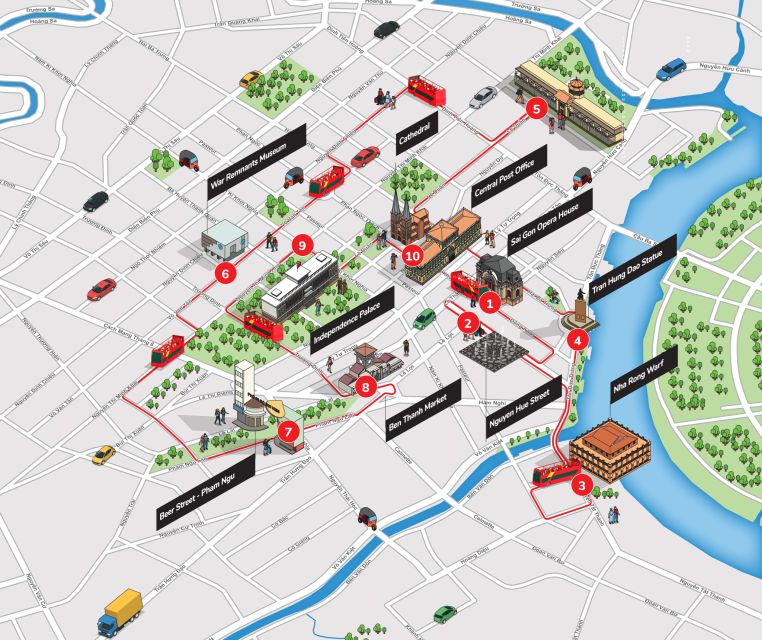
The Red Route operates from 9am, with the last departure from Stop 1 at 4pm. Buses are scheduled every 30 minutes, and the full loop takes about 75 minutes.
The Blue Route also begins at 9am. Its last departure from Stop 1 is listed at 3:45pm, with buses every 45 minutes and a loop of about 80 minutes.
Those final departure times matter. If you get off late in the afternoon, you may have a long wait or need another way back. Keep the printed timetable or guidebook with you, and ask staff where the next bus will stop. Stop signs are not always obvious.
A one-day pass works if you mainly want an overview and two or three stops. The two-day pass suits you better if you want to visit museums, markets, and pagodas without rushing. It also gives you a second chance if rain, heat, or a long museum visit interrupts the first day.
Some bookings also include or offer an evening city ride. The night trip is a different experience from the daytime routes, with illuminated streets and buildings seen from the open-top deck. Confirm the exact evening option attached to your booking, since the standard daytime timetable and the night ride are not identical.
Who will get the most from this tour
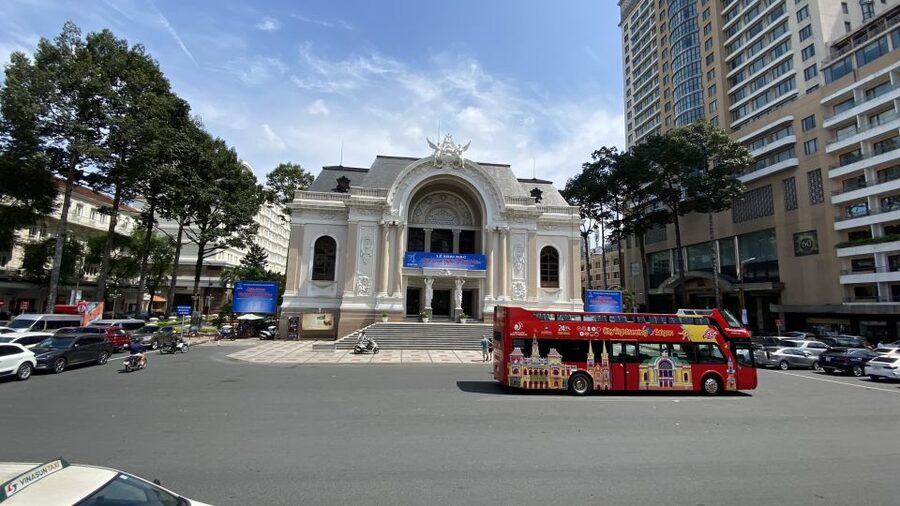
This is a good fit for first-time visitors, families, older visitors, and anyone who wants an easy city overview without negotiating motorbike traffic. It also helps you decide which parts of Saigon deserve a longer visit.
Families can set their own pace, and the ability to sit downstairs in air conditioning is useful. You can also avoid making children walk between every sight. The bus is not a substitute for exploring on foot, but it makes a practical base.
It suits photographers who want a high view of the streets and people who enjoy watching city traffic. It is less suitable if you need fast point-to-point transport or prefer a live guide with continuous personal explanations.
Bring your passport or ID card. Pets and smoking are not allowed. You can use either a mobile or paper voucher, and cancellation is allowed up to 24 hours before departure for a full refund. Tickets are exchanged at the Opera House counter, and the voucher can be used on any day within 12 months of the selected travel date.
Should you book the Saigon bus tour?
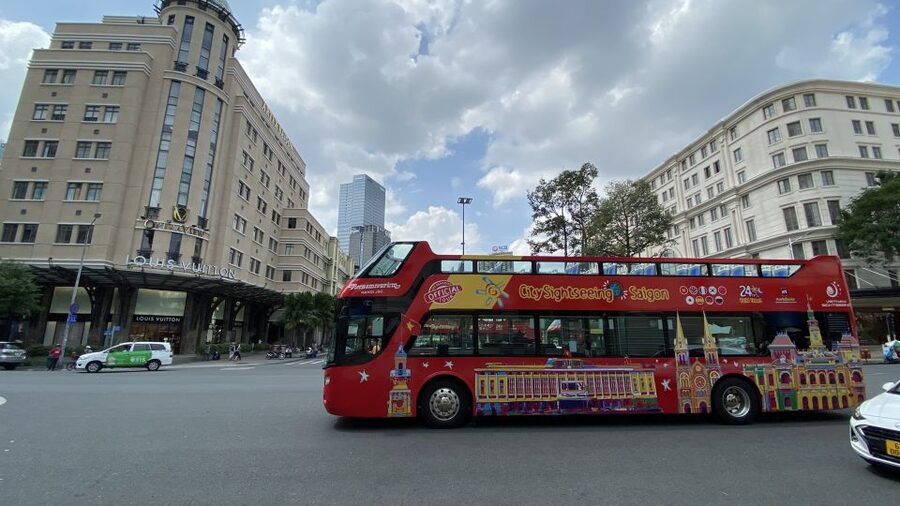
Book it if you want to get your bearings quickly, see both central Saigon and District 5, and choose your stops as you go. The Blue Route, in particular, adds value by reaching Binh Tay Market, Ho Thi Ky Flower Market, and several pagodas.
Choose the two-day option if you want time for the War Remnants Museum, Independence Palace, Ben Thanh Market, and the Blue Route without racing the timetable. Choose one day if your main goal is a broad city view.
Skip it if you are only visiting one or two attractions and plan to use Grab between them. The $21 price is justified by the two routes, recorded commentary, Wi-Fi, open-top views, and flexibility, but it is not the cheapest form of transport. For most first visits, I would ride one complete loop, use the Red Route for the central sights, then make a special effort to take the Blue Route.
FAQ

How long is the Saigon hop-on hop-off pass valid?
You can choose a pass valid for one day or two days.
How often does the Red Route run?
The Red Route runs about every 30 minutes. The first departure from Stop 1 is at 9am, and the last departure from Stop 1 is at 4pm.
How often does the Blue Route run?
The Blue Route runs about every 45 minutes. The first departure from Stop 1 is at 9am, and the last departure from Stop 1 is at 3:45pm.
How long does each full route take?
The Red Route takes about 75 minutes for a complete loop. The Blue Route takes about 80 minutes.
Which languages are available for the audio guide?
The audio guide is available in English, Spanish, German, French, Chinese, Japanese, Korean, Vietnamese, and Russian.
Where can I exchange my ticket?
You can exchange your ticket at the counter beside the Saigon Opera House, facing the Continental Hotel.
Can I use a mobile voucher?
Yes. Both mobile and paper vouchers are accepted.
Does the ticket include attraction admission or food?
No. Food, drinks, hotel transfers, and entry to attractions are not included.
Recently added around Vietnam
- Hanoi City Tour: Bat Trang, Train Street, Lunch & Luxury Bus★ 4.9 · 15 reviews
- Retro Hop-on-hop-off Bonbon City Tour: Classic Package★ 4.0 · 32 reviews
- Hanoi: 24 Hour Hop on Hop off Bus Tour★ 4.0 · 67 reviews
- Hanoi: 4 Hour Hop on Hop off Bus Tour★ 4.0 · 47 reviews
- City Sightseeing Hanoi Hop-on-Hop-off Bus Tour★ 3.0 · 53 reviews
- Ho Chi Minh City: Late-Night Open-Top Bus Tour★ 3.5 · 137 reviews
- Ho Chi Minh City: Panoramic City Bus Tour★ 3.9 · 285 reviews
- Night Bus Tour in Ho Chi Minh City★ 3.0 · 39 reviews
Hop-On Hop-Off Bus Tours, compared.


City Sightseeing Hop-on Hop-off Bus with Audioguide
Read our review →
Tootbus Hop-on Hop-off (Optional River Cruise)
Read our review →Big Bus Hop-On Hop-Off Tour with Optional Cruise
Read our review →
London Big Bus Hop-On Hop-Off Tour with Optional River Cruise
Read our review →
Big Bus Hop-on, Hop-off Open-Top Sightseeing Tour
Read our review →
Browse the lists this tour appears in