
Review · QUEBEC CITY BUS TOURS
Quebec City Hop-On Hop-Off
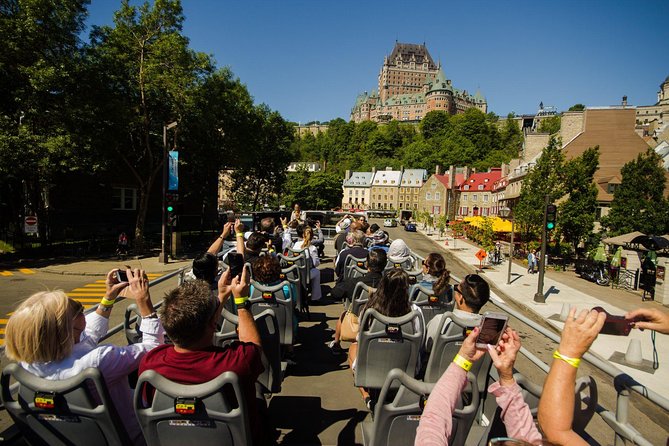
Quebec City’s red double-decker bus gives you a quick visual tour of a city that can feel confusing on foot, especially on a first visit. From the open top, you see the old stone streets, riverfront, fortifications, Parliament Hill, and the Plains of Abraham in one sweep. The full circuit takes about two hours, though traffic and loading delays can stretch that.
I like the easy overview and the route’s broad reach. You can move from Old Québec and Place Royale to Saint-Roch, the Old Port, the Citadelle, and the Museum of Fine Arts without arranging separate taxis. I also like the 10-language audio tour, which adds history while you watch the city go by.
The weak point is bus frequency on busy days. Cruise ships, festivals, and packed departure points can mean long waits, full buses, and little chance to hop back on. The top deck offers fine views, but it can be cold, and the seats have limited legroom for tall passengers.
Key points to know before you book
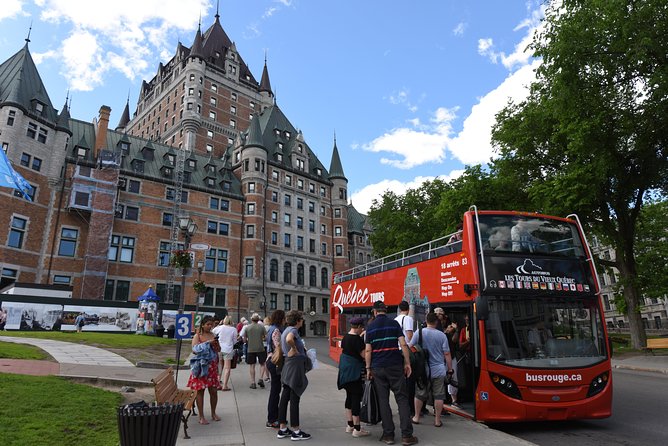
- Fifteen stops cover more than Old Québec: The route reaches Saint-Roch, the Old Port, Parliament Hill, the Citadelle, the Plains of Abraham, Grande Allée, and the Museum of Fine Arts.
- Ride once before making plans: A complete circuit helps you understand the city’s layout and choose which stops deserve your time.
- The audio works in 10 languages: Commentary is recorded, with onboard earphones provided. Some units have reportedly failed, so keep expectations practical.
- A 1-day pass may be enough for sightseeing: The 2-day option makes sense only if you can tolerate possible waits and use the service on less crowded days.
- Cruise-ship days are the main risk: Multiple ships in port have produced long queues and full buses. Check the port schedule before buying.
- Bring your mobile ticket ready: Digital boarding can be awkward, and groups buying together may need to visit the information building at Stop 1 for separate printed tickets.
What this Quebec City bus tour actually gives you
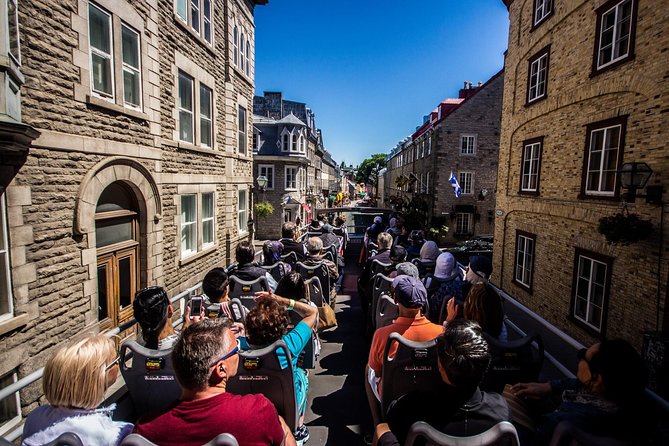
This is both a sightseeing ride and a simple way to connect several parts of Quebec City. You can board at any stop, listen through the supplied earphones, and get off when a site catches your eye. Then you wait for a later bus and continue the route.
The central appeal is not depth. Two hours is enough for orientation, not a full examination of the Citadelle, museums, churches, markets, or historic streets. Think of the first circuit as a moving map. It shows you how Old Québec relates to Saint-Roch, the riverfront, Parliament Hill, and the broad green space of the Plains of Abraham.
The open top is a real advantage on a clear day. You get less obstructed views than from a standard city bus, especially when looking at upper walls, church towers, and the city’s slopes. I would still bring a jacket. Sitting on top can be chilly even when the streets feel pleasant.
The bus is a red, London-style double-decker. Onboard Wi-Fi is included, along with the audio tour. The recorded narration covers the past, present, and future of Quebec City and gives useful context as the bus moves between districts. It is offered in 10 languages, though the English audio has not always worked perfectly on every bus.
More Hop-On Hop-Off Bus Tours in Canada
- Big Bus Vancouver Hop-On Hop-Off Sightseeing Tour
★ 3.5 · 3,028 reviews - Montreal: Hop-On Hop-Off Double-Decker Bus Tour
★ 4.1 · 2,760 reviews - Toronto: City Sightseeing Hop-On Hop-Off Bus Tour
★ 4.3 · 2,544 reviews
Start at the Fort Museum and Place d’Armes
Stop 1 is at the Fort Museum, at Place d’Armes, beside the Musée de l’Amérique francophone. This is one of the most useful starting points because you are already close to the heart of Old Québec.
From here, you can walk toward the Château Frontenac, Dufferin Terrace, the fortifications, and the narrow streets of the upper town. The stop also serves as the information point, so it matters if your group needs separate printed tickets. Several people using one digital booking have found that a single pass on a phone is not always convenient when the group wants to split up.
I suggest beginning with the full loop if you have not visited before. You will see the city’s major districts without committing to a walking plan too early. Once you return near the old town, you can choose a stop with more confidence.
Stop 2 brings you into Saint-Roch
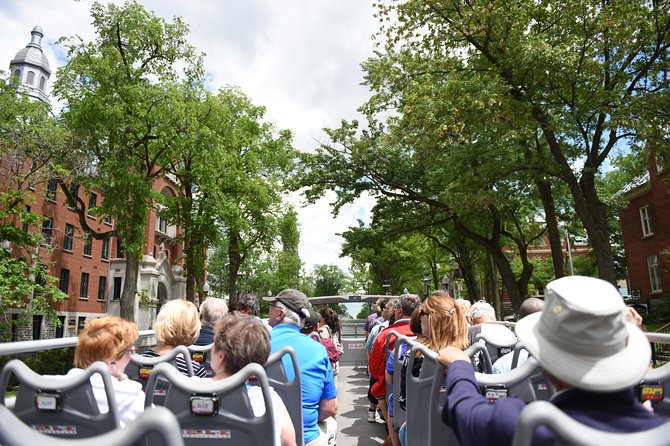
The second stop, at de la Couronne, serves Quartier Saint-Roch. This district has shopping and restaurants, and it gives you a useful contrast with the more polished historic core.
Saint-Roch feels more modern and local than the postcard streets around Place Royale. It is a practical place to get off for food or a break from the old town. The route also shows how Quebec City extends beyond the fortified center, which is easy to miss if you spend your entire visit around the Château Frontenac.
As with every stop, check the bus situation before walking away. A short stop becomes less useful if the next bus is full or far behind schedule. On crowded days, you may find it faster to walk between nearby parts of the city.
The riverfront sequence: Stops 3 through 5
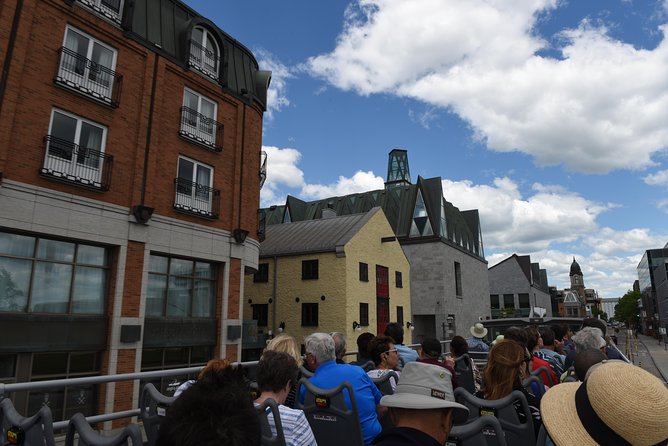
Stop 3, at 85 Rue Dalhousie, is near the Musée de la civilisation, Place de la FAO, and the waterfront promenade. This is a good choice if you want museum time or a walk beside the St. Lawrence River.
Stop 4, at Trav. Qc-Lévis, places you near Place Royale and Notre-Dame-des-Victoires Church. You can also reach the Centre d’interprétation de la Place Royale, Maison Chevalier, shops, and restaurants. Place Royale is one of the most rewarding places to leave the bus because the streets and buildings are best appreciated at walking speed.
Stop 5, at 306 Rue Saint-Paul, serves the Old Port promenade and the Old Port Market. This area works well for a meal, browsing, or a slower walk along the water. The market and port also give you a different view of Quebec City than the steep streets of the upper town.
These three stops are close enough in spirit to form one walking day, but they are not interchangeable. The museum stop is best for indoor culture, Place Royale for historic streets and church architecture, and Rue Saint-Paul for the port and market.
Same city, a different seat on a different deck:
- Montreal: Guided Bus Tour
★ 4.4 · 3,064 reviews - Ottawa: Bilingual Guided City Tour by Amphibious Bus
★ 4.6 · 2,089 reviews - Vancouver: Hop-on Hop-off Sightseeing Tour with 10 Stops
★ 3.9 · 1,807 reviews - Quebec City: Hop-on Hop-off Open-Top Double Decker Bus Tour
★ 4.4 · 1,484 reviews
Parliament Hill and the city’s upper terrace
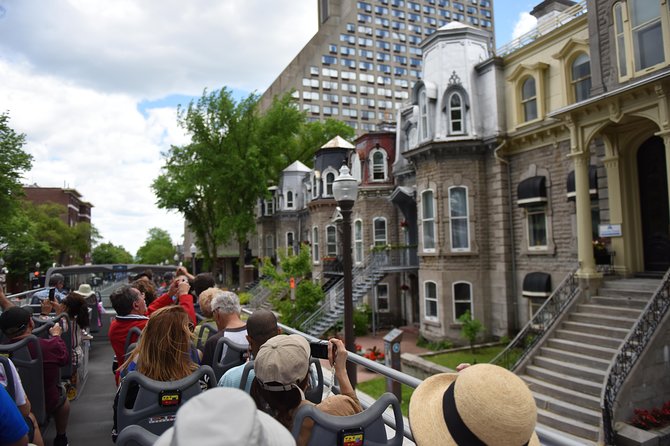
Stop 6 is at Place Québec parking. Stop 7, at the Observatoire de la Capitale, brings you to Parliament Hill, the Hôtel du Parlement, the Fontaine de Tourny, and the Promenade des Premiers ministres.
This section is valuable because it shows Quebec City as a working capital, not only as a preserved old town. The parliament buildings and formal public spaces give the route a broader sense of the city’s civic life.
The Observatoire stop may appeal if you want a high viewpoint, though the bus itself already gives you open views from above street level. If you are short on time, I would choose the outdoor walk around Parliament Hill first and save an interior attraction for another visit.
Stop 8, at Gén.-De Montcalm, serves the Plains of Abraham, the Musée des plaines d’Abraham, restaurants, and Parliament Hill. The Plains are a large open area and a useful place to stretch your legs after sitting on the bus.
The Citadelle and Cap Diamant
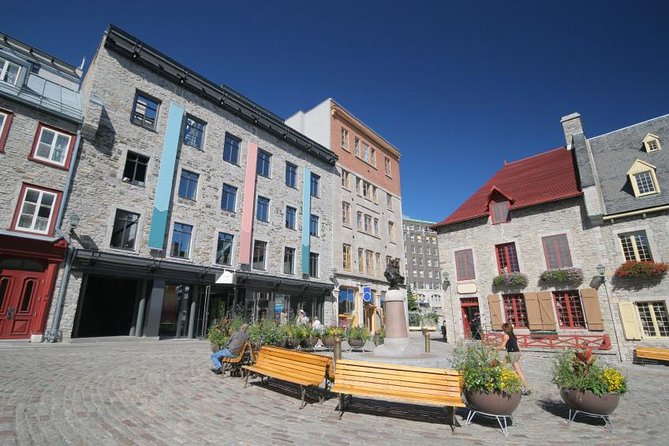
Stop 9, near the Monument Confucius, connects with the Citadelle, the Plains of Abraham, and Parliament Hill. Stop 10, at 1 Avenue du Cap Diamant, is close to the Citadelle, the remains of a blockhouse, and the Promenade des Gouverneurs.
This is one of the route’s most useful stretches for first-time visitors. The Citadelle is not simply another photo stop. Its position helps explain Quebec City’s defensive layout and the importance of the high ground above the river. The Promenade des Gouverneurs gives you a fine walking option along the Cap Diamant area.
Plan carefully before getting off here. The route may look simple on a map, but the city’s slopes and elevated sections can make a short distance feel longer on foot. If you have limited mobility or dislike hills, staying on for the overview may be easier than attempting several stops in succession.
Grande Allée, the Museum of Fine Arts, and Avenue Cartier
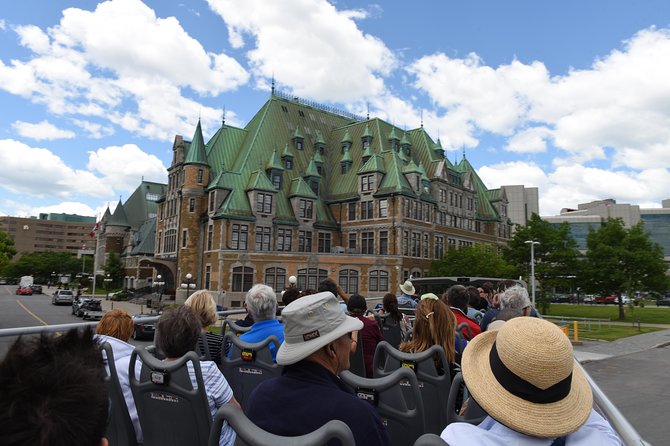
Stop 11, at 290 Grande Allée O, serves the Musée national des beaux-arts du Québec, also called MNBAQ, and the Plains of Abraham. This stop is the best fit for an art-focused visit.
Grande Allée also has restaurants, so it can work as a lunch or dinner stop. The Museum of Fine Arts requires more time than the bus route allows, which is another reason the 2-day pass can be useful in theory. You can return to the route after a museum visit, provided buses are running with enough space.
Stop 12, at Cinéma Cartier, is near Avenue Cartier, shopping, and restaurants. It is less about major monuments and more about seeing a neighborhood where people eat, shop, and spend an ordinary evening.
Stops 13 and 14 serve Rue Saint-Jean and the Saint-Jean-Baptiste area. Stop 13, at 175 Rue Saint-Jean, is close to shopping and Saint-Jean-Baptiste Church. Stop 14, at 931 Rue Saint-Jean, is near Palais Montcalm, Le Capitole, Faubourg Saint-Jean-Baptiste, Parc Canada, restaurants, and parking.
This part of the route is useful if you want a break from the heavily visited core. Saint-Jean-Baptiste gives you more everyday city life, along with theaters, shops, and places to eat. It is also a practical area for combining the bus with independent walking.
City Hall and the end of the circuit
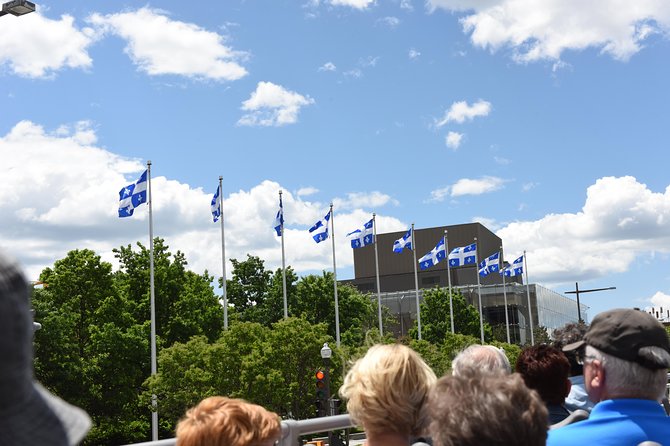
Stop 15 is at the Édifice Thaïs-Lacoste-Frémont, near City Hall, or Hôtel de Ville. This returns you toward the old center and makes a natural end to the circuit.
At this point, you should have a clear sense of the city’s main zones: the upper old town, the lower riverfront, Saint-Roch, the parliament district, the Plains of Abraham, and the western neighborhoods. That orientation is the tour’s strongest service.
The complete ride is advertised at about two hours, but do not build a tight connection around that number. Traffic, events, technical problems, and loading delays can add a lot of time. One reported route had a long pause at the Château Frontenac and another delay caused by a technology problem. Treat the bus as flexible sightseeing, not a timed shuttle.
Price, pass length, and real value
At $46.93 per person, the 1-day pass is not cheap if you only sit on the bus for one circuit. You are paying for the open-top view, the recorded narration, the route coverage, and the option to get off at major sights.
The price becomes easier to justify if you use the bus to connect several areas that would otherwise require long walks or separate rides. It is especially useful on a first day, when you want to learn the city’s shape before choosing where to spend your limited hours.
The 2-day option offers more flexibility, but it is not automatically better value. If buses are infrequent or too full to board, the extra day does not solve the main problem. I would choose two days when you have a relaxed schedule, want to visit museums or the Citadelle, and are visiting at a time when demand is moderate.
Do not buy this mainly as a dependable transportation pass. On crowded days, the hop-on part can break down. You may wait 30 to 90 minutes, then watch a full bus pass without stopping for your queue. In that situation, walking may be quicker.
The cruise-ship warning matters
The biggest issue is capacity. Several cruise ships in port can send a large number of people toward the same stops at once. Festivals and other city events create the same problem.
Queues have reached roughly 50 to 70 people in difficult cases, with some buses arriving full. People have waited more than an hour, and in one case more than two hours, before finding space. A refund was issued quickly in at least one severe disruption, but that is not a useful substitute for sightseeing time.
If your visit falls on a major cruise day, check the port schedule before booking. Start early if you decide to go, and avoid planning the bus as your only way back to a ship or a fixed appointment. If you need reliable movement around town, walking or another form of transport may serve you better.
Audio, seating, and weather
The audio commentary is one of the tour’s better features when it works. It gives you facts without requiring a live guide, and the 10-language choice makes the tour accessible to a broad audience.
The tradeoff is that recorded narration cannot answer questions or explain why a particular event changed the city. Some commentary can feel abrupt, giving a date or a tragic event without enough explanation. You get an overview rather than a personal lesson.
Some riders have found the English audio unavailable, while others found it clear and informative. Bring your own curiosity and use the ride as a framework for later visits.
The upper deck gives the best views, but it can be cold. Lower seating protects you from weather but offers less visual appeal. Legroom is limited, and two tall people may not fit comfortably side by side. The buses are generally described as clean, but crowded rides can become standing-room-only.
Mobile tickets are accepted, and Wi-Fi is included. Keep the ticket open before you board, since phone access at the stop may be slow or awkward. If you are buying for a group, ask at Stop 1 about separate tickets before everyone heads in different directions.
Who should book it?
I recommend this tour for a first visit when you want a fast city overview, prefer not to tackle Quebec City’s slopes all day, or want an easy way to connect the old town with Saint-Roch, the Plains of Abraham, and the Museum of Fine Arts.
It also suits families and couples who value a relaxed first circuit before choosing their stops. The broad route and audio commentary are the most praised parts, and the open-top view makes the ride more enjoyable on a clear day.
I would be cautious if your visit falls during several cruise ships, a major festival, or a tightly scheduled day. I would also avoid treating the bus as guaranteed public transportation. Book it for the sightseeing perspective, not because you need a bus to arrive at a precise time.
Free cancellation is available up to 24 hours before the start time. Poor weather can lead to a different date or a full refund, while late cancellations and late changes are not accepted.
Should you book the Quebec City Hop-On Hop-Off?
Book it if you want to get your bearings fast and can accept a flexible pace. Ride the whole loop first, then decide which of Place Royale, the Old Port, the Citadelle, Parliament Hill, Saint-Roch, or the Museum of Fine Arts deserves a longer stop.
Choose the 1-day pass for a simple overview. Choose two days only if you have time to wait and are visiting outside the most crowded cruise and festival periods. On a quiet day, this is an easy and pleasant introduction to Quebec City. On a packed day, it can become an expensive lesson in patience.
FAQ
How long does the full Quebec City bus route take?
The tour lasts approximately two hours for the full sightseeing circuit. Traffic, boarding delays, city events, and technical problems can make the actual ride longer.
How many stops are on the route?
The route has 15 listed stops, including the Fort Museum, Saint-Roch, the Musée de la civilisation, Place Royale, the Old Port, the Observatoire de la Capitale, the Plains of Abraham, the Citadelle, Grande Allée, Saint-Jean-Baptiste, and City Hall.
Can I choose between a one-day and two-day pass?
Yes. The available ticket options include a 1-day pass and a 2-day pass.
Is the audio tour available in English?
Yes. The onboard audio tour is offered in English and nine other languages, for a total of 10 languages.
Is Wi-Fi included on the bus?
Yes. Onboard Wi-Fi is included with the pass.
Can I board at any stop?
Yes. You can board at any of the listed bus stops and get off at stops that interest you, then board again when a bus is available.
Does the tour provide hotel pickup and drop-off?
No. Hotel pickup and drop-off are not included.
What happens if bad weather cancels the tour?
If poor weather causes the experience to be canceled, you will be offered another date or a full refund.
What is the cancellation deadline?
You can cancel for a full refund up to 24 hours before the experience start time. Cancellations or changes made less than 24 hours in advance are not accepted for a refund.
Recently added around Canada
- Vancouver Hop On Hop Off Trolley Tour★ 4.0 · 426 reviews
- Toronto: Niagara Falls Bus Tour with Maple Tasting and NOTL★ 4.6 · 524 reviews
- Toronto: Night Sightseeing Tour on a Double-Decker Bus★ 4.5 · 133 reviews
- Quebec City: 1-Hour Express Double-Decker Bus Tour★ 4.5 · 699 reviews
- City Sightseeing Toronto Hop-On Hop-Off Bus Tour★ 3.5 · 726 reviews
- Hop-On and Hop-Off Banff Bus★ 5.0 · 781 reviews
- Quebec City: Old Town and Montmorency Falls Bus Tour★ 4.7 · 820 reviews
- Best of Quebec City: Panoramic Bus Tour with Local Guide★ 4.0 · 897 reviews
Hop-On Hop-Off Bus Tours, compared.
City Sightseeing Hop-on Hop-off Bus with Audioguide
Read our review →
Tootbus Hop-on Hop-off (Optional River Cruise)
Read our review →Big Bus Hop-On Hop-Off Tour with Optional Cruise
Read our review →
London Big Bus Hop-On Hop-Off Tour with Optional River Cruise
Read our review →
Big Bus Hop-on, Hop-off Open-Top Sightseeing Tour
Read our review →
Browse the lists this tour appears in