

Review · MEXICO CITY BUS TOURS
Mexico City: Hop-on Hop-off Bus Tour
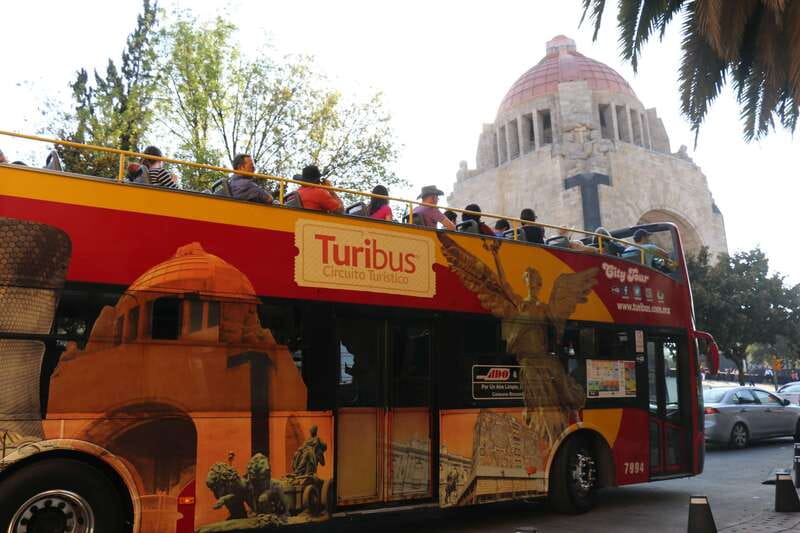
Mexico City is too large to understand on foot in a day, and this four-route Turibus pass gives you a useful first look without forcing you into a fixed group itinerary. You can ride through the Zócalo, Reforma, Polanco, Coyoacán, and the Basilica area, then hop off wherever a museum, market, or plaza catches your eye.
I like the freedom to use the bus as both a narrated sightseeing ride and practical transport. I also like the price, about $21 per person, especially if you use the pass for two days. The catch is traffic: a route that looks short on the map can take much of an afternoon, and the Spanish bus announcements may make the English audio hard to hear.
Key points to know
- Four very different routes: Historic Downtown, Polanco, South, and Basilica each show a distinct side of Mexico City.
- Best for first-time orientation: The bus helps you locate museums, plazas, neighborhoods, and major avenues before returning on foot.
- Two days are far better than one: Traffic and limited departure times on some routes make all four circuits difficult in a single day.
- Bring your own earphones: The supplied earbuds may be poor, and some buses have weak or missing headset connections.
- Use the top deck wisely: It offers fine views and fresh air, but afternoon sun can be fierce and the metal seats can get very hot.
- Expect traffic delays: The timetable is a guide, not a guarantee, especially on the South route and around central Mexico City.
A practical first look at Mexico City
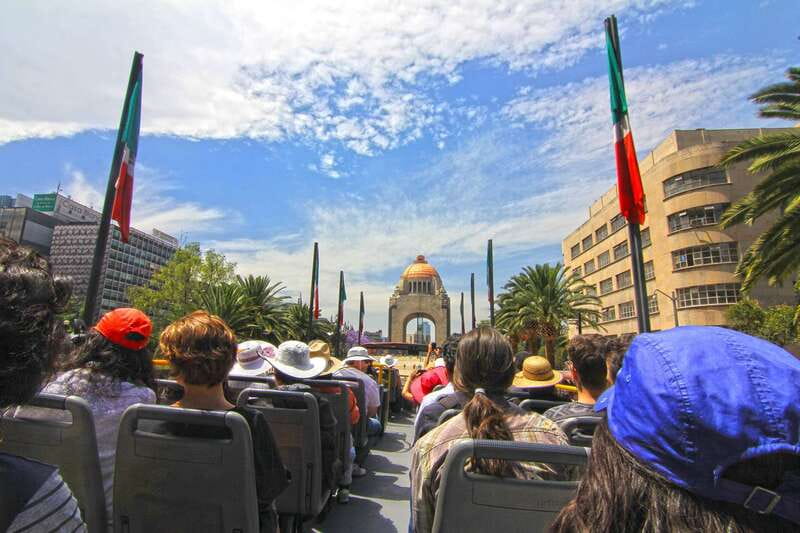
The Turibus Mexico City Hop-on Hop-off Tour is most useful as an orientation tool. You are not simply sitting on a bus for a loop. You can use the ride to see where the museums and neighborhoods are, get off for a few hours, and then continue on another route with the same bracelet.
That matters in Mexico City, where major sights are spread across a huge urban area. Historic Downtown, Polanco, Coyoacán, and the Basilica of Guadalupe do not form one easy walking circuit. A taxi or rideshare between them can add up, while the Turibus combines transport with an audio introduction.
The pass costs about $21 and is sold for one or two days. I see the one-day ticket as good value if you mainly want the Historic Downtown route and one additional area. The two-day option makes more sense if you want museums, Coyoacán, Polanco, and the Basilica without spending the whole day watching traffic crawl past.
You can begin at any listed stop by showing a printed or electronic voucher. That flexibility is useful, but check the stop carefully before setting out. Stop locations can be slightly away from the attraction they serve, and signage is not always as clear as it should be.
More Hop-On Hop-Off Bus Tours in Mexico
- Mexico City: Hop-on Hop-off City Tour by Turibus 1-Day Pass
★ 4.1 · 691 reviews - Hop On Hop Off Tour with Free Stops in Puerto Vallarta
★ 4.0 · 647 reviews - Cancun City Sightseeing and Shopping Tour on a Double Decker bus
★ 4.0 · 540 reviews
Historic Downtown route: Zócalo, Reforma, and the city center
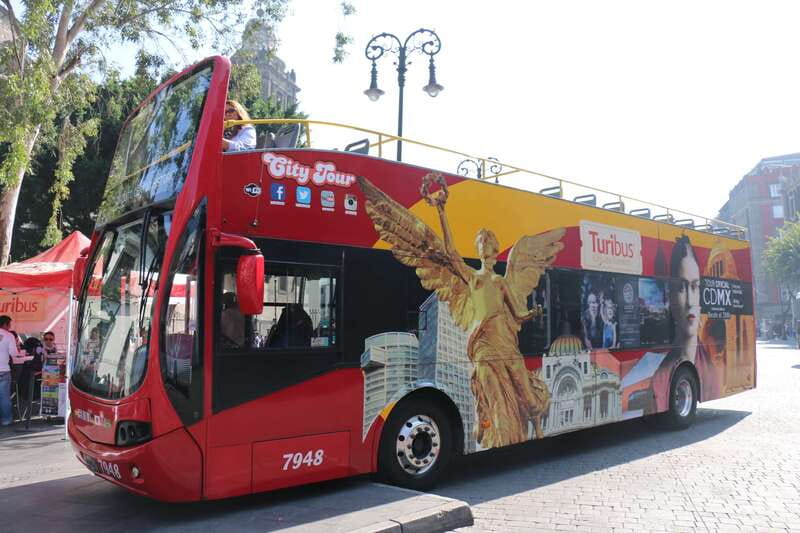
The Historic Downtown route is the main event. It runs daily from about 9 a.m. to 7 p.m., with buses roughly every 30 minutes. Its long loop connects major parts of central Mexico City, including Reforma, museums, the Zócalo, and several important monuments.
You can board at the Zócalo, the city’s great central plaza, or at stops such as Auditorio, the Museum of Modern Art, Condesa, Cibeles, Reforma 222, and the Museum of Anthropology. The route also passes the Monument to Independence, commonly called the Angel of Independence, the Monument to the Revolution, the Hemiciclo a Juárez, and Plaza Manuel Tolsá.
This is the route I would take first. The audio gives you a basic framework for the city’s pre-Hispanic, colonial, and modern periods, while the bus lets you see how the central districts fit together. You can mark places that deserve a return visit rather than trying to enter every museum in one rushed circuit.
The Zócalo stop is especially useful for a longer break. From there, you can explore the central plaza and nearby streets, find food, and visit sights on foot before boarding again. The route also brings you close to the Franz Mayer Museum and several other cultural stops, although you should allow extra time if you intend to go inside.
Traffic is the main problem. The central circuit can run late during busy periods, and a full ride may take much longer than expected. I would avoid treating the timetable as exact and would not schedule a flight, timed museum entry, or restaurant reservation too tightly after the bus.
If you have only one day, start early on this route. Morning gives you the best chance of completing a useful portion of the circuit before traffic builds. You can then switch to another route if buses and time allow.
Polanco route: museums, shopping, and modern Mexico City
The Polanco route shows a different city. It is shorter, with seven stops, and focuses on upscale shopping, contemporary architecture, museums, and the area around Auditorio Nacional.
The listed stops include Campos Elíseos, Masaryk and Molière, Centro Comercial Antara, Museo Soumaya, Hipódromo and Granja Las Américas, and Museo del Papalote. Departures from Auditorio are scheduled at 10 a.m., 11:30 a.m., 1 p.m., 2:30 p.m., 4 p.m., and 5:30 p.m.
Those limited departure times are important. This is not the route to board casually every 20 minutes. I would check the next departure before getting off, especially if you plan to visit Museo Soumaya or another attraction.
Museo Soumaya is one of the most useful stops for an art-focused day, while the shopping streets around Masaryk and Molière give you a look at Mexico City’s polished commercial side. The route also links well with the Historic Downtown circuit around Auditorio and the National Museum of Anthropology area.
You can ride the Polanco loop simply to see the contrast between the older center and the city’s newer, more fashionable districts. I would not use it as a replacement for walking. The bus shows you the scale and character of the district, but you will need to get off to appreciate the museums, shops, and streets properly.
South route: Coyoacán, Frida Kahlo, and UNAM

The South route is the most useful choice for Coyoacán and the city’s southern districts. It runs daily from around 11 a.m. to 7 p.m. and includes stops at Mercado Roma, the World Trade Center, Torre Manacar, the Frida Kahlo Museum, Centro Histórico de Coyoacán, San Ángel, the National Autonomous University of Mexico, the botanical garden, Perisur, and Cuicuilco.
The route is listed with 19 stops, though the service is less frequent than the main central route. Expect roughly hourly or half-hourly service depending on the point and operating conditions. That makes planning essential.
The Frida Kahlo Museum is the headline stop for many people. The bus stop may not be directly at the museum entrance, so allow a little walking time. Coyoacán itself deserves more than a quick photo stop. The route gives you access to its central area, markets, and surrounding streets, where you can pause for food and a slower look at one of Mexico City’s most distinctive neighborhoods.
The San Ángel and UNAM stops add architectural and cultural range. You can also reach the botanical garden and shopping areas farther south. The route is valuable because these places are not close to the Zócalo, but that distance is also its weakness.
Traffic can make the ride to Coyoacán take far longer than expected. One useful tactic is to ride the South route earlier in the day, then return to the Historic Downtown route later, rather than spending the afternoon trapped in slow traffic. If the Frida Kahlo Museum is your priority, buy or arrange its admission separately and leave plenty of room around the bus schedule.
Do not assume that completing the South route and the other three routes in one day is realistic. A full circuit can consume much of your available time even before you get off.
More Hop-On Hop-Off Bus Tours in the world:
- Barcelona: 24 or 48-Hour Hop-On Hop-Off Bus Tour
★ 4.4 · 20,872 reviews - Rome: City Sightseeing Hop-on Hop-off Bus with Audioguide
★ 4.0 · 16,045 reviews - Paris: Tootbus Hop-on Hop-off (Optional River Cruise)
★ 4.3 · 15,279 reviews - Paris: Big Bus Hop-On Hop-Off Tour with Optional Cruise
★ 4.4 · 13,279 reviews
Basilica route: Garibaldi and Guadalupe

The Basilica route is the shortest and most specialized. Departures from the Zócalo are scheduled at 10 a.m., 11:30 a.m., 1 p.m., 2:30 p.m., 4 p.m., and 5:30 p.m. Its listed stops are Zócalo, Garibaldi, Basílica de Guadalupe, and Palacio de los Condes de Miravalle.
This route makes sense if the Basilica of Guadalupe is high on your list. It connects the central plaza with one of Mexico City’s major religious sites and gives you a compact introduction to older and newer parts of the capital.
Garibaldi offers a very different atmosphere from Polanco or Reforma. The route also provides a simple way to combine the Basilica with a central Mexico City day, since departures begin and end at the Zócalo.
Because there are only a few stops and fixed departure times, I would check the return schedule before getting off. The route is not as flexible as the Historic Downtown circuit. If you miss a scheduled bus, the wait may be significant.
The audio guide, earphones, and onboard comfort

The digital audio system is offered in Spanish, English, German, French, Italian, Chinese, Japanese, Portuguese, and Russian. There is also a special audio channel for children. The commentary covers major sights and places the city in its pre-Hispanic, colonial, and modern setting.
The system is useful, but it is not flawless. Spanish announcements may play loudly over the bus speakers, making the English channel difficult to hear. Some riders also found that the English commentary cut off before finishing, while certain headset jacks did not work.
I recommend bringing your own earphones with the standard plug if possible. Ask for the audio channel as soon as you board and test it before settling in. Avoid sitting directly beside a loudspeaker, and keep the volume high enough to overcome street noise without making it uncomfortable.
The buses are open-top double-deckers. The upper deck gives you a better view of monuments, avenues, and passing neighborhoods, and many people find the ride relaxing after several hours of walking. The lower deck is a better choice in strong sun or poor weather.
Mexico City’s afternoon sun can be harsh, particularly on the exposed upper deck. Metal seats may become uncomfortably hot, so a hat, sunscreen, and water are sensible. There are no restrooms onboard, and lunch and drinks are not included.
How to plan one day or two
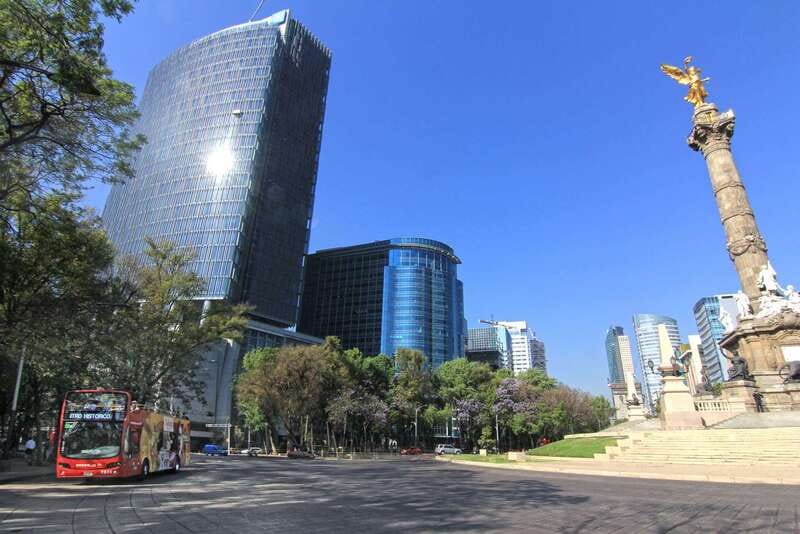
For one day, I would keep the plan simple:
- Start with the Historic Downtown route in the morning.
- Get off at the Zócalo or a museum stop for a walking break.
- Use the afternoon for Polanco or the Basilica route, depending on your interests.
- Treat the South route as optional unless Coyoacán is your main priority.
For two days, divide the city by area. Use one day for Historic Downtown and the Basilica, then reserve the second for Polanco and the South route. This gives you more time to get off, visit museums, eat, and wait out traffic without feeling rushed.
I would also take a complete circuit early in your visit, even if you do not get off. That first ride helps you decide where to return. You can see the relationship between Reforma, the center, Condesa, Polanco, and the museum district before spending time on foot.
The bus can also work as a transfer between areas, but you need patience. A route that is cheap and convenient in theory may be slow in practice. Traffic conditions can affect frequency and journey times, and an advertised stop may occasionally change.
Who gets the most value for $21?
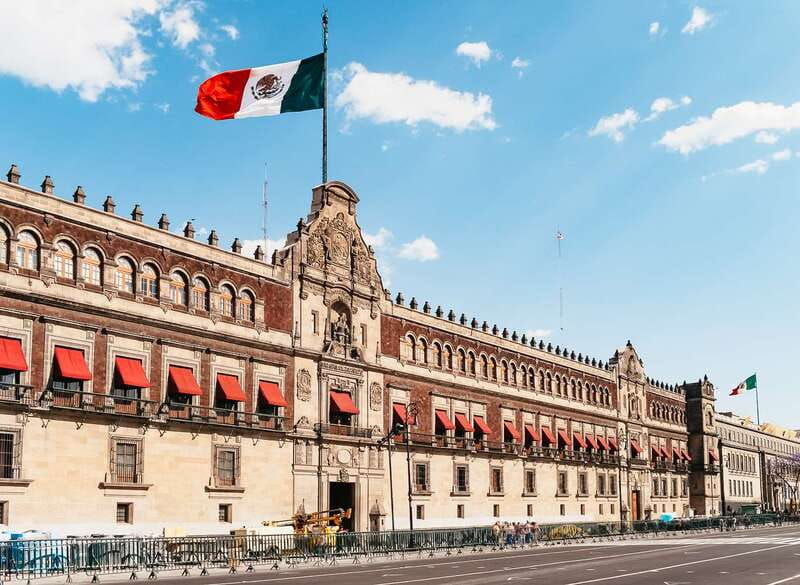
This tour suits a first-time visitor who wants a broad look at Mexico City without arranging several separate rides. It is also helpful if you prefer not to navigate unfamiliar bus connections or if you want an audio introduction while moving between districts.
Families may like the open upper deck and children’s audio channel, though the lack of restrooms and the heat deserve attention. Older visitors may appreciate the chance to cover more ground with less walking, while still choosing exactly where to get off.
The pass is less useful if you already know the city well, plan to spend most of your time inside a few museums, or dislike sitting in traffic. It is also not an efficient way to force every route into one day.
At $21, the value is strongest when you use the bus for both sightseeing and transport. One or two short rides may not justify the ticket by themselves. A full day, or better yet two days with several routes and stops, makes the price easier to defend.
The service is wheelchair accessible. Children up to age three ride free but must sit on a parent’s lap. The buses are not private tours, so the experience depends on traffic, seat availability, sound quality, and the behavior of other passengers.
Should you book the Mexico City Turibus?

I would book it if you have one or two days in Mexico City and want a low-cost introduction to several far-flung districts. Choose the two-day pass if you want Coyoacán, Polanco, the Basilica, and central Mexico City without racing between them.
I would choose the one-day pass for a focused overview, especially the Historic Downtown route. Bring earphones, protect yourself from the sun, and leave generous time between stops. If you accept that this is a city orientation ride, not a precision transport service, the Turibus can be one of the easiest ways to get your bearings and decide where to spend the rest of your visit.
FAQ
How long is the Mexico City Turibus ticket valid?
You can choose a ticket valid for one day or two days. Check availability for the operating date and starting times.
Can I board at any stop?
Yes. You can begin at any listed stop by showing your printed or electronic voucher when boarding.
Can I use all four routes with one ticket?
Yes. The ticket gives you access to all four routes and stops with a single bracelet.
How often do the buses run?
The Historic Downtown route runs approximately every 30 minutes. The South route operates less frequently, while the Polanco and Basilica routes have listed departure times rather than constant service.
What languages are available for the audio guide?
The audio guide is available in Spanish, English, German, French, Italian, Chinese, Japanese, Portuguese, and Russian. A special audio channel is available for children.
Are the buses wheelchair accessible?
Yes, the activity is wheelchair accessible.
Are food, drinks, or restrooms included?
No. Lunch and beverages are not included, and the buses do not have restrooms.
Recently added around the world
- Vine Hopper: Hop-On Hop-Off Wine Tour – Northern Route★ 4.5 · 62 reviews
- Vine Hopper: Hop-On Hop-Off Wine Tour – Southern Route★ 4.5 · 64 reviews
- Xi’an 1-Day Coach Tour of Terracotta Army★ 4.5 · 47 reviews
- Xi’an: Terracotta Army Mini-Bus Tour with Options★ 5.0 · 240 reviews
- Stellenbosch Wine Tractor hop-on-hop off wine tasting tour★ 5.0 · 72 reviews
- Warsaw City Sightseeing in a Retro Bus★ 5.0 · 196 reviews
- Valletta: Sunday Vintage Bus to Marsaxlokk★ 4.1 · 117 reviews
- From Stellenbosch: Hop-On Hop-Off Wine Tour Southern Route★ 4.7 · 105 reviews
Hop-On Hop-Off Bus Tours, compared.


City Sightseeing Hop-on Hop-off Bus with Audioguide
Read our review →
Tootbus Hop-on Hop-off (Optional River Cruise)
Read our review →Big Bus Hop-On Hop-Off Tour with Optional Cruise
Read our review →
London Big Bus Hop-On Hop-Off Tour with Optional River Cruise
Read our review →
Big Bus Hop-on, Hop-off Open-Top Sightseeing Tour
Read our review →
Browse the lists this tour appears in