Review · HOP-ON HOP-OFF BUS TOURS
Buenos Aires Hop-On Hop-Off Bus, Free Walking Tours & Discounts
Buenos Aires is spread across a huge area, and this bus gives you a useful first look without forcing you to master the city’s buses and subway on day one. I especially like the long route, which links San Telmo, La Boca, Puerto Madero, Recoleta, and Palermo in one circuit. I also like being able to ride the full loop before choosing where to get off.
The main drawback is finding the stops. Several are not well marked, and route or stop changes may not be clearly announced. The audio can also fall out of sync with the sights, so I would treat this as a city orientation with transport, not as a polished guided tour.
Key points to know before you board
- The full circuit takes about three hours: Traffic can make the ride longer, so leave room in your day.
- You get 1-, 2-, or 3-day options: The pass begins when you activate it, and a 24-hour period may run across two calendar days.
- The route covers major districts: You can reach La Boca, Recoleta, Puerto Madero, Palermo, Barrio Chino, and Monumental.
- Stop-finding is the weak link: Some locations have signs, but others can be difficult to identify from the street.
- Walking tours are optional: They use voluntary payment for the guide, require reconfirmation on the bus, and may be offered in Spanish.
- The $39 price can be fair for a first day: It works best if you use the bus for several districts, not just one short ride.
A useful first circuit around a very large city
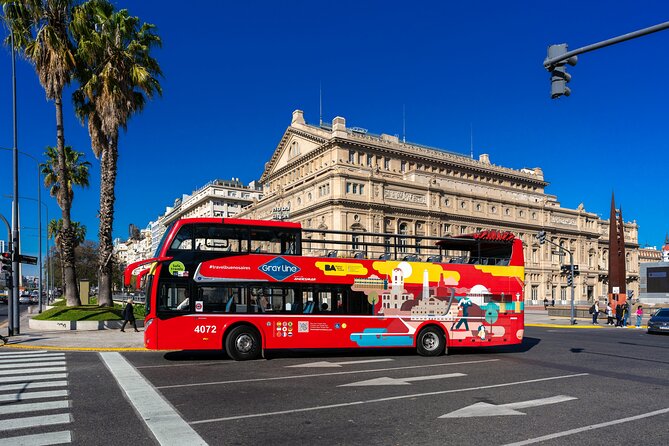
This Gray Line Argentina service is built for orientation. You board an open-top double-decker bus, plug in the provided earphones, and watch Buenos Aires roll past from a high seat. The buses have air conditioning and a sunroof, though the upper deck can still feel hot or exposed depending on the weather.
The route is long enough to show you how far apart the city’s main areas are. You pass grand civic buildings, old working-class districts, museums, parks, football grounds, waterfront promenades, and wealthy northern neighborhoods. That range is the real reason to book it.
I would begin with one complete circuit if you have the time. A full ride takes roughly three hours, and traffic may stretch that. From the upper deck, you get a better sense of Buenos Aires than you do by jumping straight between isolated sights. Afterward, you can decide whether La Boca, Recoleta, San Telmo, or the northern parks deserve a closer visit.
The recorded audio is available in several languages, but it is not always reliable. It may be hard to hear, stop numbers can be announced incorrectly, and the commentary may not match the street outside. On some buses, the earphones work better for music than for clear sightseeing information. Bring your own earphones only if the bus connection permits it, since the supplied information does not confirm compatibility with personal headphones.
More Hop-On Hop-Off Bus Tours in the world:
- Barcelona: 24 or 48-Hour Hop-On Hop-Off Bus Tour
★ 4.4 · 20,872 reviews - Rome: City Sightseeing Hop-on Hop-off Bus with Audioguide
★ 4.0 · 16,045 reviews - Paris: Tootbus Hop-on Hop-off (Optional River Cruise)
★ 4.3 · 15,279 reviews
From Diagonal Norte to San Telmo
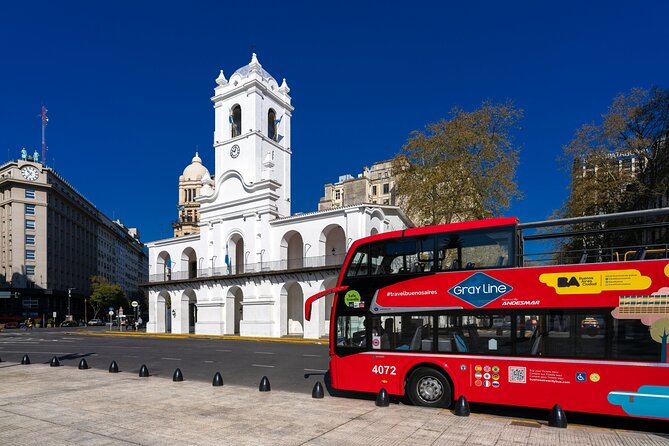
The central part of the route begins at Diagonal Norte, at Avenida Presidente Roque Sáenz Peña 728. This is a practical starting area for seeing the center, though you should confirm the exact roadside position before waiting. The first stop is Congreso at Avenida Rivadavia 1545, near the domed National Congress building and the broad civic axis that leads through central Buenos Aires.
Stop 2, Paseo de la Historieta, at Avenida Independencia 311, offers a lighter look at Argentine popular culture. It is connected with comic characters and street art, including the famous Mafalda figure found around San Telmo. This is a good point for families and anyone who wants a break from formal monuments.
Stop 3 is San Telmo and Plaza Dorrego, at Avenida San Juan 350. This is one of the best places to leave the bus and walk. San Telmo has old streets, antique shops, cafés, and a strong connection to tango culture. Plaza Dorrego is the natural focus, but the nearby lanes are part of the experience. Allow extra time here if you want atmosphere rather than a quick photograph.
The bus route is helpful for reaching San Telmo, but do not expect the stop to place you directly beside every attraction. Some stops are farther from the sights than first-time visitors expect. Use the printed map, watch the street names, and ask the bus staff to confirm your return point.
La Boca, Usina del Arte, and football country
Stop 4 at Usina del Arte, on Agustín R. Caffarena 51, takes you into the southern part of the city. The former power station now serves as a cultural venue, and its industrial design makes it different from the older civic buildings downtown. The exact usefulness of this stop depends on the day’s program, since the bus ticket does not include food or museum admission.
The next stop is Bombonera at Brandsen 805, home of Boca Juniors. Football is central to Buenos Aires culture, and this stop gives you a direct connection to one of Argentina’s best-known clubs. If you are interested in football, this is one of the most worthwhile places to hop off. If not, you may prefer to continue quickly toward Caminito.
Stop 6, La Boca and Caminito, is at Avenida Don Pedro de Mendoza 2163. Caminito is famous for its brightly painted buildings, tango performances, and tourist shops. It is also a working neighborhood with a complicated reputation, so keep your visit focused on the marked visitor area and follow normal city precautions.
The optional walking tours can add value here, especially if one is operating in a language you understand. These tours are not included as a fully paid private guide service. They use voluntary payment for the guide, operate according to weather and local conditions, and must be reconfirmed with the guide on the bus. If you do not take the walk, there is no refund for that part.
Waterfront stops from Costanera Sur to Puerto Madero
After La Boca, the route moves toward Costanera Sur. The stop differs by day. Monday through Friday, it is at Avenida Dr. Tristán Achával Rodríguez 337. On Saturday and Sunday, it is at Julieta Lanteri 1700.
This matters because the route map and stop numbering can become confusing. The same general area is labeled as Stop 7, but the location changes with the day. Check the current information before getting off, especially if you plan to return to the bus later.
Costanera Sur gives you open space beside the water and a change from the dense central streets. It can be a pleasant place for a walk, but weather matters. There is little shelter during a hot afternoon or sudden rain, and waiting times can feel long if the next bus is delayed.
Puerto Madero comes next at Avenida Alicia Moreau de Justo 930. This former port district is known for renovated warehouses, modern apartments, restaurants, and the Puente de la Mujer bridge. It is one of the easiest areas to explore independently after leaving the bus because the waterfront paths are clear and the district is compact.
At Estación Fluvial, on Cecilia Grierson 320, you are near the river terminal and the northern end of Puerto Madero. This is more useful as a transport link than as a major sightseeing stop. If your goal is to see the city rather than board another service, Puerto Madero itself is usually the more rewarding place to get off.
More routes around the world:
- Mt Fuji and Hakone 1-Day Bus Tour Return by Bullet Train
★ 5.0 · 26,383 reviews - London: Warner Bros. Studio Harry Potter Tour & Branded Bus
★ 4.7 · 19,194 reviews - Amsterdam: Zaanse Schans, Edam, Volendam & Marken Bus Tour
★ 4.6 · 15,034 reviews - 1-Day Tokyo Bus Tour
★ 5.0 · 14,250 reviews
Recoleta, Teatro Colón, and the central sights
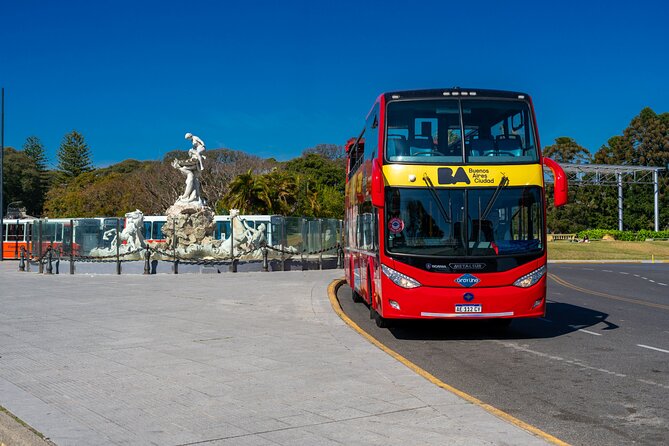
The route then turns back toward the center. Galerías Pacífico, at Avenida Córdoba 787, is a grand shopping center with ornate interior decoration. It gives you a quick look at the city’s elegant commercial side and is a practical stop if you need shade, a restroom, or a meal, although food is not included in the ticket.
El Ateneo at Avenida Callao 927 is one of the route’s most distinctive stops. The former theater was converted into a bookshop, with bookshelves and reading areas arranged inside the old auditorium. You may need to walk from the stop, and the bus does not provide a reserved visit, but this is a fine independent stop for book lovers.
Plaza San Martín, at Avenida Santa Fe 808, brings you into a central park surrounded by historic buildings and busy avenues. It is a useful place to connect the bus ride with a walk through the central districts.
Floralis Genérica, at Avenida Presidente Figueroa Alcorta 2800, is one of Buenos Aires’ recognizable modern sculptures. The enormous metal flower is set in a broad public space and makes a good photo stop. Nearby, MALBA at Avenida Presidente Figueroa Alcorta 3465 is the stronger choice for modern Latin American art, though admission and visiting time are separate from the bus ticket.
Recoleta is near the northern end of the route, at Avenida del Libertador 1480. This is one of the city’s essential areas, with the famous cemetery, cafés, museums, and formal architecture. The bus is a useful way to reach it, but you should allow at least a few hours if you want to explore properly. A quick hop off and back on will give you only a taste.
Teatro Colón is the final listed stop, at Cerrito 892. The theater is one of Buenos Aires’ major cultural buildings. The bus can put you close to it, but a tour or performance is not included. If you are planning a timed theater visit, allow plenty of slack because traffic can make the bus schedule hard to predict.
Palermo, Planetario, and the northern loop
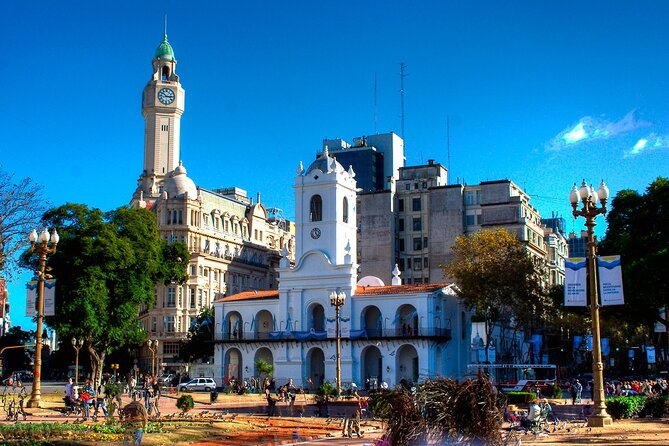
The northern part of the route is where the bus earns its keep for first-time visitors. Planetario, at Avenida Sarmiento 3866, sits in the Palermo park area and is surrounded by broad green spaces. Club de Pescadores, on Costanera Rafael Obligado 2610, continues the waterfront ride and gives you a different view of the city from the river edge.
Aeroparque, at Avenida Costanera Rafael Obligado 1055, is included as a route stop, though it is not a primary sightseeing destination for most people. Parque de la Memoria, at Avenida Costanera Rafael Obligado 6745, offers a quieter and more reflective visit. Its memorial setting makes it a place where you should slow down rather than treat the stop as a quick photo break.
Monumental, at Avenida Presidente Figueroa Alcorta 7576, takes you to the major football stadium associated with River Plate. Like Bombonera, it is most useful to football fans. Barrio Chino, at the intersection of Avenida Virrey Vértiz and Echeverría, gives you restaurants, shops, and a more local neighborhood feel than the central tourist districts.
Campo Argentino de Polo at Avenida del Libertador 4000 and Monumento a los Españoles at Avenida del Libertador 3250 round out the Palermo section. The large avenues and open parkland are pleasant to see from the upper deck, but some attractions are spread far from the bus stops. Check the walking distance before hopping off.
Museo Nacional de Arte Decorativo at Avenida del Libertador 1920 provides another museum option, while Recoleta brings you back toward the center. The circuit ends at Teatro Colón, completing a route that covers far more ground than most visitors could comfortably walk in a day.
Price, pass length, and what you really get
At $39 per person, this is not the cheapest way to move around Buenos Aires. The city has public transport, and many central sights can be reached on foot. The bus makes financial sense when you want to cover several far-flung districts in one or two days and value not having to plan every connection.
The 1-, 2-, and 3-day choices let you match the pass to your schedule. A short visit may justify one full circuit plus one or two stops. A longer pass gives you time to return to Recoleta, La Boca, or the northern parks without trying to see everything in one tiring day.
The pass activates when you first use it. A 24-hour period can therefore stretch across two calendar days if you begin later in the day. Confirm the exact validity printed on your booking, especially if you are choosing the shortest option.
The discount voucher book can improve the value if you use participating locations, but do not book solely for discounts you may never claim. The strongest included extras are the optional walking tours and the ability to cover the city’s long distances from one seat.
Stop signs, route changes, and timing problems
The biggest practical issue is not the route itself. It is knowing where to wait. Some stops are clearly marked, while others have no obvious sign. Exact addresses can be difficult to translate into a visible roadside location, and a printed map may not match the numbering announced on board.
I would arrive early, stand on the correct side of the road, and ask a nearby shop or bus staff member to confirm the location if possible. Do not rely only on the stop number. Look for the attraction name, street intersection, and direction of travel.
Route changes have caused confusion, including canceled navigation at one stop and stops being moved without much warning. The recorded announcement can also be one number ahead or behind the map. If a particular stop matters to you, ask before leaving the bus.
Traffic is another factor. A full loop is advertised at about three hours, but congestion can make it longer. One ride was described as taking roughly three and a half hours, and long waits of 40 minutes have occurred. Carry water, use sun protection, and choose the covered, air-conditioned section when the weather turns hot.
Weather can also disrupt the day. Thunderstorms may make the open upper deck unpleasant, and walking tours can be canceled because of weather or operating conditions. There is no refund for a walking tour you skip.
Who should book this Buenos Aires bus?
I would recommend it most strongly to first-time visitors with limited time, families who want an easy overview, and anyone who finds Buenos Aires public transport daunting at first. It is also useful if you want to compare neighborhoods before choosing where to spend your evenings.
It is less suitable if you need exact timing, clear live narration, or guaranteed access to every listed stop. Independent walkers who are comfortable with the subway and city buses may get better value by combining public transport with focused walks.
The service is generally accessible to most people, and service animals are allowed. Hotel pickup and drop-off are not included, so you must reach the route yourself. Food and drinks are also your responsibility.
Free cancellation is available if you cancel at least 24 hours before the scheduled start. Changes inside that period are not accepted, and a ticket-duration change requires canceling the current booking and making a new one so that the QR code updates correctly.
Should you book it?
Book this bus if you want a broad first look at Buenos Aires and plan to use it as a flexible transport pass. Ride the full loop, then choose two or three areas for real exploration. La Boca, San Telmo, Recoleta, Puerto Madero, and the Palermo parks are the best reasons to use it.
Skip it if your day depends on precise stop locations or polished commentary. In that case, walking and public transport may serve you better. At $39, the value comes from the distance covered and the time saved, not from the audio guide alone.
FAQ
How long does the full bus route take?
The full circuit takes about three hours, though traffic can make the ride longer. Some rides may take around three and a half hours.
What ticket lengths are available?
You can choose a 1-day, 2-day, or 3-day pass.
Where does the route start?
The listed starting point is Stop 0, Diagonal Norte, at Avenida Presidente Roque Sáenz Peña 728.
Does the ticket include walking tours?
Yes, access to exclusive walking tours is included. The walks are optional and use a voluntary payment system for the guide.
Are the walking tours guaranteed to operate?
No. They depend on weather and operating conditions. You should confirm the schedule with the guide on board the bus, and you must arrive at the correct stop.
Is hotel pickup included?
No. You must reach the bus route independently. Hotel pickup and drop-off are not included.
Are food and drinks included?
No. Food and beverages are not included in the ticket price.
Are audio guides available in several languages?
Yes. The buses provide a multilingual audio guide, although the audio may sometimes be unclear, out of sync, or matched to the wrong stop number.
Can I cancel for a refund?
Yes, if you cancel at least 24 hours before the experience start time. Cancellations made less than 24 hours in advance are not refunded.
Recently added around the world
- Vine Hopper: Hop-On Hop-Off Wine Tour – Northern Route★ 4.5 · 62 reviews
- Vine Hopper: Hop-On Hop-Off Wine Tour – Southern Route★ 4.5 · 64 reviews
- Xi’an 1-Day Coach Tour of Terracotta Army★ 4.5 · 47 reviews
- Xi’an: Terracotta Army Mini-Bus Tour with Options★ 5.0 · 240 reviews
- From Stellenbosch: Hop-On Hop-Off Wine Tour Southern Route★ 4.7 · 105 reviews
- Malta: Vintage Bus Ride through the Three Cities★ 4.1 · 112 reviews
- Adelaide Hills & Hahndorf Hop-On Hop-Off Wine Tour★ 5.0 · 136 reviews
- Barossa Valley Hop-On Hop-Off Wine Tour★ 5.0 · 418 reviews
Hop-On Hop-Off Bus Tours, compared.
City Sightseeing Hop-on Hop-off Bus with Audioguide
Read our review →
Tootbus Hop-on Hop-off (Optional River Cruise)
Read our review →Big Bus Hop-On Hop-Off Tour with Optional Cruise
Read our review →
London Big Bus Hop-On Hop-Off Tour with Optional River Cruise
Read our review →
Big Bus Hop-on, Hop-off Open-Top Sightseeing Tour
Read our review →