
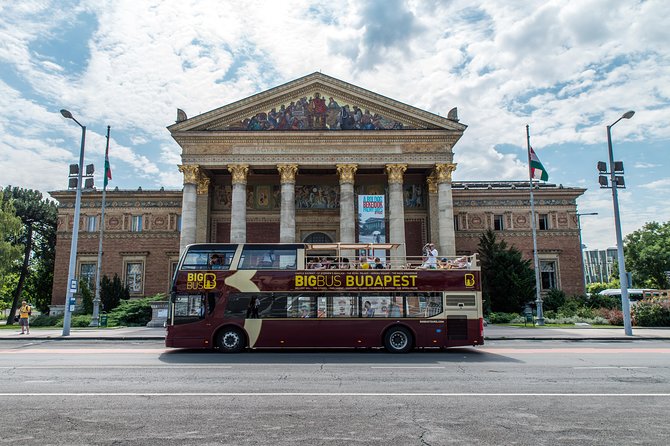
Review · HOP-ON HOP-OFF BUS TOURS
Big Bus Budapest Hop-On Hop-Off Bus and Walking Tour
Budapest is spread across two very different sides of the Danube, and this bus gives you a useful first look at both. You can ride past Parliament, Heroes’ Square, the Chain Bridge, Castle Hill, and Gellért Bath, then hop off when something catches your eye. I like the wide sightseeing route and the choice of a one, two, or three-day pass, especially if you are new to the city.
The included walking tour adds a little structure to an otherwise self-guided outing. The 16-language audio system is also helpful, though sound quality and timing can vary from bus to bus. One important catch: the advertised Danube cruise benefits are not entirely clear, so check the exact booking terms before you pay.
Key points to know before you board
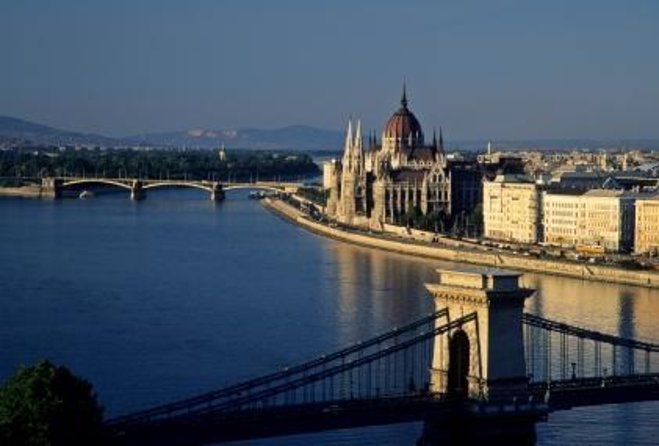
- One loop covers a lot of ground: The route links Pest, Buda, Castle Hill, the Danube waterfront, Andrássy Avenue, and the major railway stations.
- The bus is best for orientation: Use the first ride to mark places you want to revisit on foot.
- The audio system is inconsistent: It can be clear and well timed, but it may also cut out or overlap with stop announcements.
- A 30% cruise discount is listed: Do not assume the river cruise is free, as current package details may have changed.
- The top deck depends on weather: Rain, cold, wet seats, plastic windows, and low roof rails can affect the ride.
- Plan around traffic: A blocked street, tram, bus change, or long wait can disrupt a tight sightseeing schedule.
What the Budapest bus tour is really good for
At $42.13 per person, this is not the cheapest way to move around Budapest. The city has an extensive public transport network, and public buses, trams, and metro lines can be a better deal if you already know where you are going.
The value here is different. You pay for a moving introduction to Budapest, with major sights presented in one broad circuit. You do not need to study the tram map, work out which side of the river you are on, or search for every landmark. Sit upstairs when conditions are good, listen in your chosen language, and let the city come to you.
I would use this on the first day of a Budapest visit, not as my only transport for a longer stay. The route helps you understand the city’s shape. Pest is flatter and more urban, while Buda rises toward Castle Hill and the old royal district. After one full circuit, you can decide which areas deserve your time.
The pass lasts for consecutive days, so a two or three-day ticket gives you more chances to hop off. Still, do not assume a longer pass is automatically better value. One detailed account found that buses traveled in one direction and that a full round trip could take about two hours. If you spend most of your time waiting or riding past places you have already seen, public transport may serve you better.
More Hop-On Hop-Off Bus Tours in the world:
- Barcelona: 24 or 48-Hour Hop-On Hop-Off Bus Tour
★ 4.4 · 20,872 reviews - Rome: City Sightseeing Hop-on Hop-off Bus with Audioguide
★ 4.0 · 16,045 reviews - Paris: Tootbus Hop-on Hop-off (Optional River Cruise)
★ 4.3 · 15,279 reviews
Starting at St. Stephen’s Basilica and the central Pest stops
The main redemption point is at Bajcsy-Zsilinszky út 17, near the center of Pest. Other central stops include Március 15. tér, József Attila Street, St. Stephen’s Basilica, and nearby Anker köz.
St. Stephen’s Basilica is a smart place to begin exploring on foot. It is one of central Pest’s key landmarks, and from here you are close to cafés, streets leading toward the Danube, and the Opera area. The stop is also useful if your hotel is in the inner city.
The route then passes the Chain Bridge. This is one of Budapest’s essential views, especially when you look from the Pest side toward the Buda hills. The bus gives you a quick crossing, but the bridge deserves a separate walk if you have time. You will get far more from it at street level than through a bus window.
The József Attila Street stop is convenient for the basilica, the riverfront, and nearby central streets. The bus can save your legs here, but the distances are not great. I would hop off only if you have a particular sight in mind, then continue on foot.
Dohány Street, the Opera, and Andrássy Avenue
The next section brings you to Dohány Street Synagogue, Anker Lane, Andrássy Avenue, the Hungarian State Opera, and Liszt Ferenc Square.
Dohány Street Synagogue is one of the most important Jewish sites in Budapest. The stop puts you near the old Jewish Quarter, where you can continue walking through streets filled with restaurants, bars, and historic buildings. The bus gives you the location, but it does not replace a visit inside the synagogue complex.
Andrássy Avenue is one of the city’s grandest roads. It leads from central Pest toward Heroes’ Square, with the Opera and Liszt Ferenc Square along the way. Liszt Ferenc Square is a handy place to get off for food and a break. It is also a good point from which to walk along the avenue rather than watch it pass through a window.
The audio commentary is supposed to explain the sights as you go. In the best cases, it gives useful background on architecture and Budapest’s past. In weaker moments, the narration starts late, stops in the middle of a sentence, or does not match the building outside. Staff announcements can also overlap with the recorded track.
My practical advice is simple: do not rely on the audio for every detail. Use it as a bonus, and keep your eyes open. If the sound is poor on one bus, try another vehicle when you can.
Heroes’ Square and the eastern part of the route
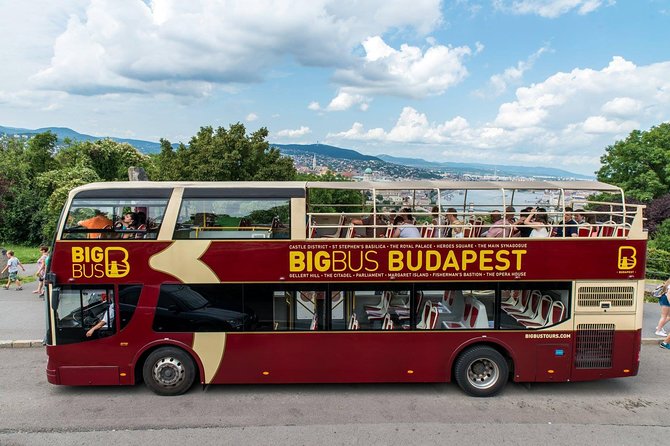
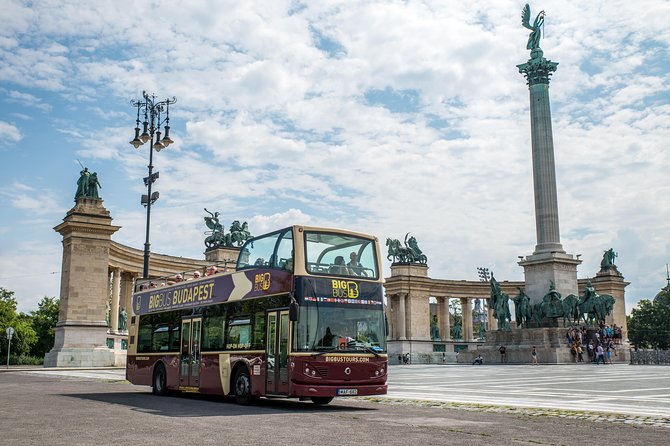
Heroes’ Square is one of the strongest stops on the circuit. Its monumental sculptures and broad open space make it easy to understand why this is a major Budapest landmark. It also gives you access to City Park, though the bus stop itself is only the beginning of that visit.
Nearby attractions include the famous ice-skating area in winter. The sight can be especially appealing during the Christmas season, when the park takes on a festive feel. The bus is useful here because the eastern end of the route is a fair distance from the central riverfront.
The circuit continues toward Keleti Railway Station, Puskás Ferenc Stadium, and New York Café. Keleti is a practical transport point, though it is not the prettiest stop on the route. Puskás Aréna will interest football fans and those curious about modern Budapest.
New York Café is one of the city’s best-known grand cafés. The bus stop makes it easy to locate, but expect this area to be popular. If you want to visit the café, plan your time separately rather than treating the stop as a quick photo break.
More routes around the world:
- Mt Fuji and Hakone 1-Day Bus Tour Return by Bullet Train
★ 5.0 · 26,383 reviews - London: Warner Bros. Studio Harry Potter Tour & Branded Bus
★ 4.7 · 19,194 reviews - Amsterdam: Zaanse Schans, Edam, Volendam & Marken Bus Tour
★ 4.6 · 15,034 reviews - 1-Day Tokyo Bus Tour
★ 5.0 · 14,250 reviews
Váci Street, Gellért Bath, and the Danube side
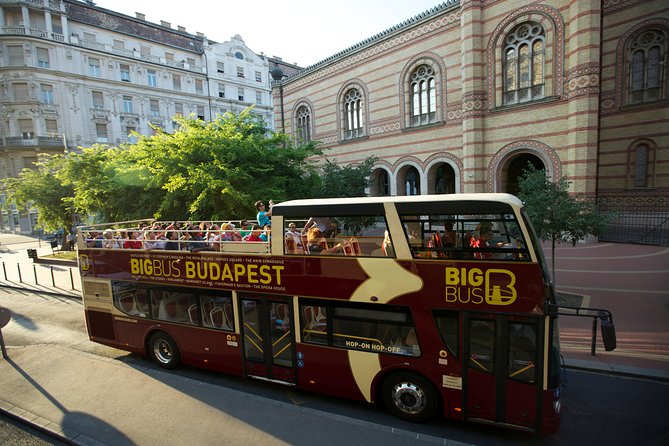
The route returns toward central Pest through Váci Street, a well-known shopping and pedestrian area. This stop is useful for walking toward the river, although the street itself can feel more commercial than local. It is a good place to combine bus sightseeing with a meal or a stroll.
Crossing toward the Buda side, the route reaches Gellért Thermal Bath. Budapest is famous for its thermal bathing tradition, and Gellért is one of the city’s best-known bathhouses. The bus makes it easier to connect the bath with sights on the Pest side, but you will need to allow separate time for bathing.
This is one of the points where the tour is more useful as a sightseeing link than as a door-to-door service. Traffic can slow the route, and the bus does not always arrive exactly when you expect. Use the operator’s live tracking feature if available, and keep a little flexibility in your schedule.
Castle Garden, the Funicular, and Buda views
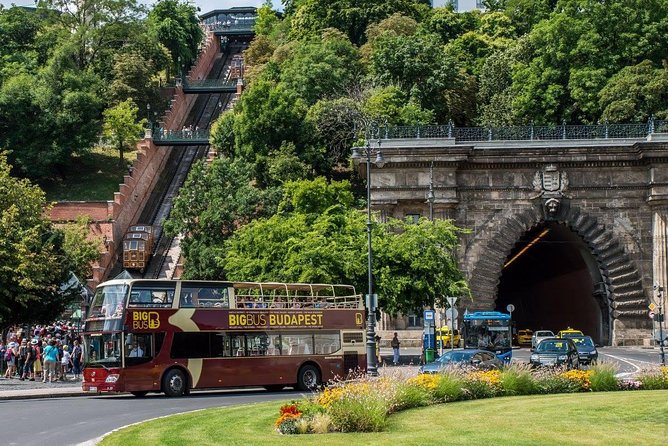
The Buda section includes Castle Garden Bazaar, the Budapest Castle Hill Funicular, Batthyány Square, and Margaret Bridge.
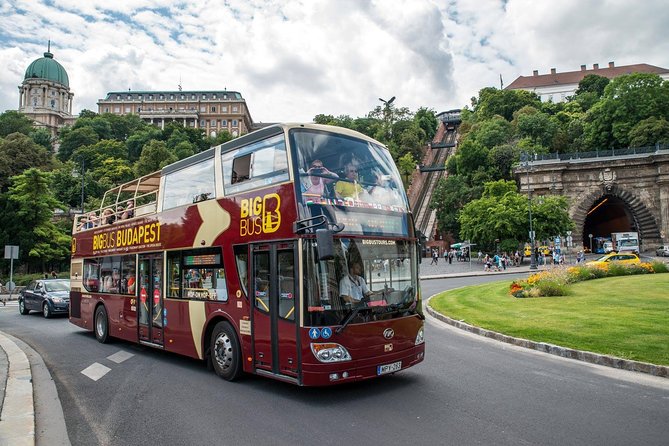
Castle Garden Bazaar sits at the foot of Castle Hill and is a natural place to get off. From here, you can look toward the palace district and decide how much uphill walking you want to do. The Funicular stop offers another route toward Castle Hill, although the tour ticket does not state that a funicular ride is included.
Castle Hill is one of Budapest’s essential areas. The bus gives you a practical way to reach its lower edge, but do not expect the vehicle to deliver you to every courtyard, church, and lookout. You need to explore this district on foot.
Batthyány Square offers one of the finest Parliament views across the Danube. This is a stop worth remembering even if you stay on the bus during the first circuit. Get off here for a photograph, then take in the contrast between the broad river, the Buda hills, and the ornate Parliament building opposite.
Margaret Bridge links the route with Margaret Island and the northern central districts. The itinerary also includes Nyugati Railway Station, another useful central stop. These points are less about major sightseeing than about giving you access to different parts of the city.
Parliament, Fővám Square, and the second route section
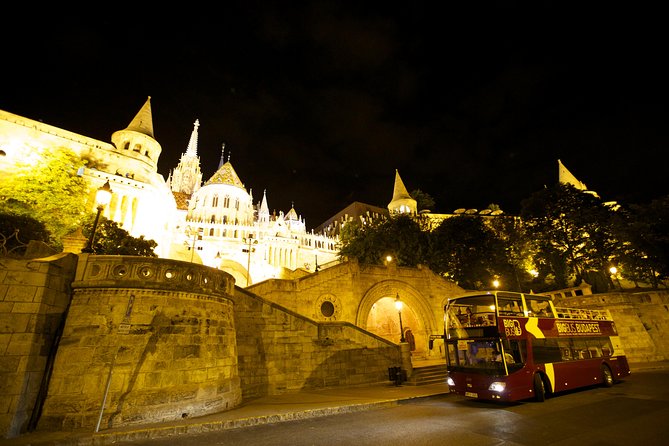
The Parliament stop is one of the most popular on the circuit. From the riverfront, you can appreciate the building’s scale and its position beside the Danube. The bus offers a quick view, but Parliament is best understood from several angles, including across the river at Batthyány Square.
After returning near St. Stephen’s Basilica, the route includes Petőfi Square, Fővám Square, Kálvin Square, Astoria, Bajcsy-Zsilinszky Road, and Nyugati Railway Station. Fővám Square is handy for the Great Market Hall area, while Kálvin Square connects with several central neighborhoods.
Astoria places you close to the historic center and the Jewish Quarter. It can be a useful interchange point for walking, but the bus route is not a substitute for Budapest’s regular transport if you need to reach a specific address quickly.
The long list of stops is a strength, but it can also make the experience feel less like a private sightseeing tour and more like a shared city service. On crowded departures, seats may be tight and the upper deck may not give every passenger a clear view.
The walking tour and Danube cruise question
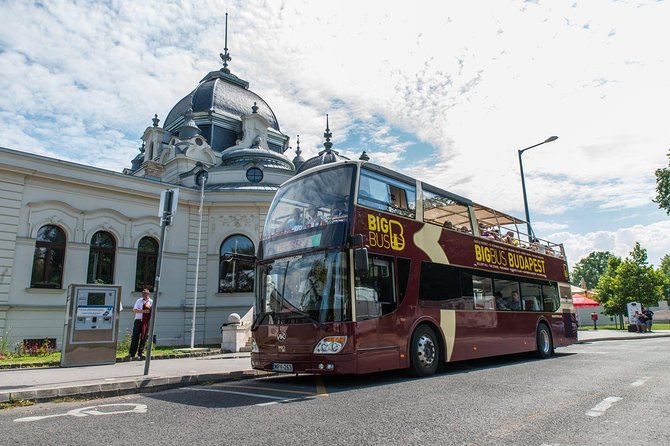
A one-hour guided walking tour is included. The supplied information does not name the guide or give a fixed walking route, so treat it as an added orientation rather than a specialist private tour. It can be a useful change of pace after sitting on the bus.
The Danube offer needs careful attention. The package information lists a 30% discount on a river cruise, while older descriptions and some bookings have referred to a one-hour cruise as included. Current terms may provide the discount only, not a free boat ride.
That distinction matters. A cruise can be one of the most enjoyable ways to see Parliament, the bridges, and both riverbanks, but you should budget for it if your booking confirms only a discount. Some boat trips may also have no audio commentary. In cold or damp weather, misted windows can spoil the view.
Comfort, weather, and service details
The buses vary. Some have comfortable seating and clear commentary. Others may feel cramped, cold, or poorly ventilated. Open sides can make a winter ride uncomfortable, while rain can leave upper-deck seats wet.
The top deck also has low roof rails on some vehicles. Watch your head when moving upstairs. This is a small detail, but it can make a real difference, especially when the bus is crowded.
Service interruptions are possible. A driver’s shift may require a bus change, a private event may alter the route, or traffic may leave you waiting 20 to 45 minutes. One account described being asked to change buses because of a blockage, while another reported a bus ending service earlier than expected.
For a relaxed day, this is manageable. For a timed Parliament entry, train connection, or restaurant reservation, it is a risk. Keep your schedule open and use the app’s stop finder and live tracking tools. Bus stops can be hard to identify, and instructions about exchanging a QR code for a paper ticket have not always been consistent. Ask staff on the bus if you are unsure.
The provider offers free cancellation up to 24 hours before the start time. Changes or cancellations inside that window are not accepted for a refund.
Who should buy the $42.13 ticket?
I would recommend this tour to a first-time visitor who wants a broad city view without planning every tram and metro connection. It also suits anyone who walks with difficulty, anyone visiting for a short stay, or anyone who wants to mark several neighborhoods before choosing where to spend more time.
The one-day pass makes the most sense if you plan to ride the full loop, stop at two or three places, and take the walking tour. A two or three-day pass can pay off if buses run reliably during your visit and you intend to use the route repeatedly.
I would hesitate if your main goal is fast transport. Budapest public transport can be more direct, and the bus may run in one direction with a long circuit. I would also hesitate if perfect audio, punctual departures, and a guaranteed open-top ride are important to you.
Should you book Big Bus Budapest?
Book it for the big picture, not for flawless transport. The route reaches the sights you most want to see, the pass offers flexibility, and the first ride can save you from spending your opening day guessing how Budapest fits together.
Before booking, confirm three points: the current Danube cruise terms, the ticket redemption method, and the operating schedule for your dates. If those details suit your plans, the tour can be a useful first-day tool. If you already know Budapest well, buy public transport tickets and explore on foot instead.
FAQ
How long does the bus tour take?
The listed experience duration is approximately 1 hour and 40 minutes. A full circuit may take about two hours, depending on traffic and the direction of travel.
How many stops are included?
The route lists 27 stops, covering central Pest, Heroes’ Square, Keleti Railway Station, Gellért Bath, Castle Hill, Parliament, Margaret Bridge, and other major areas.
Can I hop on and off more than once?
Yes. The ticket provides unlimited hop-on hop-off access for one, two, or three consecutive days.
What languages are available for the audio commentary?
Audio commentary is available in 16 languages. The experience itself is offered in English.
Is a walking tour included?
Yes. A one-hour guided walking tour is included with the bus ticket.
Is the Danube cruise included for free?
The package details list 30% off a Danube River Cruise. Some older booking information has described a one-hour cruise as included, so check the current terms before booking.
Is hotel pickup provided?
No. Hotel pickup and drop-off are not included. You board at one of the listed city stops.
Can I cancel for a full refund?
Yes, if you cancel at least 24 hours before the experience start time. Cancellations or changes made less than 24 hours before the start time are not refunded.
Recently added around the world
- Vine Hopper: Hop-On Hop-Off Wine Tour – Northern Route★ 4.5 · 62 reviews
- Vine Hopper: Hop-On Hop-Off Wine Tour – Southern Route★ 4.5 · 64 reviews
- Xi’an 1-Day Coach Tour of Terracotta Army★ 4.5 · 47 reviews
- Xi’an: Terracotta Army Mini-Bus Tour with Options★ 5.0 · 240 reviews
- Malta: Vintage Bus Ride through the Three Cities★ 4.1 · 112 reviews
- Adelaide Hills & Hahndorf Hop-On Hop-Off Wine Tour★ 5.0 · 136 reviews
- Barossa Valley Hop-On Hop-Off Wine Tour★ 5.0 · 418 reviews
- McLaren Vale North Hop-On Hop-Off Wine Tour★ 5.0 · 251 reviews
Hop-On Hop-Off Bus Tours, compared.

City Sightseeing Hop-on Hop-off Bus with Audioguide
Read our review →
Tootbus Hop-on Hop-off (Optional River Cruise)
Read our review →Big Bus Hop-On Hop-Off Tour with Optional Cruise
Read our review →
London Big Bus Hop-On Hop-Off Tour with Optional River Cruise
Read our review →
Big Bus Hop-on, Hop-off Open-Top Sightseeing Tour
Read our review →