
Review · BERLIN BUS TOURS
Berlin: Sightseeing Tour in Classic Volkswagen T1 Samba Bus
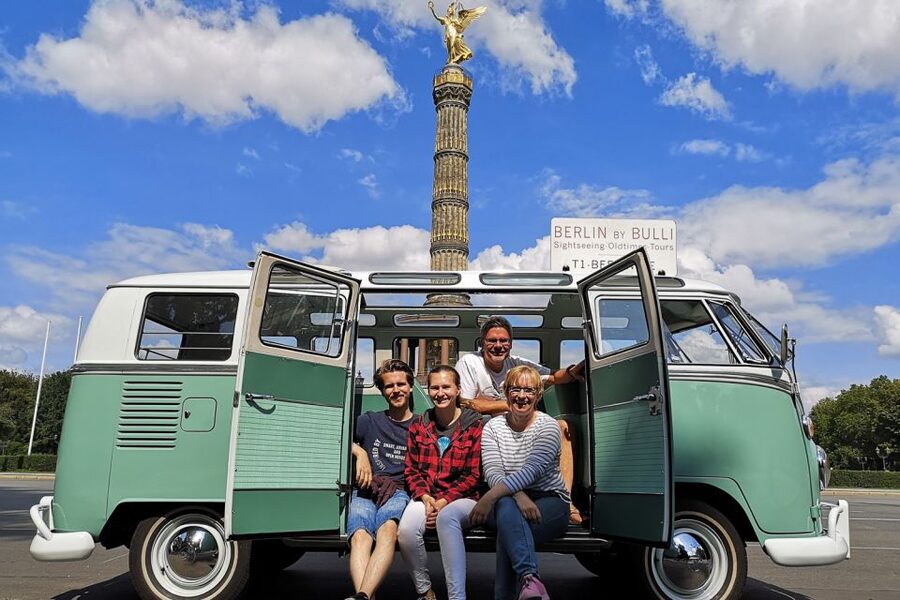
Berlin’s most unusual sightseeing vehicle is a beautifully restored 1965 Volkswagen T1 Samba bus, complete with 21 windows and enough old-school charm to make people smile as you pass. In two hours, you’ll cover nearly 50 sights, from Berlin Cathedral to the Berlin Wall, while a local guide such as Rajko or Michael explains what you’re seeing.
I like the small group of seven and the route through side streets that standard city buses often skip. I also like the photo booklet, which lets you compare present-day Berlin with older views of buildings and streets. The main drawback is simple: most sights are viewed from the bus, so this is an orientation tour, not a stop-and-explore excursion.
Key points to know before booking
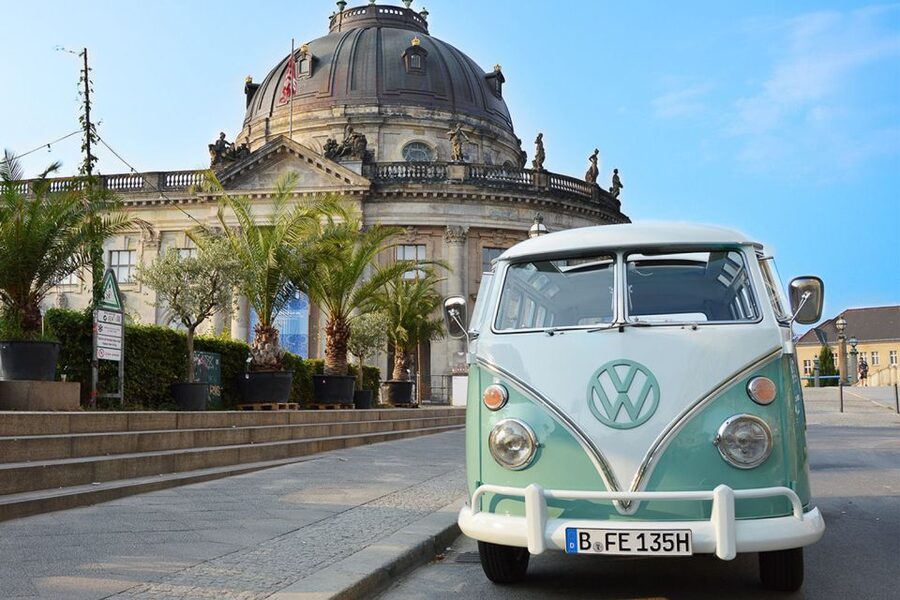
- The 1965 VW T1 Samba is part of the attraction: The immaculate vintage bus gives the tour a personal, nostalgic feel that a large sightseeing coach cannot match.
- Nearly 50 sights fit into two hours: You see Berlin Cathedral, the Brandenburg Gate, Reichstag, Kurfürstendamm, Potsdamer Platz, Checkpoint Charlie, and much more.
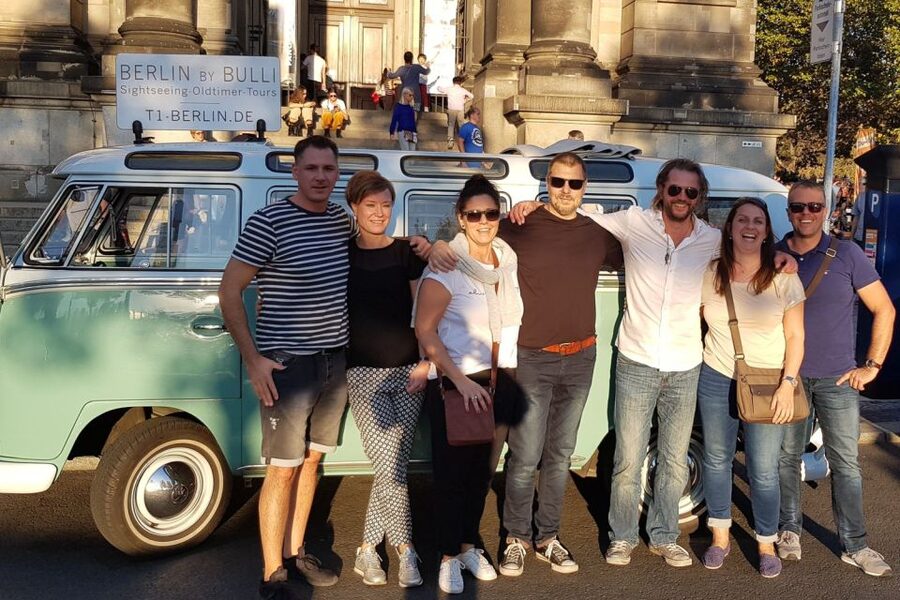
- The group is limited to seven people: This makes it easier to hear the guide and ask questions.
- The route mixes famous landmarks with side streets: You get a broad view of Berlin’s central districts, including places you might otherwise pass by.
- The photo booklet adds useful historical context: Old images help you picture vanished buildings, changed streets, and wartime Berlin.
- Book it early in your stay if you want a city overview: The route gives you a quick sense of Berlin’s layout and helps you choose where to return later.
Why the Samba bus makes the difference

The bus is not just transportation. It is the reason this tour feels different from a hop-on hop-off ride.
The T1 Samba is a classic split-window Volkswagen from 1965, carefully maintained and fitted with large windows around the passenger area. You sit close to the street, with a clear view in several directions. The vehicle is small enough to use narrower roads and relaxed enough to feel more like a private outing than a formal coach tour.
That character matters in Berlin. The city is spread out, and its major sights belong to different periods and districts. In one stretch, you may pass Prussian museums and royal buildings. Later, the route brings you past postwar landmarks, Cold War sites, modern government offices, and the remains of the Berlin Wall.
The bus also attracts attention. People on the pavement often look over and smile as it passes. That may sound minor, but it adds to the old-fashioned pleasure of the ride.
Comfort is better than you might expect from a vehicle built in the 1960s. Heating is available when needed, which is especially useful in Berlin’s cold months. A past summer ride was described as too warm inside, so open windows may matter on hot days. The bus is comfortable for the two-hour outing, but it is still a vintage vehicle, not a modern coach with adjustable climate control.
More Sightseeing Bus Tours in Berlin
- Berlin: Big Bus Hop-On Hop-Off Sightseeing Tour & Currywurst
★ 4.4 · 4,638 reviews - Berlin: City Sightseeing Hop-On Hop-Off Bus Tour
★ 4.1 · 4,233 reviews - City Sightseeing Berlin Hop-On Hop-Off Bus Tour
★ 3.0 · 981 reviews
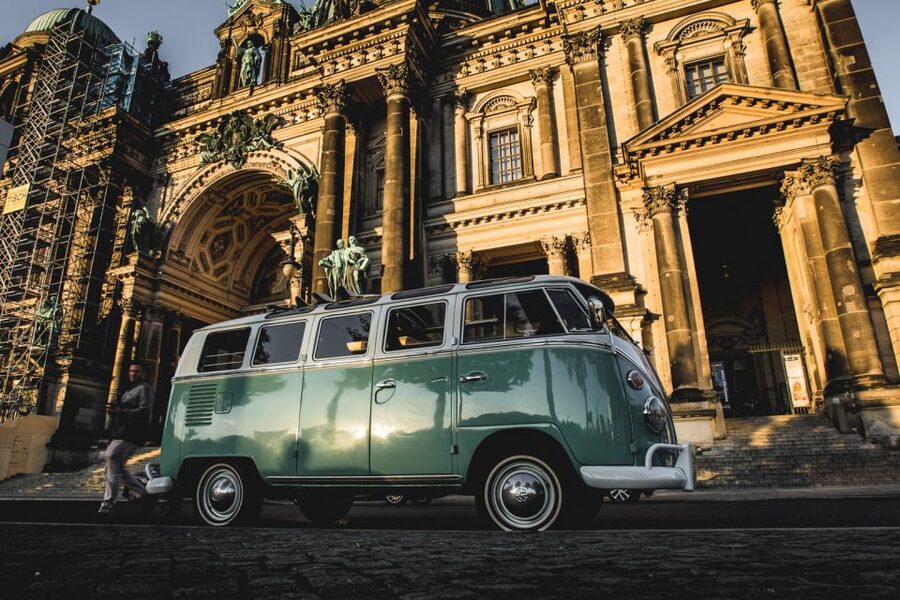
Starting at Berlin Cathedral and Museum Island
The tour begins beside Berlin Cathedral, a strong place to start because the area gives you an immediate sense of Berlin’s scale and layers.
From here, you pass through Lustgarten and Museum Island, home to the Old Museum, Alte Nationalgalerie, Neues Museum, Pergamon Museum, and Bode Museum. The museums form one of Europe’s great cultural districts, but the tour treats them as part of a larger city story rather than pausing for museum visits.
Your guide points out the German Historical Museum, Neue Wache, and the former Crown Prince’s Palace. You then continue past Humboldt University, the Berlin State Opera, Bebelplatz, and the long avenue of Unter den Linden.
This opening section is especially useful if you have just arrived in Berlin. You see how the city’s ceremonial center connects museums, universities, palaces, churches, and government buildings. The photo booklet adds another layer by showing how some of these places appeared in earlier periods.
Do not expect to get out at each museum. You are seeing the exteriors and hearing the story while the bus moves along. If a particular museum is a priority, note its location and return later on foot.
Unter den Linden to the Brandenburg Gate
Unter den Linden leads you toward Pariser Platz and the Brandenburg Gate, one of Berlin’s essential sights.
The Brandenburg Gate is easy to recognize, but its meaning changes when you hear how it sat beside the Berlin Wall during the Cold War. The gate once marked an entrance to the city, then became a symbol of division, and now serves as a central meeting point in reunified Berlin.
The route also passes the Reichstag and the government district. You see the Federal Chancellery, government offices, and Berlin Central Station. The contrast is striking: grand nineteenth-century architecture gives way to modern government buildings and the glass-and-steel station.
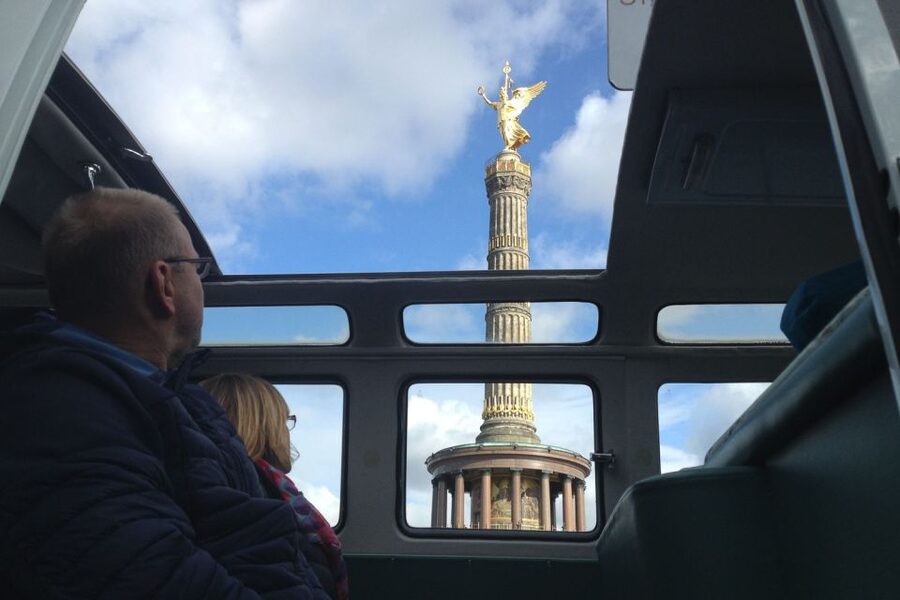
You then pass Moltke Bridge and Bellevue Palace, the official residence of Germany’s federal president. The Victory Column follows, rising in the middle of the broad Tiergarten roads. From inside the bus, you get a moving view rather than a close inspection, but the guide helps connect each building to the city’s political past.
West Berlin, the Victory Column, and Kurfürstendamm

The route turns west through the Zoologischer Garten area, passing the Berlin Zoo, Theater des Westens, Savignyplatz, and Kurfürstendamm.
This part of Berlin feels different from Museum Island and the old government quarter. Kurfürstendamm was a major center of West Berlin life during the city’s division. Today, it remains one of the city’s best-known shopping and café avenues.
You also pass Kaiser Wilhelm Memorial Church, whose damaged tower was preserved as a reminder of the Second World War. Nearby Tauentzienstraße leads toward KaDeWe, the famous department store. The tour does not stop for shopping, but it gives you an efficient look at the commercial heart of former West Berlin.
The bus continues past the embassy district, the Berlin Philharmonie, and Kulturforum. The Philharmonie is notable for its unusual tent-like concert hall, while Kulturforum brings together museums, libraries, and cultural institutions near Potsdamer Platz.
This is a good example of the route’s range. You are not seeing only postcard landmarks. You are moving through streets that explain how West Berlin functioned during the decades when the city was isolated from the surrounding East German territory.
More Sightseeing Bus Tours in Germany
- Big Bus Berlin Hop-On Hop-Off Sightseeing Tour & Currywurst
★ 4.0 · 856 reviews - Berlin: Live-Guided Evening Sightseeing Tour by Open-top Bus
★ 4.1 · 783 reviews - Hamburg: Line A Sightseeing Hop-On Hop-Off Bus Tour
★ 4.6 · 6,958 reviews - Lübeck: 1-Hour Splash Bus City Tour
★ 4.0 · 2,626 reviews
Potsdamer Platz and the Berlin Wall
Potsdamer Platz offers one of the clearest views of Berlin’s modern transformation.
Before the Second World War, it was one of Europe’s busiest urban intersections. War damage and the Berlin Wall left the area empty for decades. After reunification, it became a major redevelopment zone filled with offices, shopping, entertainment, and striking modern architecture.
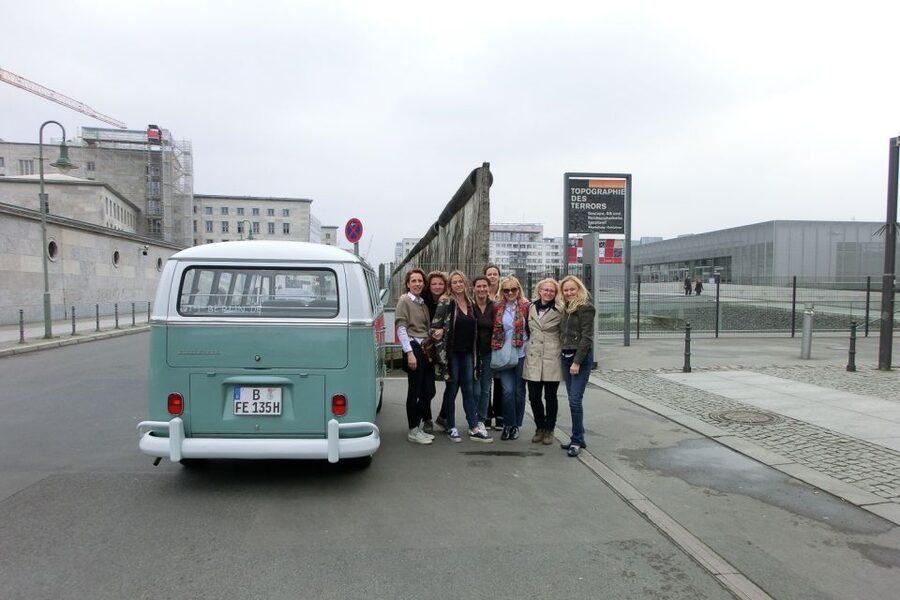
From here, the bus passes the Berlin Wall and continues along Niederkirchnerstraße. This area brings you close to major twentieth-century sites, including the former Anhalter Bahnhof and the area around the Holocaust Memorial and the former Führer Bunker location.
The guide’s commentary matters most here. Berlin’s wartime and Cold War stories can become confusing when you move quickly between sites. A good explanation helps you understand what disappeared, what survived, and why the city still has open spaces where you might expect buildings.
The tour does not replace a dedicated visit to the Topography of Terror, the Holocaust Memorial, or the Berlin Wall Memorial. Instead, it gives you a map of the places and the background needed to explore them with more purpose later.
Friedrichstraße, Checkpoint Charlie, and Gendarmenmarkt
The bus then moves toward Friedrichstraße and Checkpoint Charlie.
Checkpoint Charlie was once a crossing point between East and West Berlin. Today, it is a busy central attraction surrounded by shops and displays. The historical importance is real, but the modern setting can feel commercial. The guide’s explanation helps separate the actual Cold War story from the present-day souvenir scene.
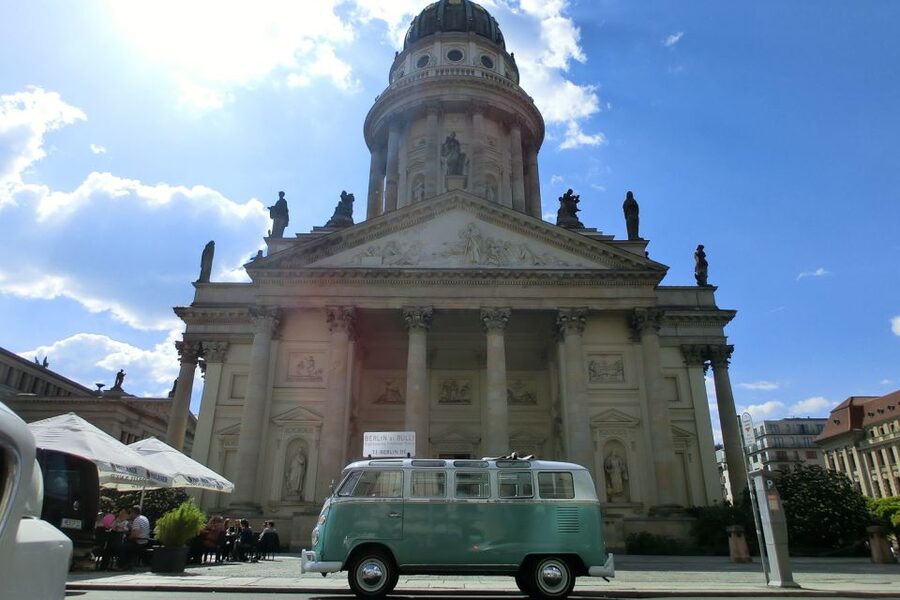
Gendarmenmarkt follows, one of central Berlin’s most elegant squares. The square is framed by the German Cathedral, French Cathedral, and Konzerthaus. From the bus, you see the overall arrangement and hear how the square fits into Berlin’s architectural history.
This section is also a reminder of the tour’s limits. You will pass many important places, but you will not have time to study every façade or walk across every square. If you want detailed photographs or quiet time at Gendarmenmarkt, return independently.
Berlin Palace, the Spree, and the city center
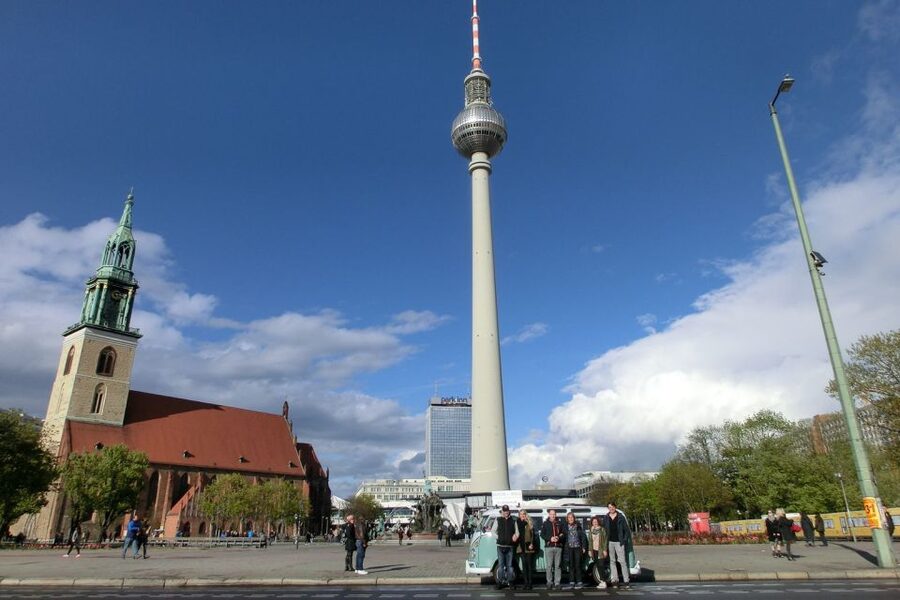
The route loops back toward the historic center, passing Berlin Palace, the Jungfern Bridge, Galgenhaus, the Red Town Hall, Neptune Fountain, and St. Mary’s Church.
Berlin Palace has a complicated story. The historic royal building was damaged in the war, demolished during the East German period, and later reconstructed in a modern project that restored much of its former exterior. The tour’s old photographs are useful here because they help you visualize the changes instead of seeing the present building as a single, unbroken story.
The Jungfern Bridge and Galgenhaus are smaller points of interest. They may not be on every first-time visitor’s list, but they help show how much of Berlin’s past survives in ordinary streets and modest structures.
The Red Town Hall and TV Tower bring you back into the former East Berlin center. The TV Tower dominates the skyline and is one of the city’s most recognizable symbols. Nearby Neptune Fountain and St. Mary’s Church add older landmarks to a district shaped heavily by postwar rebuilding.
The bus finishes back at Berlin Cathedral, completing a circular overview of central Berlin.
The guide and the historical photo booklet
The guide can make or break a fast city tour. Here, the guide drives, navigates, and talks, so the best experience comes from someone who can keep the story moving without losing the group.
Rajko is repeatedly praised for his warmth, humor, and personal understanding of Berlin. Michael is also noted for being organized and well prepared. The commentary is available in English or German, and some departures may use more than one language.
A bilingual tour can mean short pauses while the guide switches languages. One passenger specifically noted a delay caused by two languages, though the situation was handled well. If you want every minute of commentary in one language, check the language arrangement when booking.
The photo booklet, described as an analogue iPad, is a clever tool. At selected locations, you can look at old photographs while viewing the same place outside the window. This is especially helpful for the Wall, Potsdamer Platz, the palace district, and wartime sites where the modern view alone can be hard to interpret.
The booklet also gives you something concrete to remember after the tour. It turns a rapid sightseeing loop into a visual timeline.
Is two hours enough for Berlin?
Two hours is enough for an introduction, not enough for a full visit.
The route covers an impressive number of landmarks, but most are passed rather than visited. You may get a quick view of the Reichstag, Brandenburg Gate, Victory Column, Memorial Church, KaDeWe, Potsdamer Platz, the Wall, Checkpoint Charlie, and the TV Tower, but you will not have time to enter them.
That is not a flaw if you treat the tour correctly. I would use it to learn Berlin’s layout, identify areas worth revisiting, and hear the basic story of the city from someone who can connect the details.
It works particularly well on your first or second day. You can mark places such as Museum Island, the Wall, Gendarmenmarkt, or Kurfürstendamm for later exploration. Taking it near the end of a stay also has value, since familiar sights gain context and lesser-known streets fill in gaps in your understanding.
Price, group size, and practical details
At $51 per person, the tour costs more than a large public sightseeing bus, but the comparison is not quite fair. You are paying for a seven-person group, a dedicated driver-guide, a vintage vehicle, live commentary, and a route designed around both major sights and side streets.
For a family of six, the bus can feel close to a private tour because the group may have the vehicle to itself. For a solo visitor or couple, the small setting still makes it easier to ask questions and hear the guide.
The starting point is Berlin Cathedral. The tour lasts two hours and returns there. Cancellation is free up to 24 hours before departure, and you can reserve now and pay later, which helps if your schedule is still changing.
The bus is wheelchair accessible, but only folding wheelchairs are allowed. Glass objects and intoxication are not permitted. The experience is not suitable for people with epilepsy, a cold, or a body weight over 275 pounds, or 125 kilograms.
Who should take this Berlin tour?
I would recommend it to first-time visitors who want a quick city framework without sitting in a large coach. It is also a strong choice for families, couples, history fans, Volkswagen enthusiasts, and anyone who prefers a personal guide to an audio recording.
You will get the most from it if you enjoy looking out the window while listening. The tour is not built around long photo stops, museum entry, or free time.
It is less suitable if you need step-free access for a non-folding wheelchair, dislike small vintage vehicles, or want a slow walking tour with plenty of time at each monument. In hot weather, remember that the bus is an older vehicle and may feel warm even though windows can be opened.
Should you book the Samba bus tour?
Book it if you want Berlin’s major sights tied together by a human guide, with a little nostalgia along the way. The immaculate 1965 bus, the seven-person group, the historical photo booklet, and the broad route give you more personality than a standard city loop.
I would especially book it near the start of your stay. You will see enough of Berlin to understand its basic shape, hear the stories behind places you might otherwise overlook, and build a sensible plan for the rest of your visit.
Just keep your expectations clear: this is a moving city introduction, not a collection of monument visits. If that suits your style, $51 is a fair price for two hours in one of Berlin’s most memorable sightseeing vehicles.
FAQ
Where does the Berlin VW Samba bus tour start?
The tour starts at Berlin Cathedral.
How long does the tour last?
The sightseeing tour lasts two hours and returns to Berlin Cathedral.
How many people can join the group?
The group is limited to seven participants.
Which languages are available?
Live commentary is available in English and German. A tour may be conducted in more than one language.
Which Berlin sights are included?
The route passes nearly 50 sights, including Berlin Cathedral, Museum Island, Brandenburg Gate, Reichstag, the government district, Bellevue Palace, Kurfürstendamm, Kaiser Wilhelm Memorial Church, Potsdamer Platz, the Berlin Wall, Checkpoint Charlie, Gendarmenmarkt, the TV Tower, and St. Mary’s Church.
Can I get off at the sights?
The supplied tour details describe the sights as pass-by points. The experience is designed as a moving sightseeing tour rather than a series of visits with time to explore each attraction.
Is the tour wheelchair accessible?
The tour is wheelchair accessible, but non-folding wheelchairs are not allowed.
What is included in the price?
Transportation in the Volkswagen T1 Samba bus, a driver-guide, live commentary, a historical photo booklet, and heating when necessary are included.
Recently added around Berlin
- Berlin: Sachsenhausen Concentration Camp and Potsdam day tour★ 4.5 · 318 reviews
- Berlin: Bus Tour by Night with Live Commentary★ 4.2 · 687 reviews
- Berlin: Live-Guided Evening Sightseeing Tour by Open-top Bus★ 4.1 · 783 reviews
- Berlin: Hop-On-Hop-Off Bus with Boat Cruise Option★ 3.8 · 818 reviews
- Big Bus Berlin Hop-On Hop-Off Sightseeing Tour & Currywurst★ 4.0 · 856 reviews
- City Sightseeing Berlin Hop-On Hop-Off Bus Tour★ 3.0 · 981 reviews
- Berlin: 1.5-Hour Comedy Bus Tour in German★ 4.5 · 1,165 reviews
- Berlin: English Bus Tour to Sachsenhausen Concentration Camp★ 4.9 · 1,380 reviews
Sightseeing Bus Tours, compared.
City Sightseeing Hop-on Hop-off Bus with Audioguide
Read our review →
Big Bus Hop-on, Hop-off Open-Top Sightseeing Tour
Read our review →
City Sightseeing London Hop-On Hop-Off Bus & Bookable Extras
Read our review →
City Sightseeing HOHO Bus Tour + Sunset & Night Tour
Read our review →
City Sightseeing Hop-On Hop-Off Bus with Audio Guide
Read our review →
Hop-on Hop-off Sightseeing Tour by Open-top Bus
Read our review →Browse the lists this tour appears in