
Review · BANGKOK BUS TOURS
Bangkok Thai Bus Food Tour
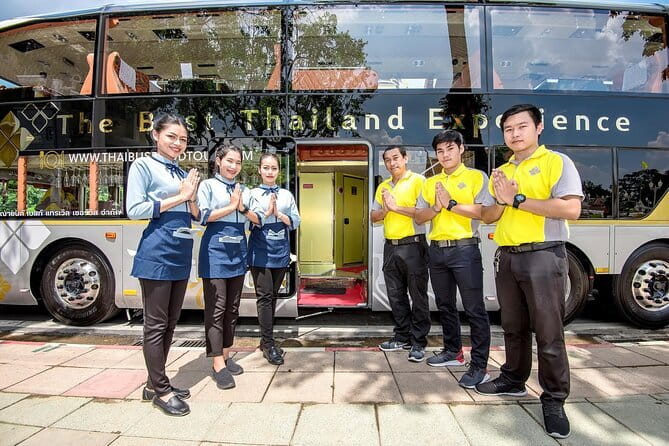
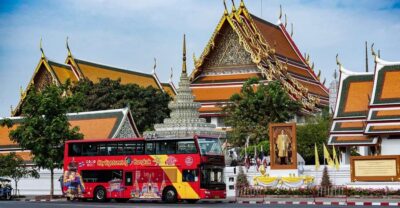
Bangkok’s Thai Bus Food Tour turns a meal into a moving sightseeing session. From a double-decker bus, you’ll pass more than 20 sights around Rattanakosin Island while eating dishes served as lunch or dinner, depending on your departure time. The tour is promoted as a Michelin-star dining experience, though the supplied details do not name the Michelin restaurant or chef.
I like the efficient route and the chance to see Bangkok’s old royal quarter without arranging several separate stops. I also like the practical comforts: air-conditioning, Wi-Fi, an LCD screen, and onboard commentary. The main drawback is the short 90-minute schedule. You’ll see many landmarks from the road, but this is not a temple-entry tour.
The ride can also feel less comfortable if you get motion sickness. The bus is noticeable, and the large windows offer a useful overview, but Bangkok’s traffic can make the journey stop and start.
Key points to know before booking
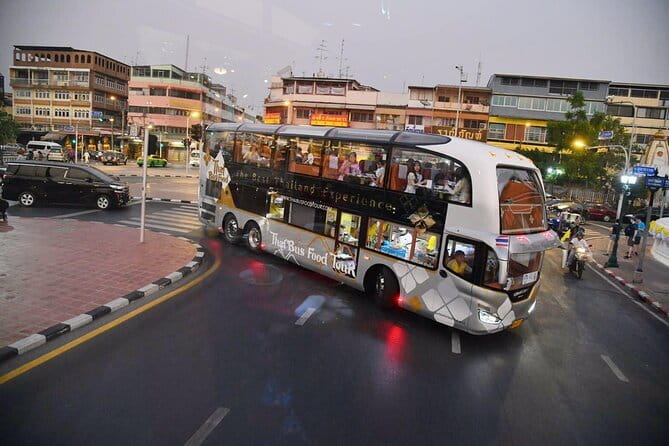
- A meal with a moving city view: Dishes and soft drinks are included in the selected package, with lunch or dinner served according to the tour time.
- A compact Bangkok route: The bus passes Chinatown, the Golden Mount, Loha Prasat, the Grand Palace, Wat Arun, Wat Pho, and other central sights.
- A 90-minute outing: This suits a first look at Bangkok’s old center, not a full temple visit.
- Small maximum group: The bus accepts up to 20 people, giving the outing a more controlled feel than a large sightseeing coach.
- Comfort features onboard: Expect an air-conditioned vehicle, free Wi-Fi, CCTV, an LCD screen, and an audio system.
- One firm booking condition: The experience is non-refundable and cannot be changed after booking.
A Bangkok meal that keeps moving
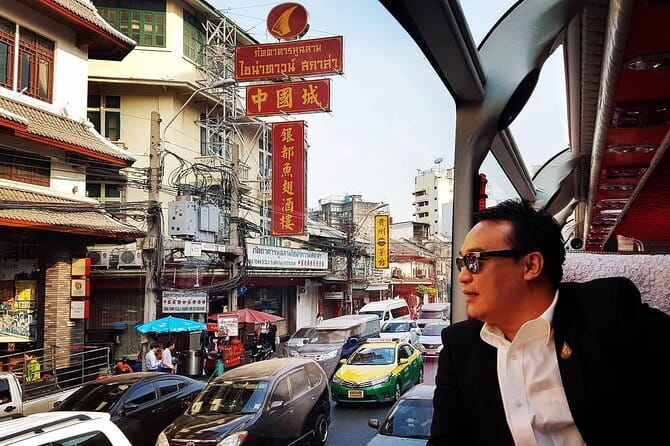
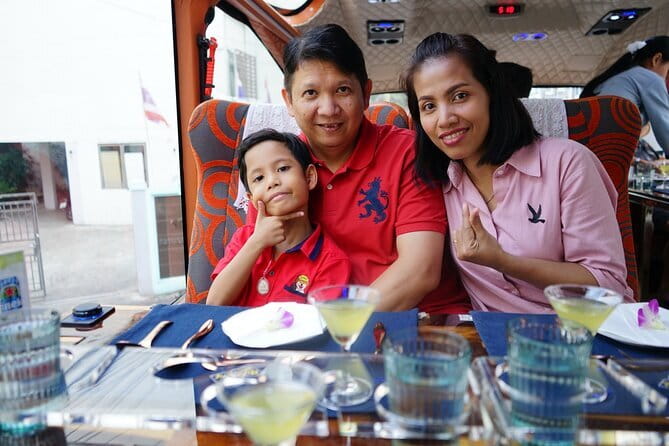
This experience works because it combines two jobs that often compete for your time in Bangkok: eating and getting your bearings. Instead of spending an hour and a half inside a restaurant, you move through Chinatown and the historic center while food is served at your seat.
The bus is a double-decker vehicle designed for sightseeing. Its visibility is part of the fun, since the vehicle is easy to notice on the streets. One past customer described feeling like a celebrity because of the attention the bus received, so you should expect the ride itself to be part of the public show.
The route is broad rather than slow. You pass a long list of famous places, but the bus does not function as a hop-on, hop-off service. Your sightseeing comes through the windows, the guide’s explanations, the onboard screen, and the views along the roads.
That makes this a good first activity in Bangkok. You can see how Chinatown, the royal district, major temples, and historic avenues relate to one another. Later, you can return to the places that deserve more time on foot.
More food and drink stops around Bangkok:
- Thai Bus Food Tour Experience in Bangkok
★ 4.4 · 53 reviews - Bangkok: Premium Damnoen Saduak & Railway Market By Food Bus
★ 4.8 · 8 reviews - NYC Bus Tour of Brooklyn, Bronx, Queens: Art, Food & Sports
★ 5.0 · 3,805 reviews
Starting at River City Bangkok
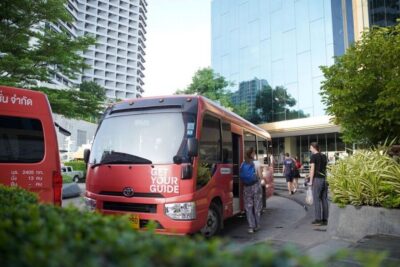
The meeting point is Thai Bus Food Tour at River City Bangkok, room 163, Building No. 23, Soi Charoen Krung 24, in Talat Noi. The activity ends at the same meeting point, which simplifies your plans before and after the ride.
The location is near public transportation, but the information provided does not specify a particular station or walking time. Give yourself enough time to find the building and the tour room. A mobile ticket is provided, so keep the booking accessible on your phone.
The group maximum is 20 people. That is small enough to avoid the feel of a major coach tour, while still large enough that you should not expect a private guide.
Chinatown begins with Wat Traimit
One of the first major sights is Wat Traimit, a Theravada Buddhist temple in Bangkok’s Chinatown area. The temple is best known for its Golden Buddha statue, and it also houses the Yaowarat Chinatown Heritage Center.
Even from the bus, Wat Traimit helps explain the character of this part of Bangkok. It links religious life with the city’s Thai-Chinese past. The temple was previously known as Wat Sam Chin and received its current name in 1940, though its roots reach back to the early Rattanakosin period.
You will not have time here to see the Golden Buddha or the heritage center in detail. Think of this part of the route as a useful introduction to Chinatown, with a note to return on foot if the temple interests you.
The red gate at Odeon Circle
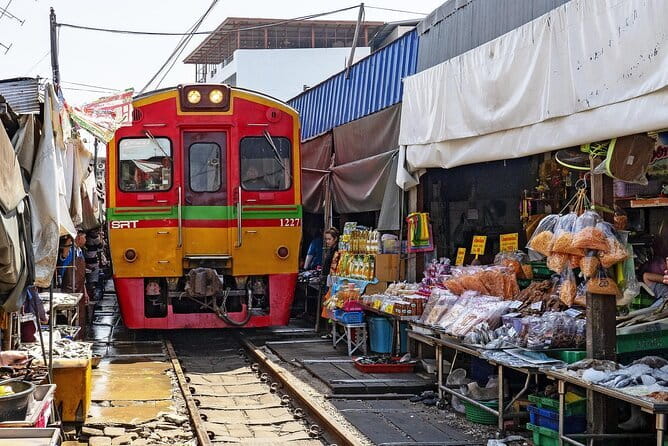
The bus then passes the China Town Gate at Odeon Circle. The red paifang sits where Yaowarat, Charoen Krung, and Tri Mit roads meet, marking a major entrance to Bangkok’s Chinatown.
The gate was built by Thai-Chinese descendants in 1999 as part of celebrations for King Bhumibol’s 72nd anniversary. Its position makes it an easy landmark to recognize from the bus and gives you a quick visual sense of Chinatown’s cultural identity.
Yaowarat is one of Bangkok’s best-known roads, and seeing the gate in context is more useful than viewing it as an isolated photo stop. You can watch the streets shift from the riverfront and Talat Noi area toward the dense commercial heart of Chinatown.
More places to eat well around Bangkok:
- Top Rated Brooklyn Half-Day Food, History & Culture Tour via bus
★ 5.0 · 758 reviews - Bologna: Open Bus City Tour and Local Food Tasting
★ 3.7 · 550 reviews - Liverpool’s Brewery Bus Tour– 4 Breweries, 12 x Craft Beer & Food
★ 5.0 · 172 reviews - Malta: 5 hr Vintage Bus Tour – Mdina & Blue Grotto inc. food
★ 4.8 · 169 reviews
Wat Saket and the Golden Mount area
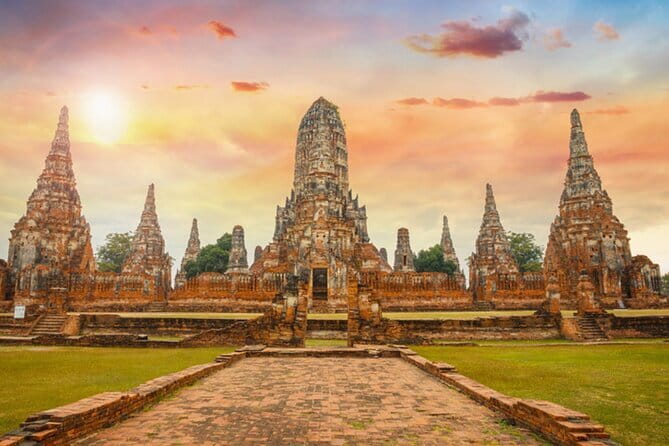
Wat Saket is another important sight along the route. The temple dates back to the Ayutthaya era, when it was known as Wat Sakae. After Bangkok became the capital, King Rama I renovated it and gave it the name Wat Saket.
The name is often linked to the story that the king stopped here to bathe and wash his hair after returning from war before entering the inner city. That small detail gives the temple a connection to the early formation of Bangkok as a capital.
The temple is also associated with the Golden Mount, or Phu Khao Thong. The bus lets you see the site without making you climb the hill, which is helpful if you want a relaxed overview. The tradeoff is clear: you will miss the views and temple atmosphere available from the top.
Loha Prasat and the old royal avenue
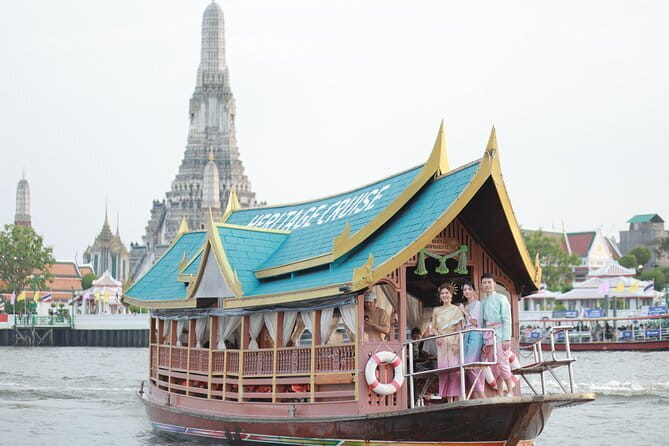
Wat Ratchanatdaram sits at the junction of Ratchadamnoen Klang and Maha Chai Road. The temple was built in 1846 by order of King Rama III for his granddaughter, Princess Somanass Waddhanawathy.
Most people know it by the name Loha Prasat, which means iron palace. The unusual name points to the temple’s distinctive design and makes it easy to remember as the bus passes.
This part of the route also brings you along Ratchadamnoen Avenue, one of the grand central roads of Bangkok. You get a sense of how the temples, monuments, and government district fit together. If architecture is your main interest, this is another place where a later walking visit would reveal far more than a passing view.
Democracy Monument on Ratchadamnoen Avenue
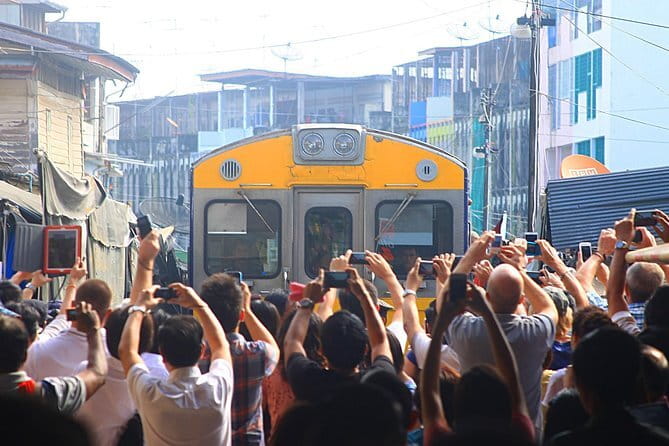
The Democracy Monument occupies a traffic circle at the meeting of Ratchadamnoen Avenue and Dinso Road. It sits roughly between Sanam Luang and the Golden Mount, placing it directly within the historic center.
From the bus, the monument becomes part of a larger picture. It is not simply a freestanding structure. Its setting on the broad avenue shows how Bangkok’s civic and royal districts were laid out around major ceremonial roads.
The sightseeing value here comes from the guide’s commentary and the wider view. Traffic circles are not places where you can casually stop for long, so the moving bus gives you a safe way to see the monument while continuing toward the Grand Palace.
The Grand Palace from the road
The Grand Palace is Bangkok’s most famous royal complex and has served as the official residence of the Kings of Siam and Thailand since 1782. The king, court, and royal government operated here until 1925.
Today, royal ceremonies and state functions still take place within the palace grounds. The complex receives more than eight million visitors each year, so a road-based view can be a sensible way to orient yourself before deciding if you want to return for a full visit.
Do not book this bus expecting palace admission. The experience provides sightseeing from the vehicle, not entry into the complex. That distinction matters because the Grand Palace can easily take several hours when you include security, walking, and nearby temples.
Views toward Wat Arun and the river district
Wat Arun sits on the west bank of the Chao Phraya River in the Bangkok Yai district. Its name comes from Aruna, the Hindu god associated with the rising sun. The temple is especially recognizable for its tall prang, built in the early 19th century during the reigns of Rama II and Rama III.
The tour does not list a boat ride or a temple visit, so your view of Wat Arun will depend on the route and the guide’s presentation. Still, including it gives the tour a wider reach than a simple Chinatown loop.
Wat Arun is one of Bangkok’s best-known landmarks, and seeing it connected to the river and the old city helps you understand the city’s geography. If you want close views of the ceramic details on the prang, plan a separate visit.
Wat Pho and the older Bangkok center
Wat Phra Chetuphon, commonly called Wat Pho, is one of Bangkok’s oldest temples. It existed before Bangkok became the capital under King Rama I and was originally known as Wat Photaram or Podharam.
The name Wat Pho is linked to the monastery of the Bodhi tree at Bodh Gaya in India, where Buddha is believed to have reached enlightenment. The old temple may have been built or expanded during the reign of King Phetracha, from 1688 to 1703.
The route also touches the temple’s place in Bangkok’s early political changes. After Ayutthaya fell to the Burmese in 1767, King Taksin moved the capital to Thonburi. Later, King Rama I established Bangkok as the capital and developed the area around the Grand Palace and Wat Pho.
Again, you should treat the sighting as an introduction. Wat Pho rewards a slow visit, and this 90-minute tour cannot provide that. Its value here is the connection between the food route, the royal center, and the oldest religious sites.
The Giant Swing and Brahmin Bangkok
The final listed sight is the Giant Swing, a religious structure in Sao Chingcha Subdistrict in the Phra Nakhon district. It stands in front of Wat Suthat and was once used in an old Brahmin ceremony.
The structure is one of Bangkok’s recognizable central landmarks. Seeing it after the Grand Palace, Wat Pho, and Wat Ratchanatdaram gives the ride a strong final section, since the route has moved through several layers of Bangkok’s religious and civic identity.
The bus does not provide a stop for a full visit, so you will get the best value from paying attention to the commentary and noting the locations you want to revisit.
What you eat, and what the price means
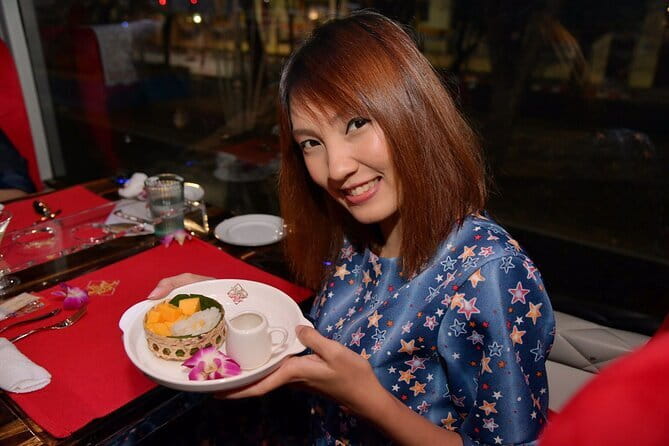
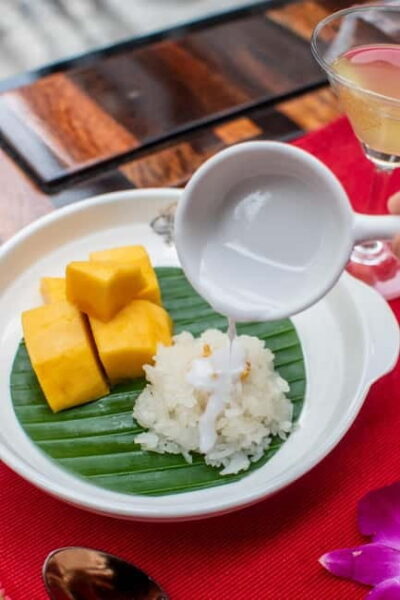
Lunch or dinner is included, depending on the departure time. Dishes and soft drinks are included in the selected package, but the supplied details do not give a full menu or identify the dishes.
The experience is listed at $0.00. That price should be checked carefully before you book, since it may reflect incomplete pricing information, a package selection, or a display issue. If $0.00 is genuinely available for your chosen date and package, the included meal, vehicle, sightseeing, and onboard services would represent remarkable value. Do not assume the price until the final booking screen confirms it.
The tour is promoted around Michelin-star dining, but no specific star, restaurant, or chef is named in the details provided. If the food is your main reason for booking, confirm exactly what the selected package includes before paying.
Comfort, commentary, and the practical tradeoffs
The air-conditioned bus matters in Bangkok. A short ride in a cool vehicle can be far easier than walking between every district, especially during a hot afternoon or after a full day of sightseeing.
Free Wi-Fi, CCTV, an LCD screen, and an audio system are also included. These features suggest a polished sightseeing setup, though the details do not explain the Wi-Fi speed, screen content, or language options.
The guide commentary is an important part of the experience. The available feedback describes the commentary as good, with another customer praising the guide’s wording and the service. No guide names are provided, so you cannot request a particular guide.
The ride is not recommended if you have motion sickness. Bangkok traffic can mean frequent braking and slow movement, and eating while the bus is moving may make that worse. Choose a seat and meal time with your comfort in mind, though specific seat selection is not described.
Who should book this 90-minute tour?
I would choose this experience if you want a quick introduction to central Bangkok, prefer sightseeing with a meal, or have limited time between other plans. It also suits families and couples looking for an easy outing with transport, food, and commentary combined.
It is especially useful at the start of a Bangkok stay. You can mark Chinatown, the Grand Palace area, Wat Pho, Wat Saket, and the Giant Swing, then return later to the places that caught your attention.
I would not choose it as your only temple sightseeing experience. The route shows many important places, but it does not replace entering Wat Pho, climbing the Golden Mount, exploring the Grand Palace, or spending time around Wat Arun.
The tour accepts a maximum of 20 people and ends where it begins at River City Bangkok. The activity is non-refundable and cannot be changed for any reason, so check your date, meeting point, package, and price before confirming.
Is the Thai Bus Food Tour worth booking?
Book it if you value efficient sightseeing with a meal, air-conditioning, and a guided overview of Bangkok’s historic center. The combination is appealing, and the two available ratings praise the food, friendly service, commentary, and guide presentation.
Skip it if you want long temple visits, a quiet restaurant meal, or complete control over the route. The $0.00 price needs verification, and the Michelin-star claim lacks named restaurant details. If those points are clear at checkout, this can be a pleasant way to see a lot of Bangkok in 90 minutes without walking the whole route.
FAQ
Where does the Thai Bus Food Tour begin?
It begins at Thai Bus Food Tour, River City Bangkok, Building No. 23, room 163, Soi Charoen Krung 24, Talat Noi, Samphanthawong, Bangkok 10110.
Where does the tour end?
The activity ends back at the same meeting point at River City Bangkok.
How long does the tour last?
The tour lasts approximately 1 hour and 30 minutes.
Is food included?
Yes. Lunch or dinner is included depending on the tour time, along with dishes and soft drinks in the selected package.
Is the vehicle air-conditioned?
Yes. The experience includes an air-conditioned vehicle.
What sights does the bus pass?
The route includes Wat Traimit, the China Town Gate, Wat Saket, Wat Ratchanatdaram and Loha Prasat, Democracy Monument, the Grand Palace, Wat Arun, Wat Pho, and the Giant Swing, along with more than 20 attractions around Rattanakosin Island.
How many people can join the tour?
The maximum group size is 20 people.
Can I cancel or change my booking?
No. The experience is non-refundable and cannot be changed for any reason after booking.
Recently added around Bangkok
- City Sightseeing Bangkok Hop-On Hop-Off Bus Tour★ 3.0 · 11 reviews
- Day Tour From Bangkok to Ayutthaya By Bus★ 4.5 · 25 reviews
- 3 Hours Heritage Ayutthaya Bus Tour to Famous Temples★ 4.5 · 2 reviews
- Ayutthaya’s Top Temple & Boat Tour From Bus Station★ 4.0 · 4 reviews
- From Bangkok: Ayutthaya Historical Day Tour by Bus★ 4.4 · 25 reviews
- From Bangkok : Meklong Railway Market By Bus★ 4.6 · 3 reviews
- Bangkok: Chinatown Night Walking Tour and Hop On Hop Off Bus★ 3.5 · 4 reviews
- Bangkok: Full-Day Hop-On Hop-Off Walking Tour Mini Group★ 4.9 · 20 reviews
Bangkok Bus Tours, compared.
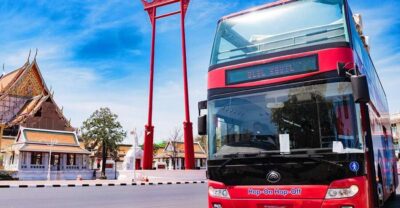
Hop-On Hop-Off Bus with 24, 48 or 72-Hour Validity
Read our review →
Browse the lists this tour appears in