
Review · SALT LAKE CITY BUS TOURS
Salt Lake City Guided Bus Tour
Salt Lake City’s best quick introduction may be a ride that links its pioneer past, religious center, grand public buildings, and Olympic legacy in one sweep. This 2.5-hour bus tour takes you from downtown to Capitol Hill, Fort Douglas, Temple Square, and This is the Place Heritage Park without asking you to study a map or find parking.
I like the live storytelling, which gives meaning to buildings you might otherwise pass with only a quick photo. I also like the short walk-off stops, especially at the Utah State Capitol and Temple Square, plus the chance to hear the Tabernacle organ when timing allows.
The trade-off is pace. You see a remarkable number of places, but many stops last only one or five minutes. A smaller minibus may also limit views from a middle seat, especially during winter departures, when the larger coach may not be in use.
Key points at a glance
- Temple Square and the Tabernacle organ: The spiritual center of Salt Lake City gets the most rewarding time on the route.
- A useful first-day orientation: You cover downtown, Capitol Hill, the university area, historic neighborhoods, and Olympic landmarks.
- Short, guided stops: You step off for photos and brief explanations, while many other sights are viewed from the bus.
- Strong guide presence: Guides including Ann, Todd, Matthew, Mark, Kristin, Grant, and Kevin are praised for clear facts, humor, and local suggestions.
- Small-group format: The tour allows up to 29 people, with some winter departures using a Mercedes Sprinter-style minibus.
- Good fit for tight schedules: Morning and afternoon departures make this a practical choice if you have only half a day in Salt Lake City.
Why this 2.5-hour tour works so well for a first look
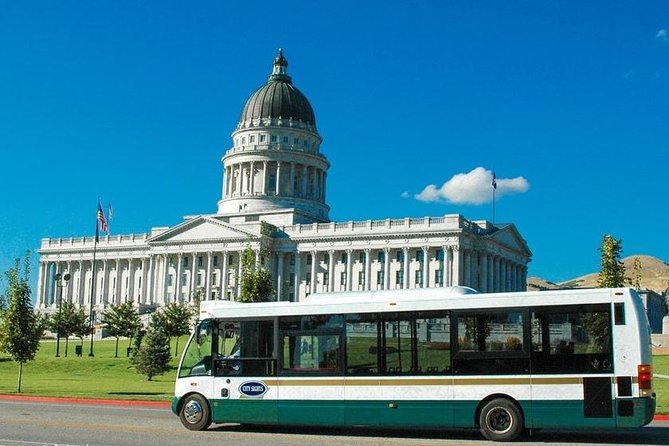
Salt Lake City can seem spread out at first. Temple Square sits downtown, the Capitol rises above the city, Fort Douglas lies near the University of Utah, and the Olympic sites are scattered across different parts of town. Walking between them is not practical, and a rental car adds parking and navigation chores.
This tour solves that problem in a straightforward way. You sit back while the driver handles the route, and the guide explains what you are seeing as the city changes outside the windows. The narration covers pioneer settlement, the Church of Jesus Christ of Latter-day Saints, state politics, architecture, military history, and the 2002 Winter Olympics.
I especially value the mix of major sights and lesser-known stops. You see the Salt Lake Temple, State Capitol, and Olympic Cauldron, but you also pass the Cathedral of the Madeleine, McCune Mansion, Council Hall, the Deuel Pioneer Log Home, and Trolley Square. That gives you a better sense of Salt Lake City than a route focused only on Temple Square.
The tour begins and ends at the Radisson Hotel Salt Lake City Downtown on West South Temple Street. It is offered in English, uses mobile tickets, and allows a maximum of 29 people. Most people can take part, and service animals are allowed.
More routes with a guide on the mic around the USA:
- From NYC: Guided Day Trip to Washington DC by Van or Bus
★ 4.7 · 3,418 reviews - 2-Hour Gettysburg Battlefield Guided History Bus Tour with a National Park Guide
★ 4.5 · 2,201 reviews - Los Angeles: Hop-On Hop-Off Bus Tour with Audio Guide
★ 3.7 · 2,030 reviews
Temple Square: the emotional center of the route
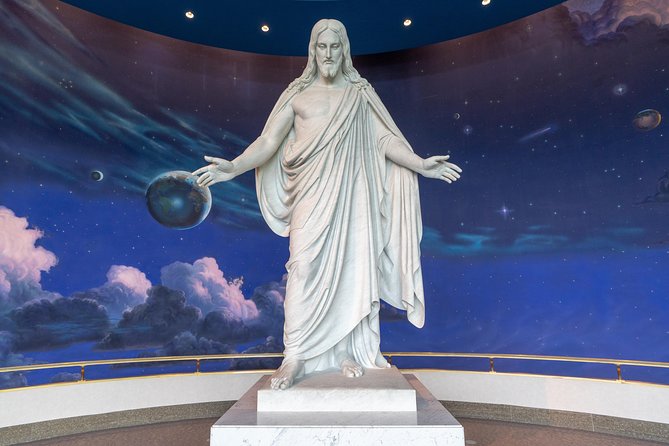
Temple Square is the main stop, and rightly so. This ten-acre downtown complex brings together the Salt Lake Temple, Tabernacle, Assembly Hall, gardens, statues, and several buildings connected with Latter-day Saint history.
You begin with the Salt Lake Temple exterior. Its pale granite walls and six tall spires dominate the city center. Construction took 40 years, from 1853 to 1893, and the stone was quarried and shaped by pioneer workers. The interior is reserved for Church members, so your experience here focuses on the exterior, grounds, architecture, and the stories surrounding its construction.
The guide helps explain details that are easy to miss. Look for the Angel Moroni statue, the hand-carved stonework, and the symbolism built into the design. Even if you are not visiting for religious reasons, the temple is important to Salt Lake City’s identity and urban form.
You then have time to explore part of Temple Square itself. The gardens are carefully maintained, and the Assembly Hall offers a pleasing contrast to the larger temple. Built from leftover granite, the 1882 Gothic-style hall has delicate spires and stained glass. The Seagull Monument recalls an early settler story that became part of Utah’s cultural memory.
Allow yourself to take photos, but do not expect a long independent visit. The listed time at Temple Square is about 15 minutes, with separate brief stops connected to the Tabernacle and the South Visitors’ Center. This is enough for an introduction, not enough for a full museum visit.
The Tabernacle organ recital is the tour’s special moment
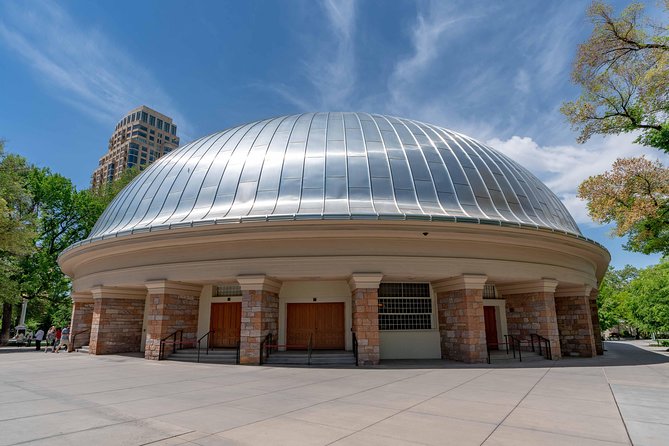
The Tabernacle is one of the strongest reasons to choose this tour. Its broad interior was completed in 1867, long before modern sound equipment. The roof and interior shape were designed so carefully that a quiet sound can carry across the hall.
The building houses a famous pipe organ with more than 11,000 pipes. One itinerary description gives the count as 11,632, while the tour materials also describe it generally as an instrument of more than 11,000 pipes. Either way, this is not a small church organ. Its sound fills the room with surprising force and clarity.
If the timing works, you hear a live organ recital during the visit. Several experiences on this route end with the recital, and it is frequently singled out as the most memorable part of the morning or afternoon. That makes the tour more than a drive past impressive buildings. You get a brief cultural experience inside one of Salt Lake City’s most important spaces.
The recital schedule can affect the exact order of the tour, so treat it as a major possibility rather than an absolute guarantee at every departure. If music matters to you, confirm the timing when booking. Either way, the guide explains the Tabernacle’s construction, acoustics, organ, and role in the broadcast program Music and the Spoken Word.
Capitol Hill combines architecture and wide views
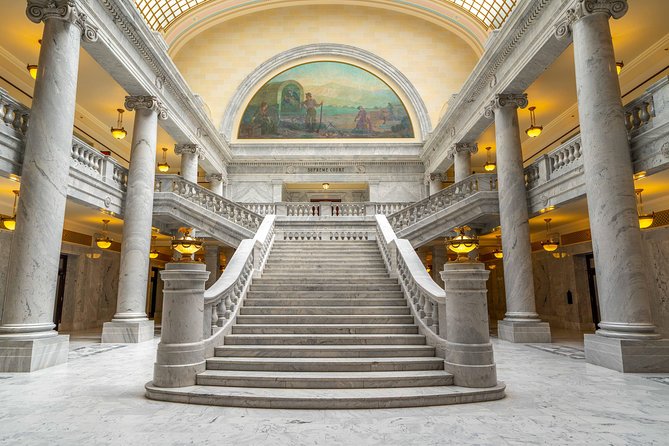
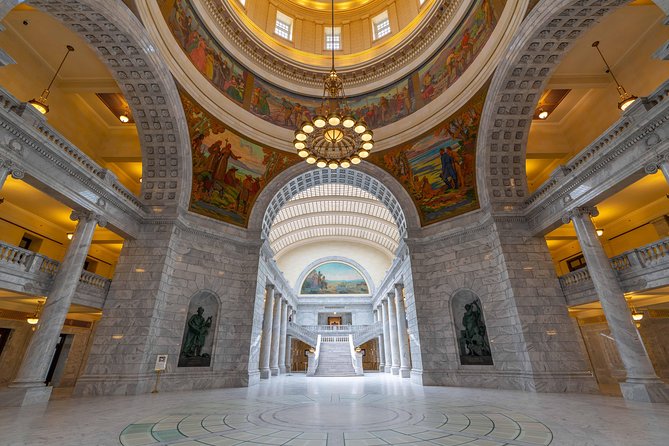
The Utah State Capitol is another rewarding stop. Completed in 1916, the Neoclassical building has a large copper dome, marble columns, murals, and a grand rotunda. The building’s size and form reflect Utah’s transition from a remote territory into a state with national ambitions.
The stop lasts about 20 minutes, making it one of the longer opportunities to get out and walk. You can take photos of the building and look back across Salt Lake City toward the Wasatch Mountains. The view is one of the clearest ways to understand the city’s setting, with the urban grid laid out below and steep mountains rising nearby.
The guide also connects the Capitol to Utah’s path to statehood and the building’s restoration. That context adds value because the building is not just a handsome government hall. It reflects debates over territorial rule, statehood, public power, and Utah’s changing place in the country.
Nearby, the route passes the City and County Building at Washington Square. Its 1894 Romanesque Revival design includes sandstone walls, towers, arched windows, and a tall clock tower. The stop is brief, so you will mainly view it from outside and hear the story from the bus.
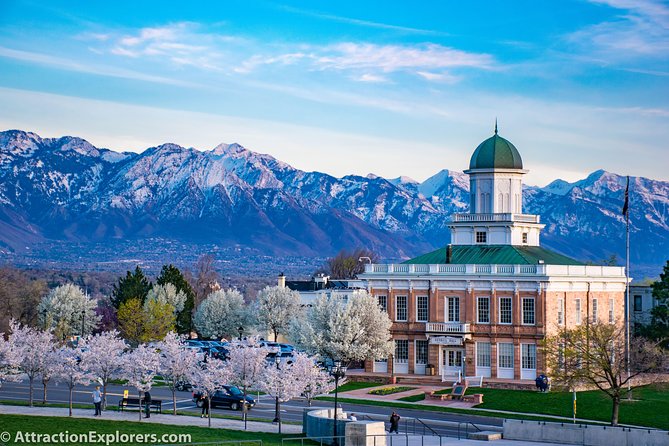
Council Hall adds another small but useful piece of political history. It served as Utah’s territorial capitol from 1866 to 1896 and was later moved brick by brick to Capitol Hill. This is the sort of detail you might miss on an ordinary city drive.
More routes around the USA:
- Grand Canyon West Bus Tour with Hoover Dam and Optional Skywalk
★ 4.0 · 7,224 reviews - Savannah Hop-On Hop-Off Trolley Tour
★ 4.5 · 6,527 reviews - New York: Hop-on Hop-off Sightseeing Tour by Open-top Bus
★ 4.2 · 5,863 reviews - Boston Hop-On Hop-Off Trolley Tour with 13 Stops
★ 4.5 · 5,576 reviews
Pioneer stories at This is the Place and the Mormon trail
The route heads toward This is the Place Heritage Park, marking the location where Brigham Young and the pioneer party first viewed the Salt Lake Valley in 1847. The site commemorates the end of a 1,300-mile journey from Illinois and offers broad views across the valley toward the mountains and Great Salt Lake.
The stop lasts about 15 minutes. That is enough to take in the monument, hear the basic story, and enjoy the view. You will not have time to explore the entire heritage park in depth, so return later if you want its living-history exhibits and longer walks.
The nearby Mormon Pioneer National Historic Trail adds wider context. More than 70,000 Latter-day Saint pioneers followed routes west between 1846 and 1869. The guide explains the practical hardships of the journey, including handcarts, wagons, weather, rivers, and mountain crossings.
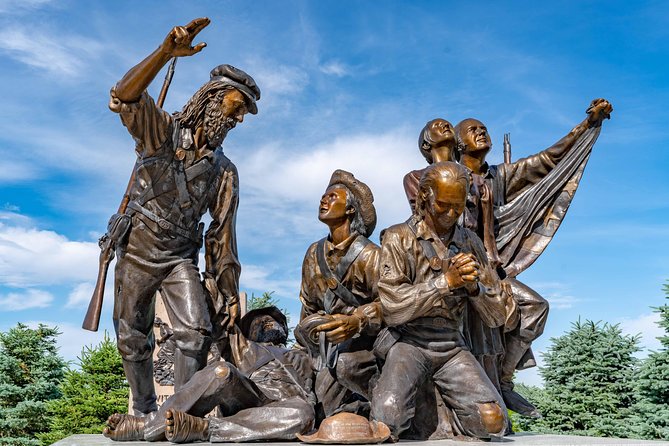
Another stop honors the Mormon Battalion, a group of about 500 Latter-day Saint volunteers who marched roughly 2,000 miles from Iowa to San Diego during the Mexican-American War. Their military service and wages helped support families and the developing settlement. It is a useful reminder that Utah’s early story included military service and a complicated relationship with the federal government, not only religious migration.
A quick tour of Salt Lake City’s religious and civic variety
One strength of this route is that it does not present Salt Lake City as a city with only one religious tradition. You pass the Cathedral of the Madeleine, Utah’s Catholic cathedral, completed in 1909. Its Gothic Revival exterior, twin spires, and stained glass show a different side of the city’s faith communities.
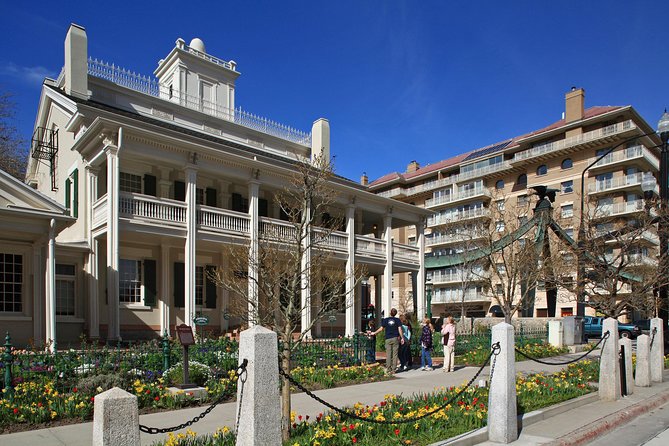
You also see the Beehive House, once Brigham Young’s residence and named for the beehive symbol above the roof. The nearby Joseph Smith Memorial Building occupies the former Hotel Utah, a grand 1911 hotel later restored for new use. These buildings help connect religious history with the city’s social and political life.
The Church Office Building gives you another visual marker. Its modern 28-story form rises near the historic temple, showing how the Church grew from a frontier movement into a worldwide organization.
FamilySearch Library and FamilySearch Center are also part of the route. The guide explains Salt Lake City’s role in genealogy and the Church’s work collecting family records. You may only view these places briefly, but they help explain why people from around the world come to this city for family research.
Fort Douglas and the University of Utah area
Fort Douglas, founded in 1862, sits above the city near the University of Utah. The fort was established during the Civil War era to protect transport routes and reinforce federal authority in Utah Territory.
From the bus, you see the historic parade grounds and red-brick buildings, including the Post Theatre. The guide describes the uneasy relationship between the U.S. Army and early Mormon settlers, along with the mining activity that developed near the fort.
This part of the tour is especially useful if you have no plans to visit the university area on your own. You also pass Rice-Eccles Stadium, site of the 2002 Winter Olympic opening and closing ceremonies, and Kingsbury Hall, a long-running performing arts venue at the University of Utah.
The stops here are generally brief, often about one minute. Think of them as orientation points rather than museum visits. If a particular building catches your eye, note it and return later.
The Olympic chapter and downtown renewal
Salt Lake City’s 2002 Winter Olympics remain a major part of its modern identity. The route includes Olympic Cauldron Park and Rice-Eccles Stadium, with stories about the Games, their ceremonies, and the city’s effort to host athletes from 77 nations.
The Olympic Cauldron is a striking glass-and-steel structure, and the stop gives you a quick photo opportunity. It is not a full Olympic museum visit, but the guide gives enough background to explain why the Games mattered to Salt Lake City’s growth and reputation.
You also pass Delta Center, home of the Utah Jazz, and The Gateway, an open-air district developed around the 2002 Games. The Gateway occupies former rail-yard land and now includes shops, food, public art, and gathering spaces. City Creek Center offers another look at downtown redevelopment, with modern architecture, retail, gardens, and a retractable roof.
Abravanel Hall, home of the Utah Symphony, adds a cultural note. Its modern glass and bronze design differs sharply from the Capitol, temple, and Victorian buildings. Taken together, these sights show a city that keeps adding new layers without losing its older landmarks.
Historic homes, public buildings, and quick drive-by sights
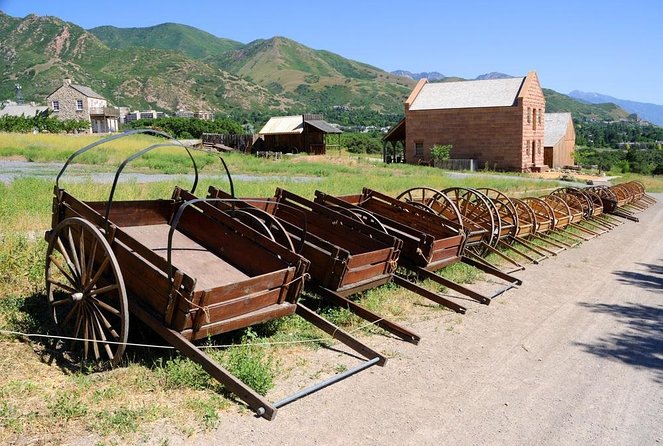
Some of the route’s attractions are best treated as visual snapshots. You pass McCune Mansion, built in 1901 for railroad executive Alfred W. McCune, and the Governor’s Mansion, a 1902 residence that became Utah’s official governor’s home in 1937.
You also see Eagle Gate, the Brigham Young Monument, the Salt Lake Meridian Marker, the Salt Lake Masonic Temple, and Trolley Square. Each has a short story, but you will not have time to linger at all of them.
The Deuel Pioneer Log Home is a good example of the tour’s range. This small cabin, built in 1847, looks modest beside the later civic and religious buildings. It gives you a direct sense of how basic the first homes could be before Salt Lake City developed into a major western city.
The route includes the Salt Lake City Public Library, designed by Moshe Safdie and opened in 2003. Its curved glass wall and rooftop garden offer a modern counterpoint to the old mansions and sandstone civic buildings. These quick views are useful if you want to decide where to spend more time later.
What the $69 price gets you
At $69 per person, this is not the cheapest way to spend two and a half hours in Salt Lake City. But the price includes transportation, navigation, a live English-speaking guide, several step-off stops, and a tightly planned route across a wide area.
I think the value is strongest if you have only one day in the city, are staying downtown, or do not want to rent a car. You would spend much of your own time working out how to connect Temple Square, the Capitol, Fort Douglas, and This is the Place by public transport or taxi.
The tour also gives you a useful plan for the rest of your visit. You can decide after the ride if you want to return to Temple Square, explore the Capitol grounds, visit the Cathedral of the Madeleine, or spend longer at the Olympic sites.
The value is weaker if you prefer slow museum visits or detailed walking tours. With more than 30 named sights on the route, the experience favors breadth. You see many places, but only a few receive enough time for a close look.
Bus size, seats, and timing
The maximum group size is 29, which is smaller and more personal than a large sightseeing coach. In spring, summer, and fall, departures may use a larger red coach. Winter departures may use a high-roof Mercedes Sprinter-style minibus.
The smaller vehicle can make the guide feel closer and the group easier to manage. It can also make window views harder from a center seat or from the side opposite a landmark. Arrive a little early and ask about a window seat if that matters to you.
The tour offers morning and afternoon start times. A morning departure may leave you free for a longer downtown visit later, while an afternoon departure can work well after a morning arrival or another scheduled activity. Allow about two and a half hours, with the understanding that traffic, events, and access to Temple Square can affect the route.
One important practical point: a Temple Square event once required the guide to skip that stop and substitute Olympic and Cathedral of the Madeleine visits. The company adjusted the route, but you should accept that major events or closures can change the day’s exact sequence.
Who should book this Salt Lake City bus tour?
I would book this for a first visit, a short stay, a non-ski day, or a morning when you want to understand the city before exploring on foot. It also suits solo visitors because the ride gives you company, structure, and a chance to ask questions without joining a large crowd.
Families can use it as an easy overview, especially if younger travelers would tire from walking between scattered sights. Older visitors may also appreciate the climate-controlled ride and the limited but well-placed walks.
I would choose something else if your main goal is a long visit inside Temple Square buildings, a full Olympic museum experience, or detailed time at every historic home. In that case, use this tour as an introduction and return independently to the places that catch your interest.
Free cancellation is available up to 24 hours before the start time. Changes or cancellations inside that window are not refunded, and the tour requires a minimum number of people to operate.
Final decision: a useful first chapter of Salt Lake City
Book this tour if you want a clear city overview with strong local narration, especially when your schedule is tight. The Tabernacle organ recital, Capitol views, pioneer sites, and Olympic stops give the ride real variety.
Skip it if you already know Salt Lake City well or prefer to spend two and a half hours at one or two places. For most first-time visitors, though, $69 buys a practical orientation, a comfortable ride, and enough stories to turn a collection of buildings into a city you can understand.
FAQ
How long is the Salt Lake City Guided Bus Tour?
The tour lasts approximately 2 hours and 30 minutes.
Where does the tour begin?
The meeting point is the Radisson Hotel Salt Lake City Downtown at 215 W S Temple St, Salt Lake City, Utah 84101.
Where does the tour end?
The tour ends back at the original meeting point.
Is the tour offered in English?
Yes. The tour is offered in English and includes live onboard commentary.
How many people can join the tour?
The activity has a maximum of 29 people.
Does the tour include Temple Square?
Yes. The route includes Temple Square, the Salt Lake Temple exterior, the Tabernacle, the Assembly Hall, and the Temple Square South Visitors’ Center area. Events or closures can sometimes change the exact route.
Can I cancel for a full refund?
Yes. You can cancel at least 24 hours before the experience start time for a full refund. Cancellations or changes made less than 24 hours before the start time are not refunded.
Recently added around the USA
- NON BUS VIP Cadillac Escalade Traverse City Old Mission Wine Tour★ 5.0 · 19 reviews
- NON BUS 4 Winery Traverse City Wine Tour on Old Mission Peninsula★ 5.0 · 445 reviews
- NON BUS Traverse City Old Mission Sunset Wine & Distillery Tour★ 5.0 · 123 reviews
- NON BUS MOVIE STARS Traverse City Old Mission 4 Winery Tour★ 4.8 · 23 reviews
- Miami Combo: Open-top Bus Tour and Sightseeing Bay Cruise★ 3.5 · 75 reviews
- City Sightseeing Seattle HOHO Bus Tour + Bookable Extras★ 3.0 · 40 reviews
- CitySightseeing Seattle Hop-On Hop-Off Bus Tour + Bookable Extras★ 3.0 · 290 reviews
- Seattle: 3-Hour City Tour by Bus★ 4.7 · 321 reviews
Guided, compared.
City Sightseeing Hop-On Hop-Off Bus with Audio Guide
Read our review →
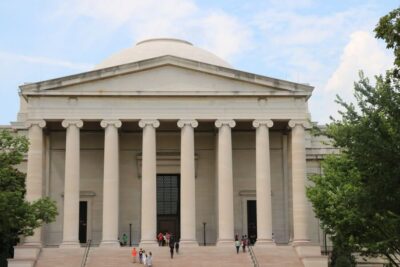
From NYC: Guided Day Trip to Washington DC by Van or Bus
Read our review →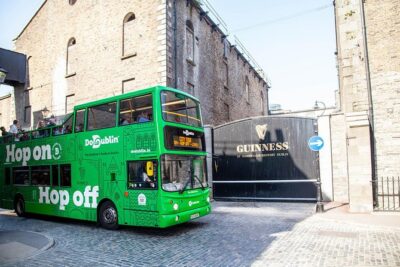
Dublin Hop-On Hop-Off Bus Tour with Guide and Little Museum Entry
Read our review →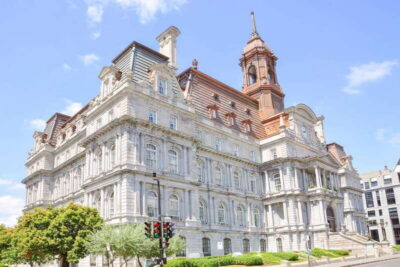
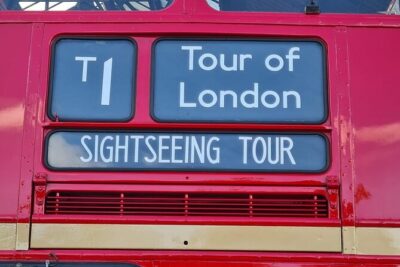
Guided Sightseeing Tour on a Vintage Open-Top Bus
Read our review →
Bus & Schönbrunn Palace Skip-the-Line Guided Tour
Read our review →Browse the lists this tour appears in