
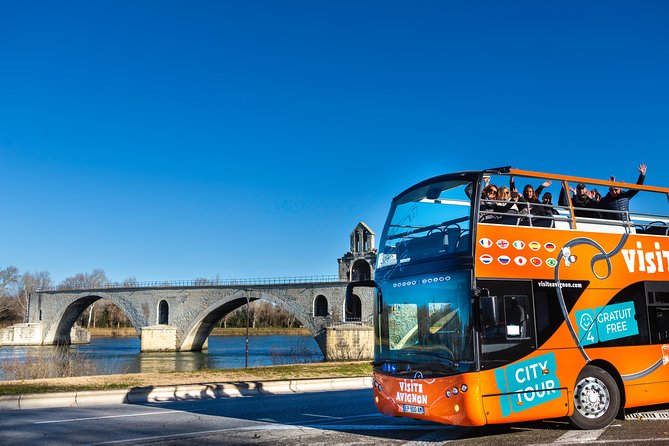
Review · FRANCE BUS TOURS
Visit Avignon and Villeneuve lez Avignon aboard a Double-Decker Bus
Avignon’s famous bridge is only part of the story. This bus ride also crosses the Rhône to Villeneuve lez Avignon, where medieval fortifications, abbey gardens, and papal-era buildings give you a broader view of the region. I like the easy route and the chance to see places beyond the main city walls without arranging separate transport.
I also like the low price of $16.30 and the recorded commentary, which helps explain what you are seeing as the bus moves through Avignon and across the river. The main caution is important: this is not always a traditional hop-on hop-off service, and the route can feel rushed, especially in traffic.
Key points to know before you book
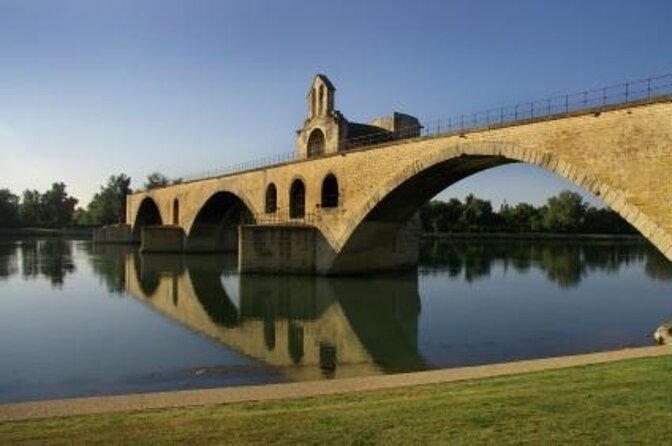
- The route reaches both sides of the Rhône, linking Avignon with Villeneuve lez Avignon and Île de la Barthelasse.
- Pont Saint-Bénézet is viewed as part of the route, but entry to the bridge is not included.
- Fort Saint-André and its gardens are among the most rewarding stops across the river.
- Audio commentary replaces a live guide, and some headset connections may not work properly.
- The service may not operate every day, with Sunday closures specifically reported and Monday availability also needing confirmation.
- The ride suits first-time visitors who want an overview, but not those expecting a flexible all-day bus pass.
A quick orientation before the bus leaves Avignon
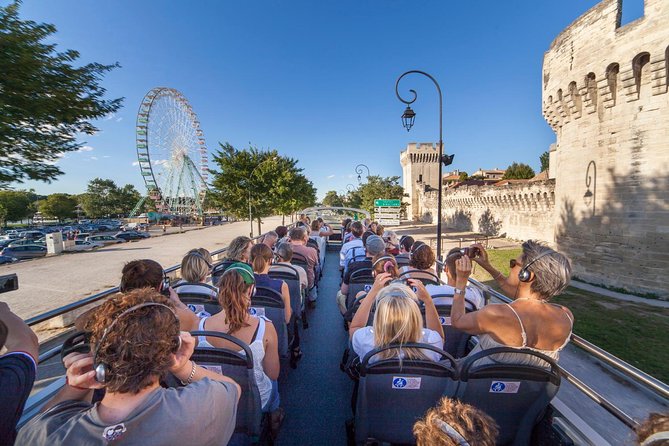
The tour begins at 40 Cours Jean Jaurès, in central Avignon, and returns to that meeting point. The bus is a standard double-decker vehicle, with a recorded audio program rather than a named live guide. The maximum group size is 73 people, so this is a shared sightseeing service, not a small private outing.
The advertised duration varies from about one hour to a full day. That wide range reflects how you use the service and how long you spend away from the bus. The core circuit can be completed in roughly an hour, while a longer visit could include paid attractions and time on Île de la Barthelasse.
I would think of it first as a city orientation ride. You get the shape of Avignon, a look across the Rhône, and a useful introduction to Villeneuve lez Avignon. You should not assume that the bus will wait while you visit every attraction or that you can always board again at each marked point.
The route information and stop maps deserve careful attention. One of the most common practical problems is confusion over where to wait, and some marked stops may not work like a classic hop-on hop-off station. Ask the driver about the return route before getting off.
More Open-Top Bus Tours in France
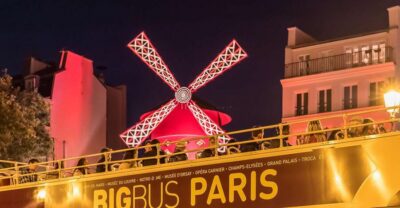
- Paris: Big Bus Panoramic Night Tour by Open-Top Bus
★ 4.4 · 4,168 reviews - Ajaccio: Town Highlights and Coast Open-Top Bus Tour
★ 4.3 · 1,523 reviews - Paris: Tootbus Open-Top Christmas Bus Tour
★ 4.0 · 1,365 reviews
Pont Saint-Bénézet and the broken bridge over the Rhône
The Pont Saint-Bénézet is Avignon’s signature sight. The popular French song about dancing on the bridge has made it famous around the world, but the surviving arches tell a more complicated story than the song suggests.
Construction began in 1177. The original bridge stretched for roughly 920 meters and had 22 arches. It was about four meters wide, a remarkable medieval crossing built in only eight years. Floods, war, and neglect eventually destroyed most of it, leaving the four arches you see today.
The bridge once linked important religious and political centers on both sides of the Rhône. During the 14th century, when the papal court was based in Avignon, it connected the city with residences and religious foundations in Villeneuve. Cardinals often preferred Villeneuve because it was quieter than Avignon.
The bridge also had a religious role. Popes reportedly stopped at the chapel of Saint-Bénézet to pray and leave an offering. It was paved in 1377 after repeated slipping accidents, a reminder that medieval crossings were practical structures, not merely monuments.
Entry to the bridge is not included in the bus ticket. If you want to walk on the remaining arches, plan for a separate admission. From the bus, the bridge is useful as a visual anchor, but you will get much more from it on foot.
The Lambert Collection and Avignon’s modern side
The Lambert Collection offers a sharp change of mood from the medieval monuments. Housed in an 18th-century mansion, it opened in 2000 during Avignon’s year as European Capital of Culture.
The collection began with works placed there by gallerist and collector Yvon Lambert. Its holdings include more than 1,200 references, with an original group of about 350 works dating from the 1960s to the present.
The museum is not only an exhibition space. Its activities include conservation, programs for young people, a bookstore with artists’ editions, and a restaurant in the mansion courtyard. That makes it a useful stop for anyone who wants more than churches, walls, and military towers.
Admission is not included. The bus gives you the location and context, but you need separate time and a separate ticket to visit the galleries. If modern art is not your main interest, you may prefer to treat this as a passing point rather than a required stop.
Crossing to Villeneuve and the Philippe le Bel Tower
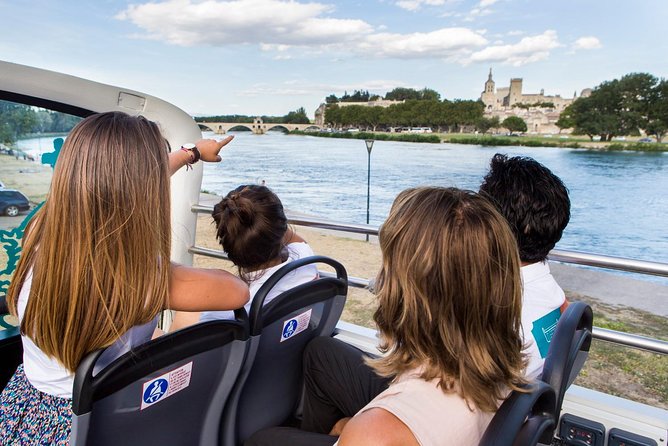
The ride across the Rhône is one of the most useful parts of the circuit. From Avignon, you see how the river shaped the city’s development and why Villeneuve mattered so much during the papal period.
The Philippe le Bel Tower was built in the 13th century by the Capetian king Philip IV. Its job was to control access to the Pont d’Avignon. It represents royal power on one side of the river, facing the authority of the papacy on the other.
That political contrast gives the route real purpose. You are not simply riding past old stone buildings. You are seeing a medieval frontier between two kinds of power, royal and pontifical.
The tower is also a strong example of medieval military design. From the bus, you may get a good exterior view, but the sightseeing ride cannot replace a visit inside if admission is available and you have time. The route is best at showing how the tower fits into the larger setting.
Same city, a different seat on a different deck:
- Paris: Tootbus Hop-on Hop-off (Optional River Cruise)
★ 4.3 · 15,279 reviews - Paris: Big Bus Hop-On Hop-Off Tour with Optional Cruise
★ 4.4 · 13,279 reviews - Paris Big Bus Hop-On Hop-Off Tour with Optional River Cruise
★ 4.0 · 6,534 reviews - Paris Tootbus Hop-On Hop-Off Bus Tour (Optional Cruise)
★ 3.5 · 3,105 reviews
Fort Saint-André and the Abbey gardens
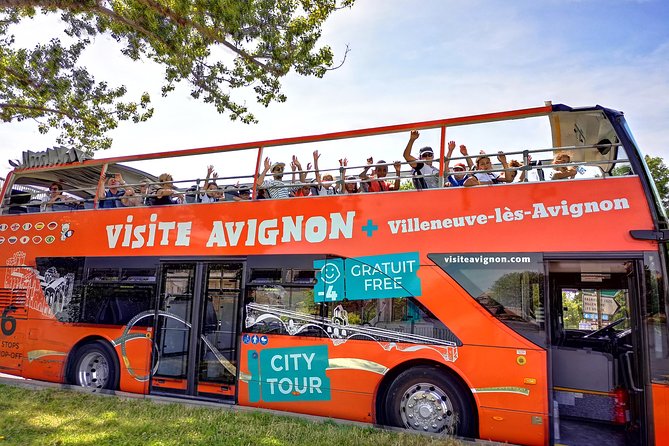
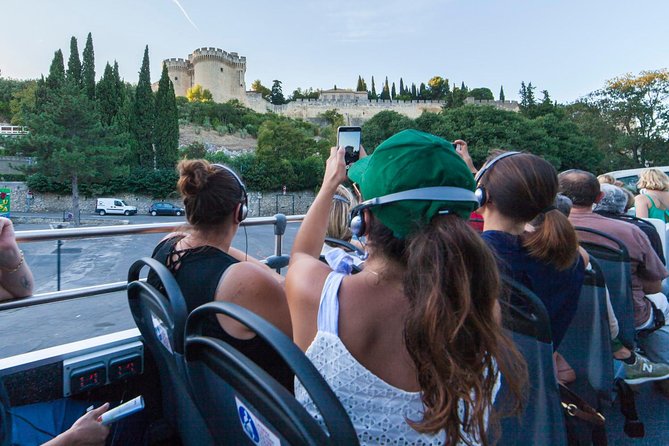
Fort Saint-André is one of the most appealing places on the Villeneuve side. Construction began at the end of the 12th century, and the fort later protected the Benedictine abbey of the same name.
The fort is a reminder that Villeneuve was not simply a residential retreat for cardinals. It was a defended settlement with a strategic position above the Rhône. Its walls and towers give you a different view of Avignon than you get from inside the city ramparts.
Admission to Fort Saint-André is free according to the tour information, which makes this one of the better-value places to include if you leave the bus. The main challenge is timing. Since the bus service is not always a flexible hop-on hop-off operation, confirm when the next vehicle will return before you set off to explore.
Nearby, the Abbey of Saint-André adds a softer and more decorative side to the visit. Its vaulted rooms were decorated in the 17th century, while the exterior includes Romanesque remains and Tuscan-style Renaissance features.
The gardens are the real prize. They carry the Remarkable Gardens label and include rose beds and Mediterranean plants arranged around older architectural remains. I would give this area more time than the quick stop suggested by the bus route, especially if you enjoy formal gardens and quiet viewpoints.
Chartreuse de Villeneuve lez Avignon
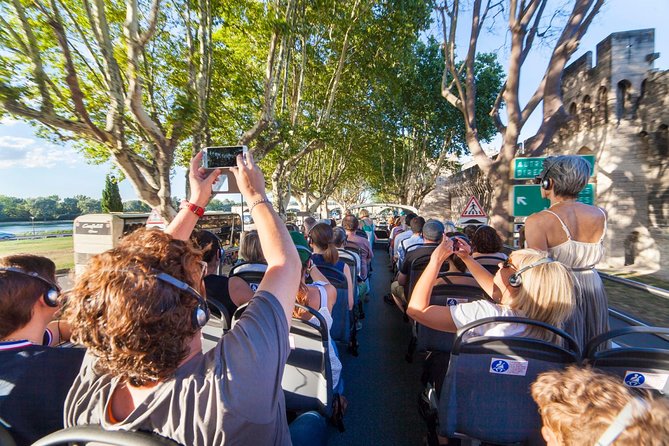
The Chartreuse of the Val de Bénédiction was built from 1353 under the direction of Pope Innocent VI. It was a former cardinal’s residence and one of the clearest reminders of how much religious power was concentrated in this small area.
The complex is associated with a 14th-century mansion where several cardinals lived. Its scale helps explain the importance of Villeneuve during the Avignon papacy. This was not a minor village across the river. It was part of the same political and religious world as the papal city.
Admission to the Chartreuse is not included. You will need to allow enough time for a separate visit, and the bus schedule may limit how long you can stay. I would choose the Chartreuse or Fort Saint-André rather than trying to see every paid attraction during a short circuit.
The bus commentary is helpful here because the buildings can look like a collection of old walls without context. The audio explains the connection between the residences, the papal court, and the bridge.
Île de la Barthelasse and the best city panorama
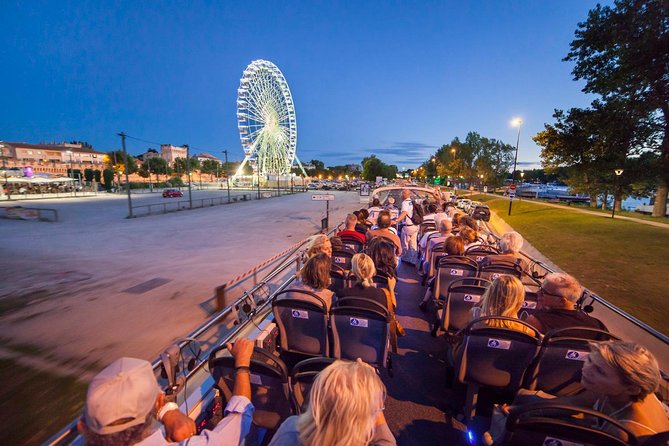
Île de la Barthelasse is a large green area on the right bank of the Rhône, covering about 700 hectares. The bus makes a short stop of roughly 10 to 15 minutes, giving you time to pause and look back toward Avignon.
This is one of the strongest photo opportunities on the route. Across the river, you can see the city of the Popes from a wider angle, with the walls, bridge, and major buildings gathered into one view.
The stop is brief, so keep your camera ready and do not wander far. The location also offers a more relaxed break after the built-up streets of Avignon and Villeneuve.
A free river shuttle can connect the island with the historic center. You can also continue by bicycle. The tour information does not promise that either option is included in the bus ticket, so treat them as separate ways to continue your day.
What the audio tour is like on the road
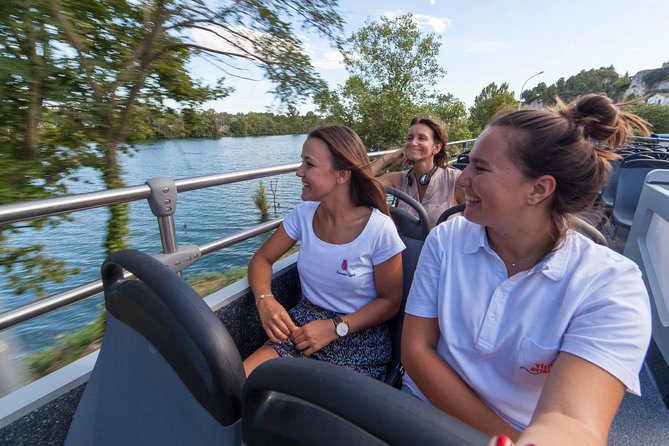
The recorded commentary covers the principal sights and gives useful background as the bus moves along the route. For a first ride through Avignon, that context is valuable because many of the key buildings are outside the obvious visitor center.
The main weakness is the equipment. Some passengers have found that headset connections did not work, leaving them unsure what they were passing. If your audio channel is silent, tell the driver at once and ask whether another headset or seat is available.
The bus can also move quickly, particularly when traffic compresses the schedule. That makes photography difficult and reduces the time you have to identify smaller details. For the best views, sit where you have a clear outward view, and do not expect every building to be announced slowly enough for a perfect photograph.
There is no indication of a live guide leading the ride. If you want personal explanations, questions, and a slower pace, a walking tour or private guide would suit you better.
Price, timing, and the real value of $16.30
At $16.30 per person, the bus is reasonably priced as a broad orientation ride. It covers more ground than a short walk and takes you across the Rhône without requiring you to arrange separate transport to Villeneuve.
The value drops if you expect a full day of unlimited boarding and disembarking. Much of the one-hour circuit can be spent in traffic, and the stops may not be placed or timed like those on a major city sightseeing network.
Paid admission is not included for Pont Saint-Bénézet, the Lambert Collection, or Chartreuse de Villeneuve lez Avignon. Fort Saint-André is listed as free. If you add several attractions, the total cost rises, but you are then using the bus mainly as transportation between visits rather than as a complete tour.
Pay close attention to operating days. Service has been reported as unavailable on Sundays, and one set of information also notes Monday concerns during May 2024. Because the service has previously been sold for dates when it did not operate, confirm the schedule directly before setting out. This matters especially if Avignon is only a one-day stop.
Free cancellation is available up to 24 hours before the start time for a full refund. Changes or cancellations inside that window are not accepted. Poor weather or failure to reach the minimum number of passengers can also lead to a different date or a full refund.
Who should choose this bus ride?
I would recommend it to a first-time visitor who wants a quick sense of Avignon and Villeneuve before deciding where to spend the rest of the day. It is also useful if you have limited mobility or simply want to avoid walking the full distance between the river, the fort, and the city center.
Families may appreciate the easy overview, though the audio equipment and short stops may test young children’s patience. Service animals are allowed, and most people can participate.
I would be more cautious if your main goal is photography, detailed sightseeing, or a flexible hop-on hop-off day. The fast pace and uncertain stop arrangements can get in the way. For those priorities, use the bus as an introduction, then explore one or two sites on foot.
Should you book the Avignon double-decker bus?
Book it if you want a low-cost overview of both sides of the Rhône, especially if Villeneuve lez Avignon is not otherwise on your schedule. Fort Saint-André, the abbey gardens, the bridge views, and Île de la Barthelasse give the ride more range than a simple loop around Avignon’s walls.
Skip it if you expect a polished, all-day hop-on hop-off system with frequent buses and clearly managed stops. The strongest plan is to confirm the operating day, ask the driver about return boarding, and treat the ride as a one-hour orientation with optional visits afterward.
FAQ
Where does the bus tour begin?
It begins at 40 Cours Jean Jaurès, 84000 Avignon, France.
Where does the tour end?
The activity ends back at the starting meeting point.
How long does the experience last?
The listed duration ranges from about one hour to one day, depending on how you use the service and how long you spend at the stops.
Is this a traditional hop-on hop-off bus?
Not necessarily. The service includes a sightseeing loop, but the stops and return arrangements may not work like a standard hop-on hop-off network. Confirm the boarding plan with the driver before leaving the bus.
Is Pont Saint-Bénézet admission included?
No. Entry to Pont Saint-Bénézet is not included in the bus ticket.
Are attraction tickets included?
No. Admission to the Lambert Collection and Chartreuse de Villeneuve lez Avignon is not included. Fort Saint-André is listed as free.
Is the commentary in English?
Yes. The experience is offered in English through audio commentary.
How many people can join the bus?
The maximum group size is 73 people.
Can I cancel for a refund?
You can cancel up to 24 hours before the start time for a full refund. Cancellations or changes made less than 24 hours before the start time are not accepted. If poor weather or an insufficient number of passengers cancels the experience, you are offered another date or a full refund.
Recently added around France
- Épernay and Champagne Open-Top Bus Tour with 3 Tastings★ 5.0 · 11 reviews
- Private Tour of Epernay and Vineyards by Bus with Champagne★ 5.0 · 7 reviews
- City Tour in Cannes aboard our Classic French Bus!★ 5.0 · 109 reviews
- Explore Cannes Countryside in Style with our Classic Bus Tours!★ 5.0 · 2 reviews
- Visit of Antibes Juan-Les-Pins by convertible bus★ 3.5 · 24 reviews
- Tour of Annecy by convertible bus★ 4.1 · 92 reviews
- Paris: Tootbus Kids Bus Tour Experience★ 4.7 · 30 reviews
- Paris: Hop-on with Emily walking tour and bus tour★ 3.3 · 8 reviews
Open-Top & Double-Decker Bus Tours, compared.

Big Bus Hop-on, Hop-off Open-Top Sightseeing Tour
Read our review →
Hop-on Hop-off Sightseeing Tour by Open-top Bus
Read our review →
Big Bus NYC: Hop-On Hop-Off Sightseeing Tour by Open-top Bus
Read our review →

Hop-on Hop-off Sightseeing Tour by Open-top Bus with 18 Stops
Read our review →
Big Bus Las Vegas: Sightseeing Night Tour by Open-Top Bus
Read our review →Browse the lists this tour appears in