
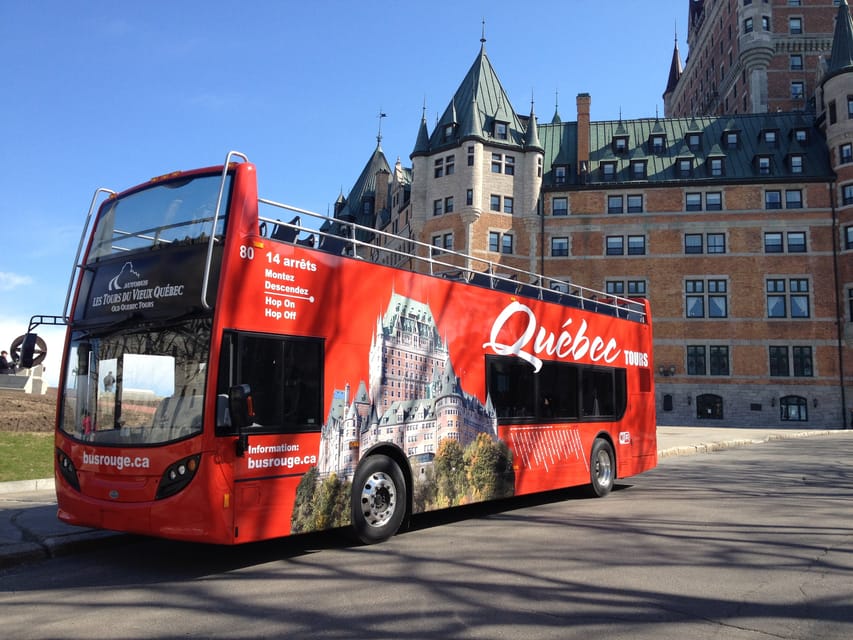
Review · QUEBEC CITY BUS TOURS
Quebec City: Hop-on Hop-off Open-Top Double Decker Bus Tour
Quebec City makes you work for its best views. Steep streets, the upper and lower town, and attractions spread beyond the old walls can turn a short sightseeing day into a tiring one. This open-top double-decker bus gives you a quick city orientation, then lets you return to the places that catch your eye.
I like the broad route and the clear audio guide. You can see Old Quebec, Saint-Roch, the Plains of Abraham, the Citadelle, and several museums without arranging separate transport. The main drawback is the wait: buses run every 30 to 45 minutes, and a full loop takes about two hours.
Key points to know before you book
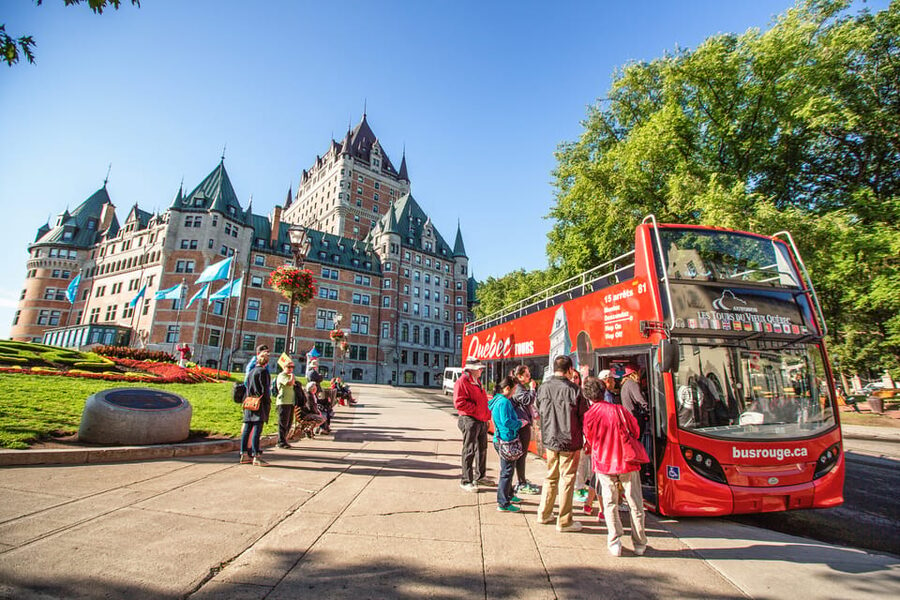
- A useful first-day orientation: Ride the entire loop before choosing where to spend more time.
- Fifteen strategic stops: The route reaches Old Quebec, Saint-Roch, the Plains of Abraham, museums, and the Citadelle.
- Open-air views: The upper deck gives you wide views and good photo chances, but bring a hat and weather-ready clothing.
- Audio in 10 languages: English, French, Spanish, Chinese, German, Italian, Japanese, Arabic, Portuguese, and Russian are available.
- Live commentary can vary: Drivers such as Pierre, Martin, Michel, and Leon have added humor and local detail, but not every departure has a live guide.
- Best value with careful use: At $48 per person for the listed one-day option, the tour pays off most when you ride the loop and make several stops.
Why the bus works well in hilly Quebec City
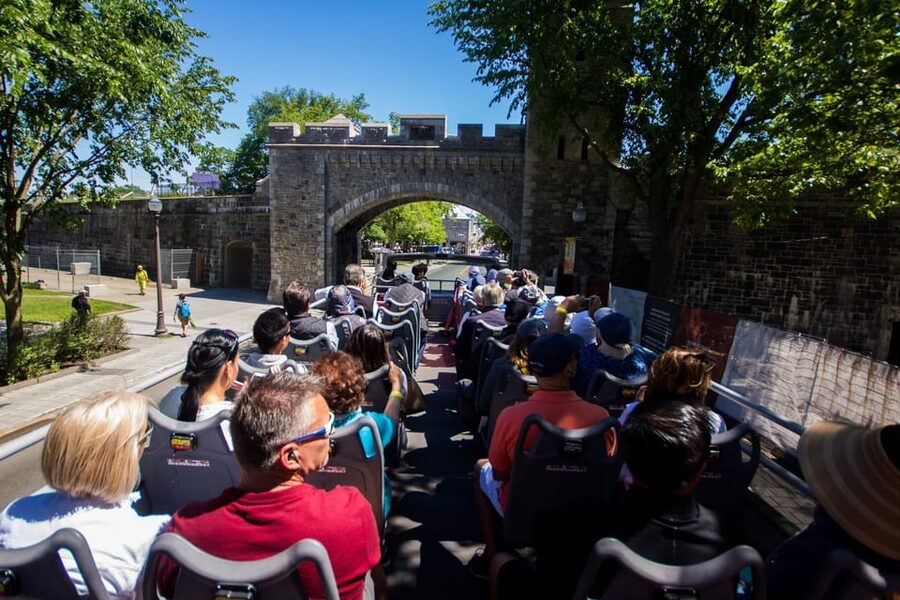
I find this tour most useful as a way to understand Quebec City before exploring it on foot. The route connects places that feel separate when you first arrive. You see the compact old center, then the lower town, Saint-Roch, the Plains of Abraham, and areas outside the usual walking circuit.
The big benefit is energy. Quebec City has hills, stairs, and uneven streets. You can walk the old town at your own pace, then use the bus to reach the Plains of Abraham, the museums, or Saint-Roch instead of making every connection on foot.
The open top is the other strong point. On a pleasant day, you get a clear view of stone buildings, fortifications, parks, and broad city streets. The bus also pauses in places where you can take photographs. Sit upstairs for the best outlook, but remember that sun and wind can change the ride quickly.
I would not treat it as a fully guided sightseeing tour every time. The recorded commentary is included and covers the city’s past and major sights, but it can be more historical than visual. At times, you may hear about Quebec City without being told exactly which building or street you are passing.
More Hop-On Hop-Off Bus Tours in Canada
- Big Bus Vancouver Hop-On Hop-Off Sightseeing Tour
★ 3.5 · 3,028 reviews - Montreal: Hop-On Hop-Off Double-Decker Bus Tour
★ 4.1 · 2,760 reviews - Toronto: City Sightseeing Hop-On Hop-Off Bus Tour
★ 4.3 · 2,544 reviews
Start at Place d’Armes beside Château Frontenac
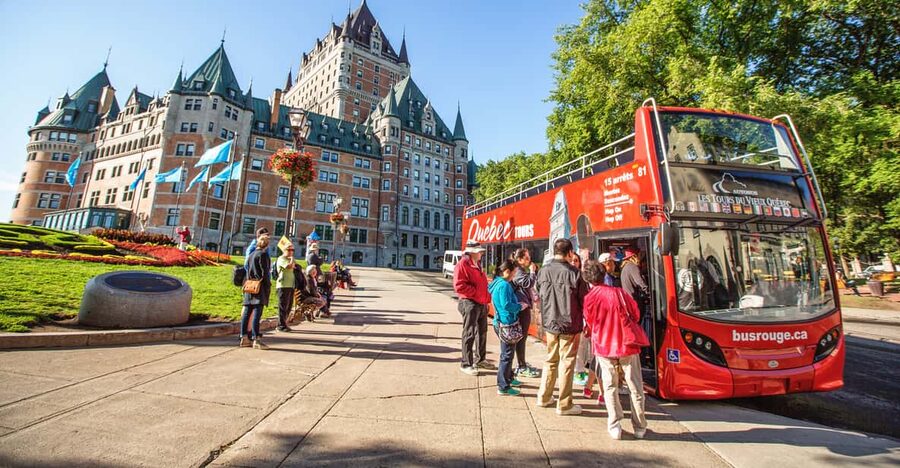
The main first stop is Place d’Armes, near Château Frontenac, at 7 Rue du Fort. The supplied meeting information also gives 85 Rue Dalhousie and 17 Rue du Fort as location references, so check the exact stop details on your ticket before setting out.
Place d’Armes is a sensible starting point because it puts you beside one of Quebec City’s most recognizable buildings and near the old center. You can begin with a complete loop, then return here to explore on foot.
You can also board at other marked stops. That matters if you are staying near another part of the route or reach the city from a different direction. Still, starting at Place d’Armes makes the route easier to understand, especially if you plan to use the bus more than once.
The first full ride should be treated as an orientation, not wasted time. You can remain on board for about one hour and 45 minutes to two hours, listen to the commentary, and note the stops that deserve a closer look.
Stop 1: Place d’Armes and the old center
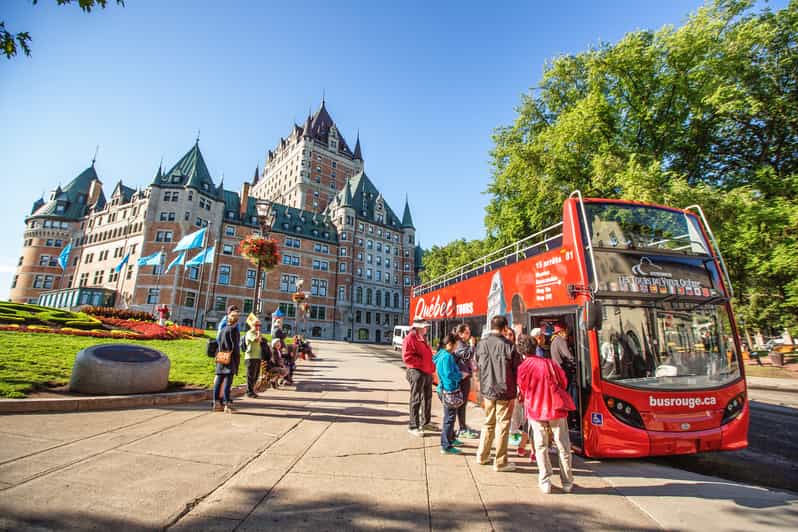
Place d’Armes is the natural gateway to Old Quebec. From here, you are close to Château Frontenac and the dense historic streets that make the city feel different from most North American cities.
This is a good stop for a first walk after your loop. The bus shows you the area, but the real pleasure comes from leaving the vehicle and exploring on foot. Give yourself time here if you want cafés, old streets, and the central sights of the old town.
The stop can also be busy. If you plan to return to the bus later, note where you got off and confirm the direction of the next departure. The 30 to 45 minute interval means a missed bus can affect your schedule.
Stops 2 and 3: Saint-Roch and the Museum of Civilization
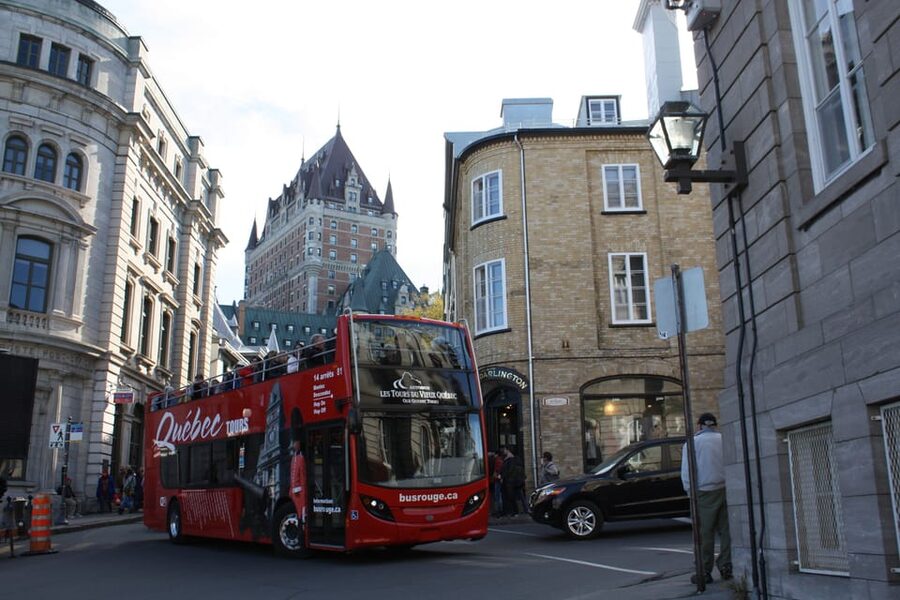
The route then passes through Saint-Roch and by the Museum of Civilization. Saint-Roch gives you a look beyond the most polished old-town streets. It is useful for seeing another side of Quebec City and for understanding how the historic core connects with newer districts.
The Museum of Civilization is one of the most useful stops for visitors who want a museum break. The route only passes by the attraction, so the bus ticket does not include admission. You will need to decide if you want to get off and visit, or simply use the stop as a marker while taking in the city from the bus.
This stretch shows why the tour is more than a ride around Château Frontenac. You get a sense of the city’s layout, not just a list of postcard buildings.
More Open-Top Bus Tours in Canada
- Quebec City: 1-Hour Express Double-Decker Bus Tour
★ 4.5 · 699 reviews - Toronto: Night Sightseeing Tour on a Double-Decker Bus
★ 4.5 · 133 reviews
Stops 4 and 5: Place Royale and the Old Port Market
Place Royale brings you back toward one of the most atmospheric parts of the lower town. It is a strong choice for getting off because it gives you a different feel from the upper town around Place d’Armes.
The Marché du Vieux-Port is also on the route. This stop works well if you want local food, market browsing, or a break from sightseeing. The information provided does not include admission details or market hours, so check those separately if the market is a priority.
One practical point: some stops are close enough that you may prefer to walk between them rather than wait for the next bus. That can save time, but it also means planning your route carefully. The bus does not arrive every 15 or 20 minutes, so avoid assuming another one will appear right away.
Stops 6 and 7: The convention center and the capital observatory
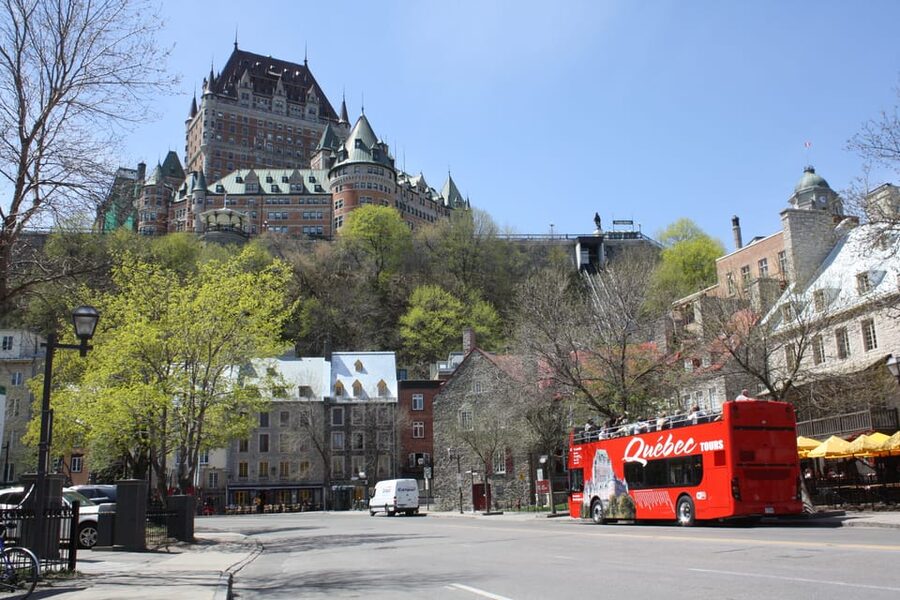
The Centre des Congrès de Québec and the Observatoire de la Capitale show a more modern side of the city. The observatory can be a good choice if you want a high viewpoint, though entry is separate from the bus ticket.
The bus gives you a useful contrast here. Quebec City is not only fortified streets and old stone buildings. The route links the old center to contemporary public buildings and wider city avenues.
The Voltigeurs de Québec Armoury, also listed as the Manège Militaire, adds a military note to the circuit. It is the sort of sight that can be easy to miss when walking only through the old town. The audio commentary helps provide context, though the exact level of detail depends on the recording and the driver.
Stops 8 and 9: The Plains of Abraham and the fine arts museum
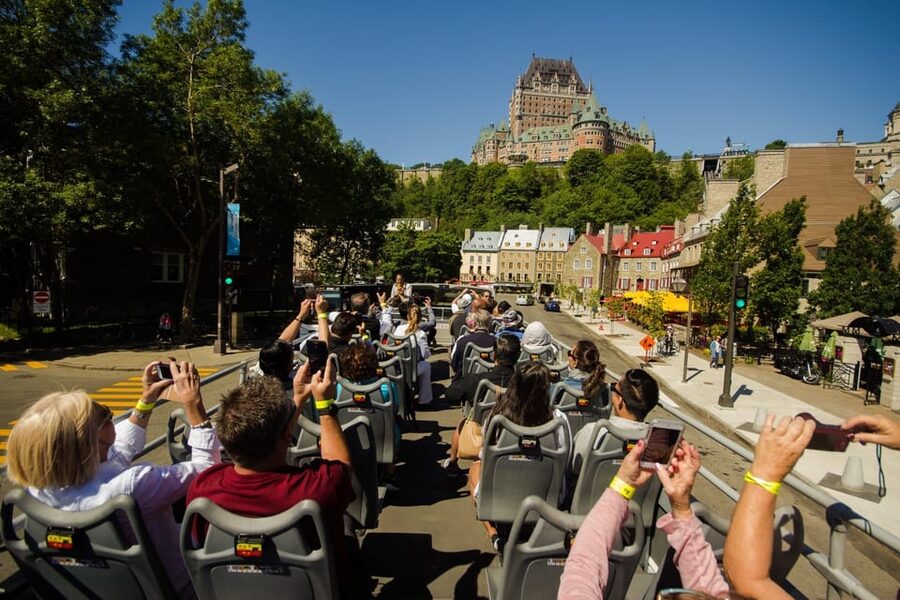
The Plains of Abraham are among the best reasons to use the bus instead of walking everywhere. The park opens up the ride, giving you a break from narrow streets and a chance to see one of Quebec City’s major public spaces.
The route also serves the National Museum of Fine Arts of Quebec. This is a practical stop for art lovers, and it gives you a clear choice: get off for a museum visit, or stay on board and continue the city circuit.
I would schedule this part of the route with care. If you leave the bus here, you may wait for the next one, and the full loop takes close to two hours. If you have only one day, choose one or two major stops rather than trying to enter every museum along the way.
Stops 10 and 11: Saint-Jean-Baptiste and Place D’Youville
Saint-Jean-Baptiste offers another look at the city beyond the most famous old-town streets. It is a useful stop if you want to wander a neighborhood rather than move from landmark to landmark.
Place D’Youville brings you close to another important access point near the old city. It can work as a convenient place to leave the bus before walking back toward the central sights.
The route design is helpful, but it is not perfectly tight for every plan. One rider noted that leaving at one stop and reaching another later stop could require riding almost the entire loop. My advice is simple: before getting off, look at the route map and decide where you want to rejoin. If two nearby stops are walkable, walking may be faster than waiting.
Stop 12: The Citadelle of Quebec
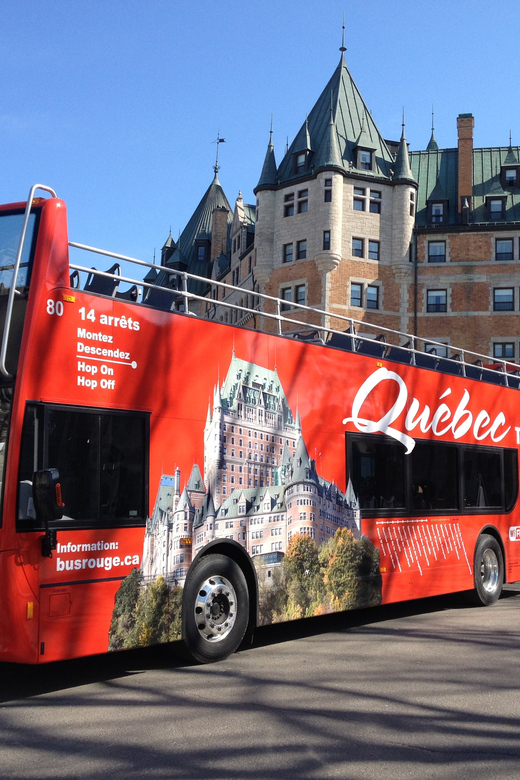
The Citadelle is one of the strongest stops for anyone interested in military history and Quebec City’s defenses. The bus brings you close to an attraction that can be awkward to reach if you are trying to cover the city entirely on foot.
The ticket covers transportation to the stop, not a separate Citadelle admission. If you want to go inside, allow time for that visit and accept that you may wait for a later bus.
This is also one of the places where live driver commentary can add something special. Several departures have included drivers who shared extra stories about the battles involving French, English, and American forces. That live element is not guaranteed, but the recorded program remains available through the headphones.
The audio guide and the drivers
The multilingual audio is one of the tour’s most dependable features. You receive earphones, and the guide is available in 10 languages: English, French, Spanish, Chinese, German, Italian, Japanese, Arabic, Portuguese, and Russian.
The sound quality has been praised by several riders, and the buses have headphone ports. The commentary leans toward historical background, which suits you if you want context during the ride. It is less useful if you need constant, precise announcements about every building passing beside you.
Some drivers add live narration. Pierre has been singled out for his humor and extra detail. Martin, also referred to as Martan in one account, has been described as friendly and entertaining. Michel and a driver believed to be named Leon have also added personal commentary and photo pauses.
You should see the live guide as a bonus, not a promise. Some drivers mainly rely on the recording, while others talk throughout the journey. The recorded audio gives the tour consistency, and a good driver can make the ride warmer and more memorable.
How to use the one-day ticket well
At $48 per person, the price is not low for a bus ride. It becomes easier to justify when you use it as both transportation and an orientation tour.
I would use the ticket in three steps:
- Ride one full loop first. This takes about two hours and lets you hear the commentary while learning the route.
- Choose two or three stops. Place Royale, the Plains of Abraham, the Citadelle, and one museum are sensible choices, depending on your interests.
- Use the bus to reduce uphill walking. Save your energy for the streets and sights where walking matters most.
A two-day option is also available. Several riders found the second day worthwhile for only a small additional cost, but the exact price depends on the booking option. One quoted experience mentioned paying $75, so check the current rate rather than assuming every date has the same price.
The value is weakest if you only ride a short section once. It is strongest if you complete the loop, get off at several places, and use the bus to connect areas that would otherwise require extra walking.
Weather, comfort, and access
Bring comfortable shoes even though the bus saves steps. You will still walk through old streets, museums, parks, and military sites after getting off.
Pack a sun hat and weather-appropriate clothing. The open upper deck is excellent in good weather, but it can feel exposed in cold, wind, or rain. A cold morning can make the top deck a poor choice, and one account noted that heating varied between buses.
The buses are wheelchair accessible. Pets and luggage or large bags are not allowed. That makes the tour suitable for many visitors with mobility needs, but the hills and walking at each stop still matter when planning your day.
Departures usually come every 30 to 45 minutes, depending on the season, traffic, and other operating conditions. Build in patience. This is a sightseeing service, not a rapid city shuttle.
Who should book this Quebec City bus tour?
I would book it for a first visit, a short stay, or a day when you want to see the city before choosing where to spend your time. It is also a good fit if hills make a full walking tour uncomfortable.
Families, older visitors, and anyone arriving without a firm plan can use the loop to get oriented quickly. The multilingual audio helps if you prefer to hear information in a language other than English or French.
I would be less enthusiastic if you already know Quebec City well and want a tightly timed transport service. The long interval between buses and the two-hour loop can make short hops inefficient. In that case, walking between nearby stops may be quicker.
Should you book it?
Book this tour if you want a broad first look at Quebec City, clear audio in your chosen language, and a way to reach the Plains of Abraham, the Citadelle, museums, and lower-town sights without tackling every hill on foot.
Skip it if your plans already focus on a small area around Old Quebec or if you dislike waiting between departures. For most first-time visitors, the best approach is to ride the complete loop early, then use the remaining time for two or three carefully chosen stops. That turns a simple bus ticket into a practical map of the city.
FAQ
Where does the Quebec City hop-on hop-off bus start?
The first stop for all loops is Place d’Armes near Château Frontenac, at 7 Rue du Fort. Other location references include 85 Rue Dalhousie and 17 Rue du Fort. You can also board at marked stops along the route.
How long does one full loop take?
One complete loop takes about one hour and 45 minutes to two hours, depending on traffic and operating conditions.
How often do the buses depart?
Buses usually depart every 30 to 45 minutes. The interval can change with the season, traffic, and other operating issues.
Which languages are available for the audio guide?
The audio guide is available in Spanish, Chinese, English, French, German, Italian, Japanese, Arabic, Portuguese, and Russian. Earphones are included.
Is the bus wheelchair accessible?
Yes, the buses are wheelchair accessible. Pets and luggage or large bags are not allowed.
Can I cancel the booking?
You can cancel up to 24 hours in advance for a full refund. A reserve-now, pay-later option is also available, depending on the selected booking option.
Recently added around Canada
- Vancouver Hop On Hop Off Trolley Tour★ 4.0 · 426 reviews
- Toronto: Niagara Falls Bus Tour with Maple Tasting and NOTL★ 4.6 · 524 reviews
- Toronto: Night Sightseeing Tour on a Double-Decker Bus★ 4.5 · 133 reviews
- Quebec City: 1-Hour Express Double-Decker Bus Tour★ 4.5 · 699 reviews
- City Sightseeing Toronto Hop-On Hop-Off Bus Tour★ 3.5 · 726 reviews
- Hop-On and Hop-Off Banff Bus★ 5.0 · 781 reviews
- Quebec City: Old Town and Montmorency Falls Bus Tour★ 4.7 · 820 reviews
- Best of Quebec City: Panoramic Bus Tour with Local Guide★ 4.0 · 897 reviews
Hop-On Hop-Off Bus Tours, compared.


City Sightseeing Hop-on Hop-off Bus with Audioguide
Read our review →
Tootbus Hop-on Hop-off (Optional River Cruise)
Read our review →Big Bus Hop-On Hop-Off Tour with Optional Cruise
Read our review →
London Big Bus Hop-On Hop-Off Tour with Optional River Cruise
Read our review →
Big Bus Hop-on, Hop-off Open-Top Sightseeing Tour
Read our review →
Browse the lists this tour appears in